Influencer Artificial Intelligence Your Guide to Creating a Virtual Star
Discover influencer artificial intelligence and learn how to build, launch, and monetize a virtual star with this practical, hands-on guide.
When you hear the term “influencer artificial intelligence,” what comes to mind? It’s not just a buzzword; it’s about using AI to build and run virtual personalities that can completely change the game for social media and marketing. Think of digital characters who deliver perfectly consistent messaging every single time and are available 24/7, without any of the logistical headaches that can come with human partnerships.
The New Wave of Digital Personalities
We're witnessing a real shift in marketing. AI influencers have gone from a fringe curiosity to a serious strategy for major brands. These aren't just digital puppets; they're fully formed personas. They have their own backstories, a distinct sense of style, and a voice crafted to resonate with a very specific audience. For brands, this offers a level of control and predictability that's incredibly appealing.
Unlike people, AI influencers don't get involved in personal scandals, they never get burned out, and scheduling conflicts simply don't exist. This reliability means brands can build long-term campaigns that stay perfectly on-message, without any unexpected deviations. Every post, every story, and every interaction can be planned down to the last detail to support clear marketing objectives.
Why Brands Are Turning to AI
The draw of influencer artificial intelligence isn't just about avoiding risk. It’s also about unlocking creative avenues that would be difficult, if not impossible, to explore with real people. A brand can literally invent a personality that is the perfect embodiment of its core values or even create a character for an elaborate fantasy world.
This creative freedom is a huge part of why they're taking off. You're not just hiring a spokesperson; you're building one from the ground up. This is the whole reason platforms like CreateInfluencers exist—to provide the toolkit for bringing these digital ideas into reality. You can get a deeper look at the process in our guide on creating AI-generated humans.
The core advantage of an AI influencer is scalability. A single virtual persona can be active across multiple platforms, engage with followers in different time zones simultaneously, and produce content at a volume that a human creator simply cannot match.
To see the differences laid out clearly, let's compare them side-by-side.
AI vs Human Influencers Key Differences
| Attribute | AI Influencer | Human Influencer |
|---|---|---|
| Consistency | 100% on-brand messaging; no deviations | Variable; subject to personal views and changes |
| Availability | Operates 24/7, across all time zones | Limited by human needs (sleep, personal time) |
| Risk Factor | No personal scandals or off-brand behavior | Vulnerable to personal controversy and errors |
| Scalability | Can produce content and engage limitlessly | Production is limited by time and energy |
| Creative Control | Fully customizable appearance, personality, and backstory | Limited by the influencer's existing persona |
This table really highlights how AI influencers can fill a unique role, offering a level of control and scalability that is fundamentally different from a human partnership.
Market Growth and Future Potential
The money flowing into this space tells the real story. The virtual influencer market, all driven by artificial intelligence, is growing at an incredible pace. Valued at USD 9.75 billion in 2025, it's on track to explode to USD 154.83 billion by 2033.
According to market analysis from SNS Insider, this represents a compound annual growth rate (CAGR) of 41.29%. That's not just growth; it's a signal of a massive shift in where marketing dollars are going.
This trend shows a clear demand for more dynamic and controllable marketing assets. As you follow along with this guide, you’ll learn exactly how to build your own digital star and turn a creative concept into a real, and potentially very profitable, asset.
Building Your AI Influencer's Core Identity
Before you even think about generating a single image, you need to give your influencer a soul. It's easy to get caught up in the visuals, but what truly hooks an audience is the story—the personality, the beliefs, and the voice behind the face. This is what separates a forgettable digital puppet from a virtual personality who builds a real, loyal community.
Think of it as method acting for the digital world. Without a solid identity, your content will feel random and your influencer’s interactions will ring hollow. A strong persona is your creative North Star, guiding every post, every caption, and every visual to ensure a consistent and believable presence online.
Finding Your Niche and Purpose
First things first, you have to carve out your corner of the internet. An influencer who’s a jack-of-all-trades is a master of none. Trying to appeal to everyone means you'll end up connecting with no one. A tight, focused niche makes it infinitely easier to attract a dedicated following and simplifies your content plan.
Ask yourself: what unique angle can my AI influencer bring to the table? Are they a passionate advocate for a cause? An expert in a super-specific field? A storyteller exploring a fantastic or unusual lifestyle?
Let's say we're creating an influencer named 'Kai.' His niche isn't just "travel." That’s too broad. His niche is sustainable and mindful exploration.
This one decision immediately shapes all his content:
- He'll showcase eco-lodges and homestays, not just five-star resorts.
- He'll put the spotlight on local artisans and ethical tourism practices.
- His posts will share practical tips for reducing your carbon footprint on the road.
Crafting a Believable Backstory
A backstory is what turns a 2D image into a 3D character. It gives them a history that explains who they are today. It doesn't need to be a ten-page epic, just enough to add depth and answer the question, why?
For Kai, maybe he was a burnt-out city slicker who had a life-changing experience on a remote trek, and now he’s dedicated his "life" to helping others travel more consciously. This simple narrative gives his passion context. It’s the reason his audience will trust his recommendations and connect with his message on a human level.
If you want to really dig into this, we've got a full guide on character design tips that breaks it all down.
A detailed persona isn't just a creative exercise; it's a strategic asset. It dictates your AI's communication style, the brands they partner with, and the community they build. A well-defined identity is the bedrock of long-term success.
Mapping Out Personality and Voice
Once you have the niche and backstory, the personality naturally follows. Is your influencer sharp and witty? Or are they warm and encouraging? These traits directly shape their tone of voice. Kai, our eco-traveler, would probably be calm, curious, and deeply respectful of the places and people he encounters.
From that, we can define his communication style:
- Voice: Thoughtful, gentle, and educational.
- Vocabulary: He'd use words like "mindful," "connection," and "stewardship."
- Attitude: He'd steer clear of flashy, overly commercial language, keeping the focus on genuine experiences.
To really nail this down and generate on-brand text, it’s worth leveraging powerful language models like GPT-4. These tools are fantastic for helping you brainstorm dialogue, write captions, and maintain a consistent voice that feels intelligent and real.
By taking the time to nail down these fundamentals—niche, backstory, and personality—you're not just creating an avatar. You're building an identity that people can get behind, and that's what it takes to stand out.
Bringing Your Virtual Star to Life
Okay, you've got a solid concept and a compelling backstory. Now for the fun part: actually creating your virtual influencer. This is where your ideas become pixels and your character starts to feel real. With a platform like CreateInfluencers, you're not just dreaming up a persona; you're building a tangible digital being, and it's easier than you might think.
Don't feel like you need to be a master artist from the get-go. Many tools offer a one-click character generation feature, which is a perfect way to get the ball rolling. It spits out a quick, randomized model that you can either run with or, more likely, use as a clay base to start sculpting from. It’s a great way to jumpstart the creative process without getting stuck on tiny details right away.
The persona you’ve already built is the blueprint for this entire process.
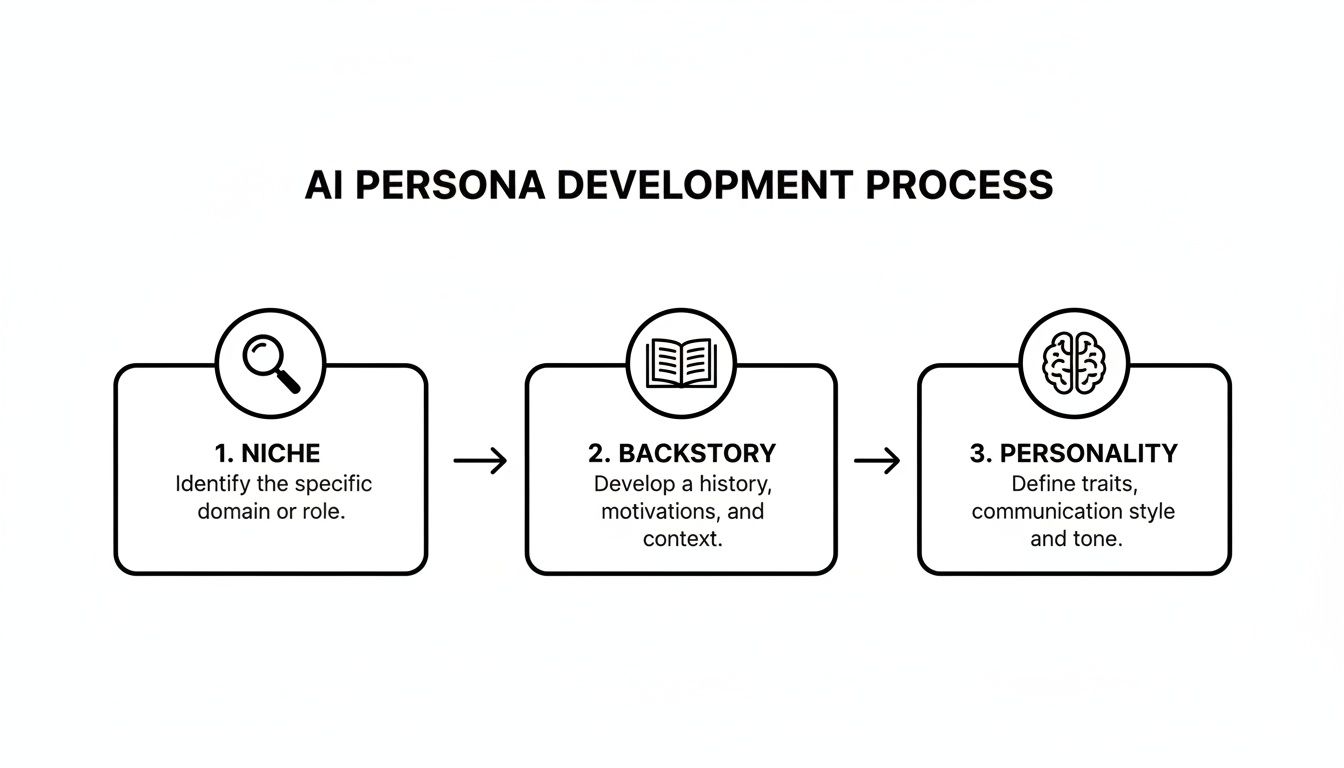
Your niche, backstory, and personality traits all feed directly into the visual creation, ensuring the final look is a true reflection of the character inside.
Going Deeper with Text Prompts
While a one-click-gen is a solid launchpad, real distinction comes from rolling up your sleeves and getting descriptive. Text prompts are your most powerful tool here. Think of it as commissioning an artist who speaks your language—the more detail you provide, the closer the final product will be to what's in your head.
You have to shift your thinking from a user to a digital art director. Instead of a bland "woman with brown hair," get specific. Try a prompt like: "hyperrealistic portrait of a 25-year-old woman with warm chestnut brown hair in soft waves, hazel eyes with flecks of green, freckles scattered across her nose, smiling softly, golden hour lighting."
That level of detail gives the influencer artificial intelligence clear instructions, leaving far less to chance and resulting in a much more unique character.
Dialing in Different Styles
The real magic of AI generation is its flexibility. You're not stuck with one aesthetic. You can nudge the AI to create visuals in wildly different styles, all by tweaking the language in your prompts.
- For Hyperrealism: Use terms like "photorealistic," "8K resolution," and "shot on a Sony A7III." Mention specific lighting, like "soft natural light" or "studio lighting," to create images that look like they came straight from a professional photoshoot.
- For an Anime-Inspired Look: Try keywords like "anime style," "cel-shaded," "Ghibli-inspired art," or "manga aesthetic." Dropping the name of a specific artist or studio can really help the AI nail the vibe.
- For a Fantasy Character: Weave in descriptive elements like "elf with pointed ears," "glowing ethereal tattoos," or "wearing ornate silver armor." Placing them in a scene with "in an enchanted forest" helps complete the picture.
Pro Tip: Your first prompt is rarely your last. Get comfortable with iterating. Tweak your keywords, add or remove details, and regenerate. Every attempt is a learning experience that teaches you how the AI thinks, making you a much better creator in the long run.
Fine-Tuning with Swapping and Selfies
Once you have a base model you're happy with, the real precision work can begin. A surprisingly effective method is to generate a character from a selfie. If you upload a reference photo, you can prompt the AI to create an influencer who shares similar facial features, giving you a consistent and strong foundation to build upon.
From there, tools like face and body swapping give you incredible control. Maybe you've generated the perfect face but want to see it on a different body or in a new pose. Or maybe the pose is perfect, but the facial expression isn't quite right. Swapping lets you mix and match these digital puzzle pieces until they click.
This modular approach is a massive time-saver. Instead of hoping for one perfect generation, you can create the best individual parts and assemble your ideal character. This is how you build a truly custom and believable influencer artificial intelligence that stands out.
Once you’ve mastered the static image, you can even level up to more dynamic content. For a deep dive into motion and speech, check out our guide on how to create a talking avatar.
Building a Cohesive Feed with Photo Packs
One amazing photo is a start, but a believable social media influencer needs a whole portfolio. This is where themed photo packs become your best friend. Platforms like CreateInfluencers have pre-styled packs that generate a whole series of images with a consistent look and feel.
Need to flesh out a "Tinder profile pack," an "Instagram travel blogger" series, or a moody "boudoir" collection? These packs apply a consistent theme, lighting, and style across dozens of images. This is the secret to making your influencer's feed look coherent and professional, reinforcing the persona you’ve worked so hard to build. It’s the fastest way to generate a backlog of high-quality, on-brand content that's ready to post.
Developing a Winning Content Strategy

A killer visual might get someone to stop scrolling, but it's consistent, engaging content that turns them into a true fan. Once you've nailed down your AI influencer's identity, the real work begins: mapping out a content plan that can actually go the distance. This strategy is the engine that will grow your community and keep people coming back for more.
If you just wing it, you’ll end up posting randomly, and the content will feel disconnected from the persona you spent so much time building. Think of a well-planned content calendar as your roadmap—it ensures every single post has a purpose.
Building a Diverse Content Calendar
Posting the same type of content over and over is the fastest way to bore your audience. For your influencer artificial intelligence to really pop, you need to mix up the media types to keep the feed feeling fresh and dynamic. A good content mix is like a balanced diet; every piece plays a different role in feeding your community.
Your calendar should be a thoughtful blend of formats, each one picked for a specific job.
- Stunning Static Images: These are your bread and butter, especially on platforms like Instagram. Use them to show off your influencer's style, capture a key moment, or share a beautifully crafted visual that makes people pause.
- Multi-Slide Carousels: These are fantastic for telling a story or sharing a quick lesson. You can build a mini-tutorial, walk through a "day in the life," or break down a complicated idea into easy-to-digest slides.
- Short-Form Videos: You absolutely cannot skip these, especially for TikTok and Instagram Reels. Videos are your best bet for showing off personality, jumping on trends, and making content that people can't help but share.
By planning this mix in advance, you guarantee a feed that’s visually interesting and has something for everyone. For a closer look at the tools that can help you pull this off, our guide on AI content creation for social media is a great resource.
Platform-Specific Content Tailoring
What kills it on Instagram could completely flop on TikTok. And content meant for a subscription platform like Fanvue needs a totally different vibe. A smart strategy means tweaking your posts to fit the unwritten rules and audience expectations of each platform.
Don't just copy and paste the same content everywhere. Adapt it.
That gorgeous, high-res photo might be perfect for your main Instagram grid. But you could also turn it into a behind-the-scenes video for an Instagram Story or a quick "get ready with me" Reel. Over on TikTok, you might use a trending sound to give the same concept a more casual, fun feel. This kind of thoughtful adaptation shows you actually get each platform's culture.
The best AI influencers feel like they belong on the platforms they use. They don't just broadcast content; they participate in the culture, the trends, and the conversations. That takes a flexible, platform-aware content strategy.
Crafting Captions That Spark Conversation
The visuals get the attention, but the captions are what hold it. Your caption is where you inject personality, tell a story, and give your audience a reason to engage. Ditch the generic, one-line descriptions of the photo. Use that space to actually connect with your followers.
Here’s how to write captions that actually get a response:
- Ask Open-Ended Questions: Don't just state an opinion; ask for theirs. A travel post could end with, "What's the one place you're dreaming of visiting this year? Drop it in the comments!"
- Share a Micro-Story: Tie the image to a short anecdote from your influencer's life or backstory. It adds a layer of depth and makes the post far more memorable than just a pretty picture.
- Use a Clear Call-to-Action (CTA): Tell people what you want them to do. It can be as simple as "Tag a friend who needs this" or "Save this post for your next trip."
These simple tricks turn passive scrolling into an active conversation, which is exactly what social media algorithms love to see.
Leveraging Hashtags and Interactive Features
Hashtags are your main tool for getting discovered by new people. Your strategy should use a mix of different hashtag types. Use big, popular tags to get broad reach, but also sprinkle in hyper-specific, niche tags to attract the kind of dedicated followers who are more likely to stick around.
But don't stop at hashtags. Make full use of the interactive tools each platform gives you.
- Polls in Stories: A super easy way to get quick feedback and make your followers feel like their opinion matters.
- Q&A Sessions: Do these regularly to let your audience "get to know" your AI influencer. It’s a great way to reinforce their persona.
- Stickers and Quizzes: These are fun, low-effort ways to seriously boost engagement on your Stories.
Using these tools consistently does more than just help one post perform better. It builds a genuine sense of community, making your audience feel like they're part of something, not just looking at content. That community-first approach is what gives an influencer artificial intelligence real staying power.
Turning Your AI Influencer Into a Business
Once you've built a compelling identity and a solid content strategy, your AI influencer is more than just a creative outlet—it's a business waiting to happen. Monetization isn't just a far-off possibility; it's the natural next step. And trust me, brands are paying attention. They're actively looking for virtual personalities who offer a unique blend of creative control and predictable performance.
The trick is to treat your creation like a real-deal brand from day one. That means putting on your business hat, knowing your value, and actively hunting for those revenue opportunities. The market for well-executed influencer artificial intelligence projects is hot right now.
Securing Brand Collaborations
The most straightforward way to start earning is through brand partnerships and sponsored posts. More and more, brands are leaning into AI influencers because they neatly sidestep real-world problems like personal scandals or inconsistent messaging. The result? Smoother, more effective campaigns.
The data backs this up in a big way. A whopping 71% of brands now believe AI influencers deliver a better ROI than their human counterparts. The average return is around $6.50 for every $1 spent, and some brands are seeing that number skyrocket past $20 per dollar. This is all thanks to the precision and 24/7 engagement that virtual stars bring to the table.
To get on their radar, you’ll need a professional media kit. Think of it as your influencer's resume. It needs to be sharp and to the point, including:
- Audience Demographics: Who are your followers? Break down their age, location, and key interests.
- Engagement Metrics: Showcase your average likes, comments, shares, and overall reach.
- Past Collaborations: A portfolio of any brand work you’ve done, even if you started with unpaid collabs to build experience.
- Rate Card: Clearly list your prices for different content packages, like a single post, a Story series, or a full video.
Exploring Digital Products and Subscriptions
Don't just rely on brand deals. Selling directly to your audience gives you a revenue stream you completely control, which is a great buffer against the unpredictable nature of sponsored content.
Think about digital products that feel authentic to your influencer's persona. For instance, a virtual fitness guru could sell downloadable workout plans, or a digital artist could offer exclusive phone wallpapers. They take some work upfront but can turn into a source of passive income down the road.
Another avenue is tapping into the subscription economy on platforms like Fanvue or OnlyFans. Here, you can give your biggest supporters exclusive, behind-the-scenes content for a monthly fee. This might look like:
- Exclusive photo sets that never make it to your public social media.
- Early access to new content or upcoming projects.
- Personalized shout-outs or other direct interactions.
This model is fantastic for building a tight-knit community of super-fans who are truly invested in your influencer's story. For a deeper dive, check out our guide on how to make money with an AI influencer.
Don't underestimate the power of affiliate marketing. It's a low-risk way to start monetizing immediately. By promoting products you genuinely believe align with your influencer's brand, you earn a commission on every sale made through your unique link.
Advanced Content Monetization
As your influencer gains traction, you can start layering in more sophisticated monetization strategies. The goal is always to diversify your income so you're not putting all your eggs in one basket. One powerful tactic is generating AI UGC ads.
This is all about creating promotional content that feels like authentic, user-generated content. This style of advertising works incredibly well because it feels more genuine and trustworthy to an audience that's grown tired of overly polished corporate ads. For an AI influencer who can crank out a high volume of varied content, it's a perfect fit.
By weaving together brand partnerships, direct-to-fan sales, affiliate marketing, and advanced ad formats, you build a resilient business around your virtual creation. It all comes back to maintaining a professional mindset and constantly looking for new ways to deliver value—both to your audience and your brand partners.
Navigating the Ethics of AI Influence
Stepping into the world of virtual influencers is more than just a creative project; it comes with a unique set of ethical responsibilities. You're not just designing a character, you're building a brand. The long-term success of that brand will ultimately depend on one thing: trust.
The absolute cornerstone of this is transparency. Trying to pass your AI off as a real person is a recipe for disaster. It’s not just deceptive—it's a surefire way to face backlash when the truth comes out. People are often fascinated and supportive when they're let in on the secret, but they don't like being tricked.
The Mandate for Disclosure
So, how do you stay transparent? It’s about making sure your disclosure is clear and consistent. Your audience has a right to know they’re following a digital persona. This doesn't mean you need a giant disclaimer on every single post, but it should be obvious to anyone who explores your profile.
Here are a few practical ways to handle this:
- State it in the Bio: Your social media bio is prime real estate. Use it to clearly identify your character as a "virtual influencer," "digital creation," or "AI personality."
- Use the Right Hashtags: Incorporate tags like #virtualinfluencer, #aiinfluencer, or #digitalart into your posts. This helps categorize your content and signals its nature to new people discovering your account.
- Make It Part of the Story: This is where you can get really creative. Weave the AI identity directly into your character’s backstory and personality. It transforms disclosure from a boring legal footnote into an engaging part of their narrative.
Trust isn't about breaking the illusion. It’s about inviting your audience to be part of the creative journey. When followers know they're interacting with an AI, they feel like they’re in on the experiment, which can build a much stronger and more dedicated community.
Avoiding Deception and IP Headaches
Beyond just being open about your influencer's origins, you have to be careful about how they present information and products. Any sponsored content needs to follow standard advertising guidelines. That means clearly marking it with #ad or #sponsored. An AI misrepresenting a product's benefits is still false advertising, plain and simple.
Intellectual property is another huge minefield. As you generate your visuals, be mindful that your prompts and any source materials don't copy existing copyrighted work or the likeness of a real person without their permission.
This is where a platform like CreateInfluencers really helps. It's designed to generate unique characters from the ground up, which significantly lowers the risk of you accidentally stepping on someone else's IP. Operating responsibly from day one protects your creation, your audience, and your brand's future.
Got Questions? We’ve Got Answers.
Jumping into the world of AI influencers can feel a bit like stepping into the future, and it's totally normal to have a few questions swirling around. Let's clear up some of the most common things people ask when they're getting started.
Can a Digital Creation Actually Build a Real Community?
Yes, and it happens more often than you'd think. An AI influencer builds a following in the exact same way a human creator does: by showing up consistently with great content, having a personality people can connect with, and actually interacting with their audience.
When you're responding to comments, running polls, and sharing stories that fit the character's persona, you're building a genuine connection. People know they're following a digital creation, but they're not connecting with the code—they're connecting with the story, the humor, and the values you've built.
Do I Need to Be a Tech Whiz to Do This?
This is probably the biggest myth out there. You absolutely do not need to be a coder or a 3D artist. Modern platforms, like CreateInfluencers, are built for creators, not developers. You can often get a character going with a single click and guide the creative process with simple text prompts.
The most crucial skill here isn't technical, it's creative. Your real power lies in your ability to dream up a compelling backstory and map out a content strategy that keeps people coming back for more. That's what truly drives success.
Is This Going to Cost a Fortune?
It really doesn’t have to. You can get started with a surprisingly small budget, or even for free. Many tools offer free trials or very affordable starter plans, so you can test the waters and create your first influencer without a big upfront investment.
Think about it: compared to what a human influencer might spend on professional photoshoots, travel, and expensive gear, the digital route can be incredibly lean. Your biggest investment will be the time and creative energy you pour into bringing your character to life and managing their online world.
Ready to build your own virtual star? CreateInfluencers provides all the tools you need to design, generate, and launch a unique AI influencer in minutes. Start for free and bring your vision to life.