Ai Generated Humans: Exploring ai generated humans, design, and impact
Learn how ai generated humans are created, their real-world uses, and the ethical questions shaping our digital future in this concise guide.
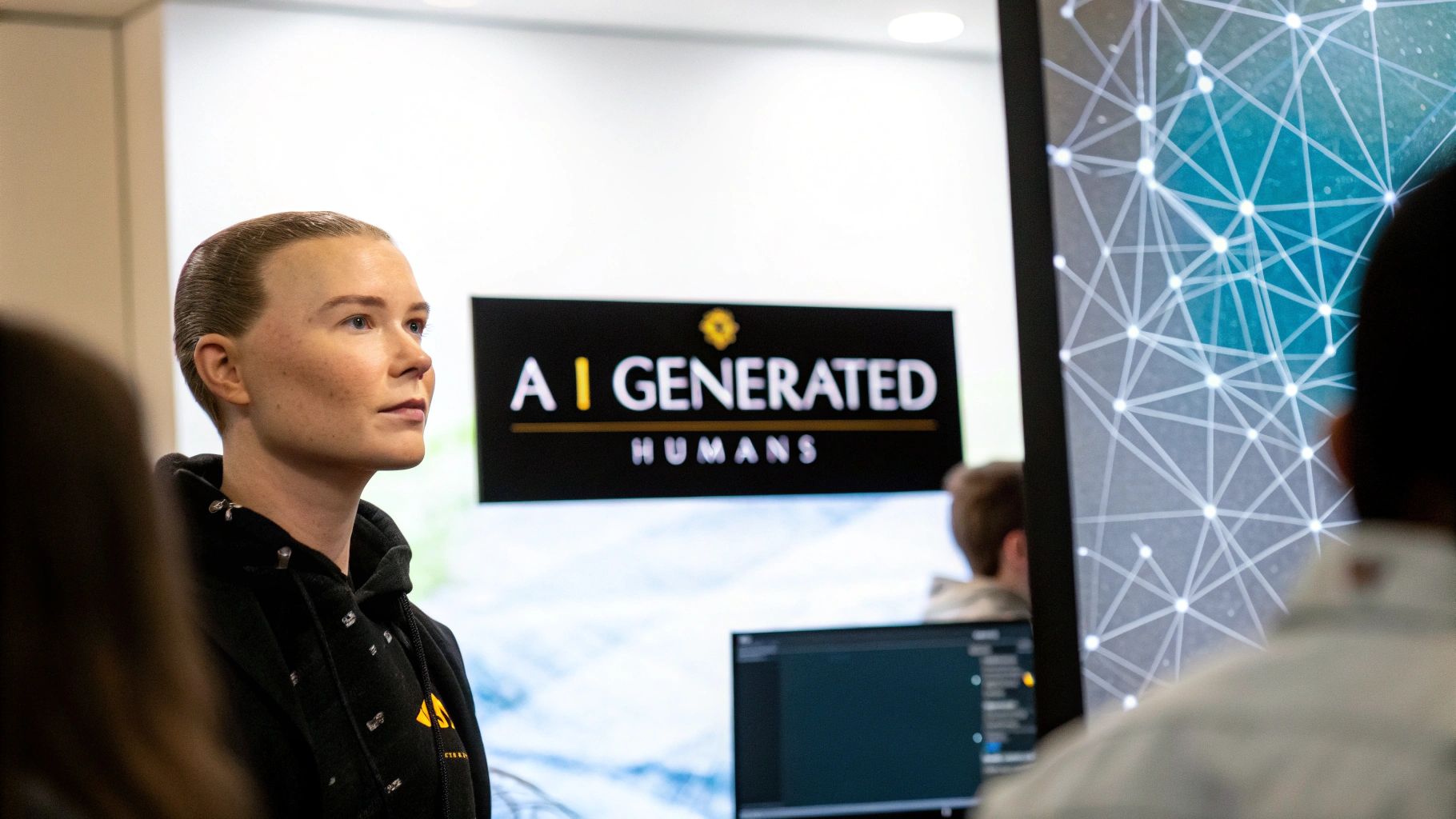
It’s a scene straight out of science fiction, but it’s happening right now: AI-generated humans are becoming a normal part of our digital lives. These aren’t clunky robots or basic avatars. We’re talking about hyper-realistic digital people, brought to life by sophisticated artificial intelligence, showing up in marketing campaigns, running their own social media accounts, and even populating virtual worlds.
Welcome to the World of Digital People
This guide is your deep dive into this fascinating new reality. We’ll journey from the initial concept to the final creation, exploring the powerful tech that makes these digital beings possible. You’ll see their surprising, real-world applications, get a hands-on workflow for making one yourself, and learn to navigate the tricky ethical questions that come with them. Get ready to see how this technology is changing creativity, business, and how we think about what’s real.
From Pixels to Personalities
At its heart, the idea is simple: create a digital person who looks and acts so real you can’t tell the difference. But don't think of it like drawing a cartoon. It's more like a master artist sculpting a person from digital clay, only the artist is an incredibly powerful AI. And it's not just about getting the face right; it's about building an entire persona from the ground up.
These digital people are given:
- A Unique Appearance: Crafted with an almost obsessive level of detail, from the texture of their skin to the tiniest flicker of an expression.
- A Defined Personality: They have backstories, hobbies, and distinct ways of communicating that are all carefully thought out.
- A Believable Voice: AI voice synthesis gives them a natural-sounding voice that matches their character.
It's this blend of stunning realism and a well-developed personality that makes AI humans so convincing. Platforms like https://createinfluencers.com/ give you the tools to manage this entire process, letting you build a complete digital influencer from scratch.
Beyond Science Fiction
We’ve been telling stories about artificial beings for centuries, but what used to be a fantasy is now a practical reality. Unlike the imaginary characters in a book or movie, today's AI-generated humans are interacting with us on our social feeds and in ads every single day. They’ve gone from being passive characters in a story to active players in our digital world.
The key distinction is that humans interpret things subjectively, bringing their unique life experiences into every creation. AI, on the other hand, computes objectively based on the vast datasets it was trained on. This difference is central to understanding both the capabilities and limitations of the technology.
This jump from fiction to function is creating new opportunities—and new problems—all the time. To keep up with the latest trends and see what others are thinking about AI-generated humans, it's worth checking out resources like Vidfarm's blog.
How AI Learns to Create Photorealistic People
So, how do you get from a line of code to a person who looks like they could be standing right next to you? Creating these AI-generated humans isn't magic. It's more like a high-tech assembly line where different AI systems collaborate, each with a specific job.
At the heart of it all are powerful models trained on mountains of data, learning the subtle nuances that make a human face look, well, human. But it’s not just about a pretty picture. The tech has to handle everything from appearance and personality to the sound of their voice.
Let's pull back the curtain and look at the key players that make it all happen. This concept map gives a great high-level view of how the technology, its uses, and the ethics all connect.
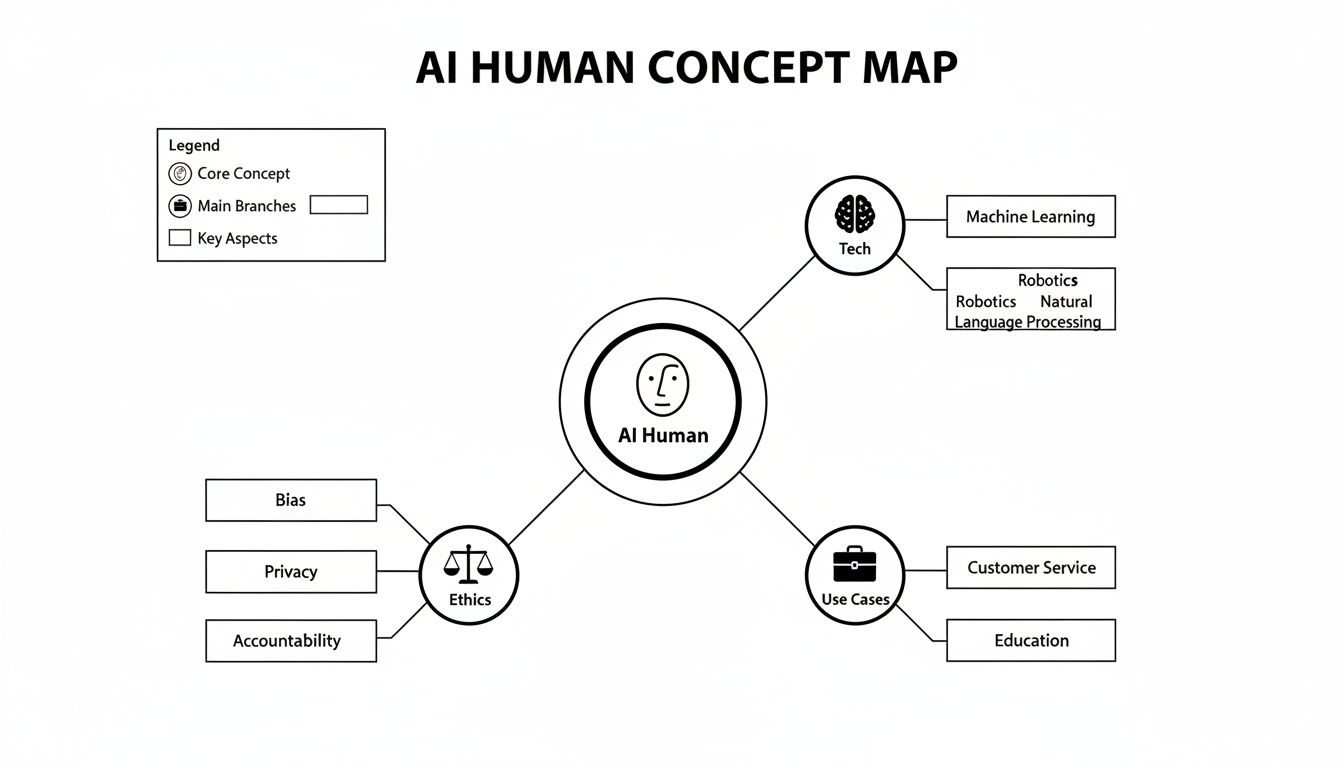
As you can see, building a digital person is a complex process that goes way beyond just generating an image.
The Art Forger and the Detective
A cornerstone technology for creating faces from scratch is the Generative Adversarial Network, or GAN. The best way to picture a GAN is to imagine a game between two AIs: one is a master art forger, and the other is a sharp-eyed detective.
The forger (the "generator") churns out fake images of people, trying its best to make them look real. Meanwhile, the detective (the "discriminator") has been studying thousands of real photos and knows exactly what to look for. Its job is to spot the forgeries.
Every time the detective catches a fake, the forger learns from its mistake and goes back to the drawing board. This endless cat-and-mouse game forces the forger to get progressively better, until its creations are so convincing they can fool the expert detective. That's how GANs produce those eerily realistic faces that are often impossible to tell from a real photo.
The Sculptor and the Block of Marble
Another incredibly powerful approach involves Diffusion Models. Think of an artist starting not with a blank canvas, but with a block of pure static—a random, noisy mess. The artist then slowly chips away at the noise, guided by a simple instruction, revealing the perfect sculpture hidden inside.
Diffusion models do something very similar. They begin with digital noise and a text prompt, like "photograph of a smiling woman." The AI then works backward, carefully removing the static step-by-step until a crystal-clear, detailed image that matches the prompt emerges from the chaos.
This meticulous "denoising" process is what allows diffusion models to achieve such a stunning level of realism, making them a go-to for creating high-quality AI-generated humans.
The scale here is just staggering. Since tools like Stable Diffusion hit the scene in 2022, users have created a mind-blowing 15 billion AI images. For context, it took traditional photography nearly 150 years to reach that number. Generative AI did it in a little over one. Digging into more AI statistics really highlights this explosive growth.
Giving AI Humans a Mind and a Voice
A convincing face is just the start. To be truly believable, a digital person needs a personality and a voice. That’s where a few other key technologies come in to add those crucial layers of depth.
- Large Language Models (LLMs): These are essentially the "brains" of the operation. An LLM, like the one that powers ChatGPT, can write a detailed backstory, define personality quirks, and generate natural dialogue, giving the AI human a unique character.
- Voice Synthesis: This is what gives the digital person their voice. Modern text-to-speech technology has moved far beyond robotic tones; it can create realistic, emotionally expressive speech that perfectly matches the AI’s personality.
When you bring all these pieces together, you get a complete digital being. The visual model creates the body, the LLM provides the mind, and the voice synthesizer gives it speech. They all work in concert to bring a truly convincing digital human to life.
Where AI-Generated Humans Are Already Changing Industries
It’s easy to think of AI-generated humans as something out of a sci-fi movie, but the reality is they’ve already moved out of the lab and into our daily lives. They are actively shaping how businesses operate, how we consume media, and how creative work gets done across dozens of sectors.
You can now find them working as digital brand ambassadors, tireless customer service agents, and perfectly customized models. This gives companies a degree of control and flexibility that’s simply not possible with human talent. This isn't some far-off prediction—it's happening right now, with real economic and cultural impact.
The Rise of the Virtual Influencer
Perhaps the most public-facing example is the explosion of virtual influencers on social media. You've probably seen them. Characters like Lu do Magalu (with an incredible 7 million followers) and Lil Miquela (who has 2.6 million followers) aren't just digital oddities; they're serious marketing powerhouses that land major deals with global brands.
These digital personalities build huge, dedicated followings by sharing their "lives," promoting products, and chatting with fans, just like their human counterparts would. The big difference? Every single aspect of their persona, from their look to their brand deals, is carefully planned and controlled by a team.
This level of control sidesteps the risks that come with human influencers, like public scandals or going off-brand. It also means they can produce content 24/7 for a global audience without worrying about time zones or travel. If you want a deeper dive into how these influencers are made and managed, the CreateInfluencers blog has some great insights.
Revolutionizing Advertising and Fashion
The advertising and fashion worlds have been quick to jump on AI-generated humans to get around the usual production headaches. Imagine a photoshoot with no studio, no photographer, and no physical models. That’s the new reality. A brand can now generate thousands of unique, hyper-realistic images featuring synthetic models specifically designed for target demographics.
This approach absolutely slashes costs and dramatically speeds up production timelines. A campaign that used to take weeks of planning and logistics can now be wrapped up in a few days.
By using synthetic models, brands can achieve a level of personalization at scale that was previously unimaginable. An e-commerce site could, for example, show the same piece of clothing on a dozen different AI models representing various body types, ethnicities, and styles, allowing customers to see a more relatable representation.
From the first creative spark to the final ad, advanced AI ad generator technologies are simplifying the entire process of creating marketing campaigns. They allow brands to test different creative ideas quickly and fine-tune their ads for the biggest impact.
Gaming and the Metaverse
In gaming and virtual reality, AI-generated humans are the secret sauce for creating truly immersive worlds. They act as non-playable characters (NPCs) that can interact with players in far more realistic and spontaneous ways, finally breaking free from repetitive, pre-written dialogue.
The technology also lets users create deeply personalized avatars that are true digital versions of themselves—or whoever they want to be. These aren't just static profile pictures; they are living, breathing entities that exist and interact within the growing number of metaverse platforms.
- Interactive NPCs: AI allows characters to hold natural conversations, remember what you've said before, and react to your actions, which makes virtual worlds feel much more alive.
- Customizable Avatars: You can craft a photorealistic digital twin or a completely new persona to represent you in virtual meetings, social hangouts, and games.
- Scalable World-Building: Developers can populate enormous digital landscapes with diverse AI humans without having to individually design and animate every single one.
Controversial Frontiers in Entertainment
While most applications are focused on mainstream industries, the use of AI-generated humans has also pushed into more controversial territories, especially adult entertainment. Some platforms and creators are using AI to generate synthetic performers for adult content, which brings up a whole host of complicated ethical and legal debates.
This application allows for content to be made without human actors, offering a way to produce material that might be unsafe or impossible to film with real people. On the other hand, it opens a Pandora's box of issues related to deepfakes, consent, and the use of a person's digital likeness. As this technology gets easier for everyone to use, these difficult conversations are only going to become more important.
As you can see, the applications for AI humans are incredibly diverse, touching everything from mainstream marketing to niche entertainment. Here's a quick summary of where they're making the biggest waves.
Key Applications of AI Humans Across Industries
| Industry / Use Case | Primary Benefit | Key Consideration |
|---|---|---|
| Virtual Influencers | 24/7 brand promotion with complete message control and no personal scandals. | Maintaining authenticity and avoiding the "uncanny valley." |
| Advertising & Fashion | Drastically reduced production costs and hyper-personalized ad campaigns. | Ensuring diversity and avoiding the reinforcement of stereotypes. |
| Gaming & Metaverse | Creates deeply immersive worlds with realistic NPCs and personalized avatars. | The high computational power required for real-time interactions. |
| Adult Entertainment | Production of content without physical actors, enabling unique scenarios. | Significant ethical and legal issues around consent and deepfakes. |
These examples are just the beginning. As the technology continues to mature, we're likely to see AI-generated humans pop up in even more corners of our digital and physical lives, bringing both incredible opportunities and new challenges to navigate.
A Practical Workflow for Creating Your First AI Human
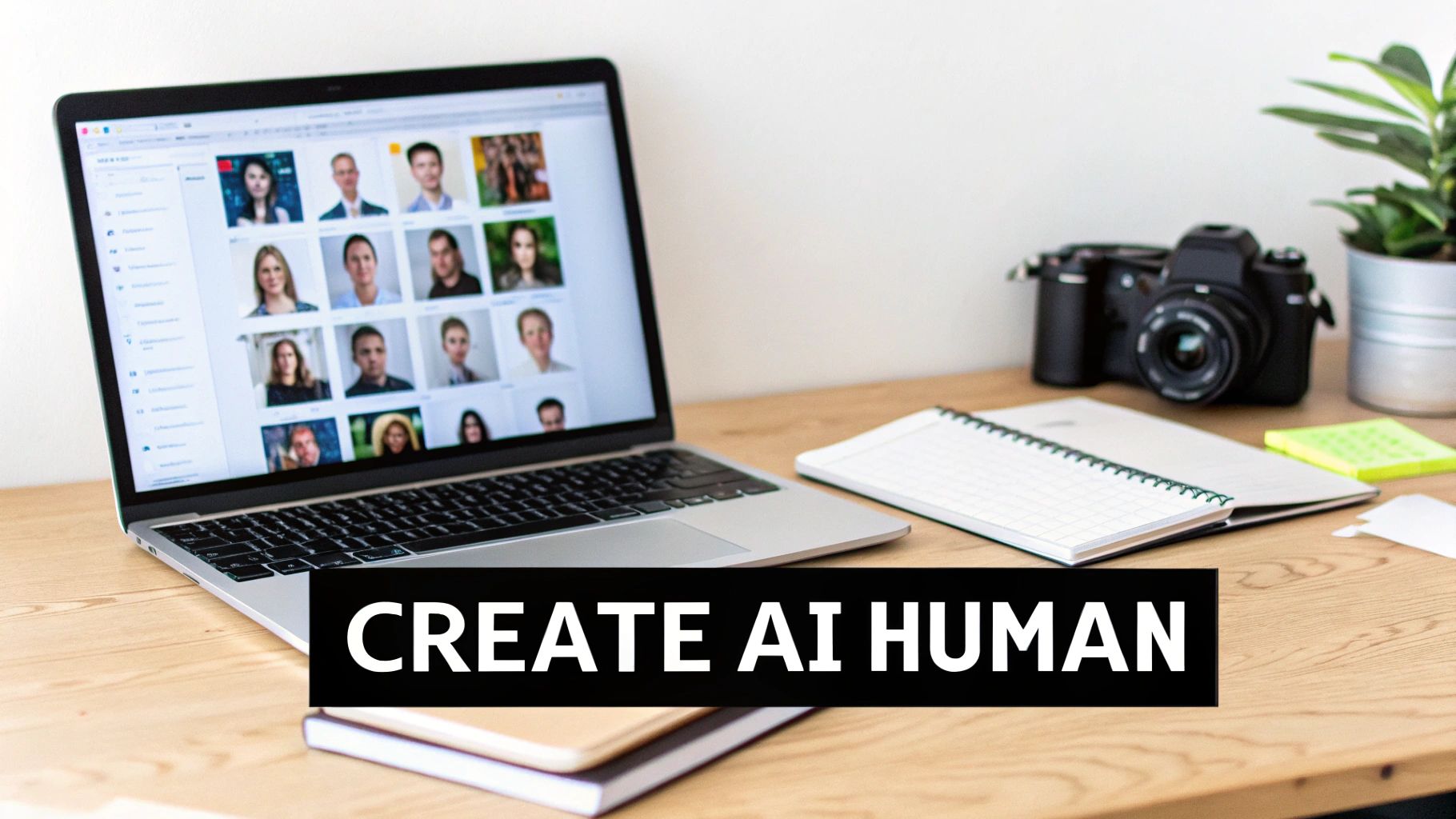
Seeing what AI can do is one thing, but actually creating your own photorealistic person is where the magic happens. The best part? You don't need a computer science degree to get started. The process is really a mix of your own creative vision and the AI's technical muscle, where your ideas are the real driving force.
Think of yourself as a director. You start with a concept, you flesh out a character, and then you use the tools at your disposal to bring them to life. Crafting AI generated humans follows a surprisingly similar path, and it all starts with a simple, powerful idea—not with lines of code.
Let’s walk through how you can go from a spark of imagination to a fully-realized digital person.
Step 1: Define Your Concept and Persona
Before you even think about writing a prompt, you need to know who you're creating. This is the most important part of the whole process. A well-defined persona is the foundation for every choice you make later, ensuring your final creation feels authentic, not just like a random set of pictures.
Start by asking the big questions:
- What's their purpose? Is this a virtual influencer for a fashion brand? A friendly avatar for a customer service bot? A character in a story you’re telling?
- What’s their backstory? Where are they from? What do they love to do? What makes them tick? Just a few sentences here can add incredible depth.
- What’s their look? Nail down their age, ethnicity, and signature style. Are they edgy and modern or classic and sophisticated?
A detailed persona is your creative North Star. When you get lost in the details of prompt engineering, you can always come back to your core concept to make sure every image and interaction lines up with the character you imagined.
This early planning is what saves you from generating a bunch of inconsistent visuals and helps you build a digital identity that people will actually remember.
Step 2: Choose Your Image Generation Tools
Once you have a clear persona, it’s time to pick the right tech to bring it to life. The world of AI image generation is packed with tools, each suited for different needs and skill levels.
If you’re just starting out, platforms like Midjourney or Leonardo.AI are fantastic. They have user-friendly interfaces (often through Discord or a web app) and are great at producing high-quality, artistic images from simple text prompts. They're the perfect entry point.
But for real control and consistency, you’ll eventually want to look at specialized services. Platforms built specifically for creating AI generated humans and influencers, like CreateInfluencers, give you a much more focused toolset. They often have features designed to keep a face consistent across many different images—a huge challenge with general-purpose tools. To get a feel for how these platforms work, you can explore the tutorials in these helpful AI influencer guides.
Step 3: Master Prompt Engineering and Refinement
This is where your vision truly connects with the AI. Prompt engineering is the art of giving the model precise, descriptive instructions to get the exact output you want. A good prompt isn't just a few keywords; it's a detailed recipe.
A solid prompt for an AI human might look something like this:
- Subject Description: "photograph of a 25-year-old Brazilian woman with curly brown hair and hazel eyes"
- Setting and Style: "standing on a sunlit balcony in Lisbon, golden hour lighting, cinematic style"
- Technical Details: "shot on a Canon EOS R5, 50mm f/1.2 lens, photorealistic, high detail"
Your first attempts will rarely be perfect, and that's okay. The secret is iterative refinement. You tweak your prompts, generate new images, and slowly inch closer to your vision. It's a dance of experimenting with different phrases, using negative prompts to exclude things you don't want (like "blurry, cartoon, deformed hands"), and generating several options until one just clicks. Once you have that perfect base image, you can use it as a reference to keep your character looking consistent in all future creations.
The Economic Impact of a Synthetic Workforce
The rise of AI-generated humans isn't just some tech fad; it’s a powerful economic engine that's already reshaping entire industries. We're talking about a synthetic workforce that's creating brand new revenue streams, shaking up traditional job markets, and fueling a multi-billion dollar generative AI boom. Companies are catching on fast: a digital employee who never sleeps, travels, or gets sick offers a massive financial advantage.
This whole movement is a huge part of why the generative AI market is exploding. The sector that powers everything from your favorite chatbot to these virtual humans has become a massive economic force, valued at an estimated $44.89 billion in 2025. Looking ahead, some forecasts predict this could balloon to $1.3 trillion by 2032, with AI humans at the center of personalized advertising and virtual worlds. You can dive deeper into the future of generative AI's market growth at Mend.io.
New Avenues for Monetization
For businesses, the most obvious economic win is the ability to create new products and services that can scale almost infinitely. Take virtual influencers, for example. They're quickly becoming major assets, landing huge brand partnerships and selling digital merchandise without the payroll and logistics of a human team.
By eliminating the high costs of photoshoots, travel, and talent fees, businesses can reallocate budgets toward creating more diverse and targeted content. A single AI persona can be adapted for dozens of campaigns simultaneously, achieving a level of efficiency that was previously impossible.
This digital-first model goes way beyond marketing. Developers can fill entire virtual worlds with synthetic actors, and creators can build loyal, subscription-based followings around unique AI personalities. Many are already finding success through programs like the CreateInfluencers affiliate program, which offers a straightforward way to earn money from their digital creations.
Job Market Disruption and Creation
Of course, a shift this big is bound to cause some disruption. Traditional jobs in modeling, photography, and even acting are facing direct competition from their digital counterparts. When a brand can generate a flawless campaign image in a few minutes, the need for a physical photoshoot—and the whole ecosystem of jobs that supports it—starts to shrink.
But this isn't just a story about job loss; it’s also about job creation. This disruption is carving out entirely new career paths, and the demand for people who can build and manage these digital beings is soaring.
- AI Prompt Engineers: Think of them as the new digital artists. They're the ones who master the specific language needed to coax lifelike visuals and consistent characters out of the AI.
- Digital Persona Managers: This role is a mix of social media manager and creative director. They're responsible for the strategy, content, and personality of an AI influencer.
- AI Ethicists and Legal Consultants: As this technology becomes more common, we need experts to help us navigate the tricky ethical and legal questions around digital identity and deepfakes.
The bottom line is that the synthetic workforce is changing the job market, no question about it. It’s making some roles obsolete while simultaneously creating a real need for a new set of specialized skills.
Navigating the Ethical Maze of Digital People

As AI-generated humans become nearly impossible to distinguish from real people, we’re wandering into a minefield of complex ethical and legal questions. The very tech that unlocks incredible creative potential also opens the door to serious misuse, forcing us to tackle thorny problems that have no simple solutions.
The most obvious threat? Malicious deepfakes. These aren't just funny memes; they are powerful weapons for spreading disinformation, manufacturing fake political endorsements, or creating non-consensual explicit content. One study revealed that well-made deepfake videos can deceive viewers up to 73% of the time, which could completely erode the trust we place in digital media. This new reality demands a serious conversation about responsibility and verification.
Transparency and the Right to Know
This brings us to a core ethical question: should AI-generated content always be labeled? Many argue that audiences have a fundamental right to know if they're engaging with a synthetic personality or a real human being. This kind of transparency fosters trust and empowers people to think more critically about what they see online.
On the flip side, some creators argue that forced labels could kill the magic, breaking the immersive experience they've worked so hard to build. The trick is finding the right balance—creating clear standards that protect the public without hamstringing creative freedom.
The real issue isn't whether the technology is "good" or "bad"—it's about building guardrails. The goal is to stop the bad stuff while still making room for positive innovation, and that starts with a shared understanding of what responsible use actually looks like.
Consent and Digital Identity
Beyond deepfakes, the whole idea of AI-generated humans pokes at fundamental issues of consent and identity. What happens when someone creates a digital twin of a real person without their permission? This isn't some far-off sci-fi scenario. It's happening now and brings up immediate legal battles over an individual's right to control their own likeness, often called "publicity rights."
This new frontier leaves us with some pretty big questions:
- Who owns a digital likeness? If an AI generates a person from a text prompt, does the creator own it? Or does the platform that hosted the AI have a claim?
- What counts as "resemblance"? How close does a digital human have to look to a real person before it violates their rights?
- How do we handle digital consent after death? Can someone’s likeness be used to create an AI person after they’ve passed away? And who gets to make that call?
These aren't just abstract legal puzzles for lawyers to debate. They are urgent social dilemmas that will shape the rules of engagement in our increasingly synthetic world. As we create and interact with more digital people, building clear ethical guidelines and legal frameworks isn't just a good idea—it's absolutely essential.
Frequently Asked Questions About AI Generated Humans
As AI generated humans become more common, the questions surrounding them are piling up. The technology is moving at a breakneck pace, so it’s completely normal to wonder about what it can do, what the risks are, and how you might use it yourself. We've tackled some of the most common questions to give you some clarity.
This isn't some niche tech anymore—it's everywhere. A massive 1.8 billion people globally have already experimented with AI tools. In the U.S. alone, 61% of adults have used AI in just the last six months. Looking ahead, some experts predict that by 2026, an incredible 90% of all online content could be made by AI, including the synthetic people we're starting to see in ads and on social media. You can dig into more stats on AI's explosive growth to see the full picture.
How Realistic Can AI Generated Humans Be?
Honestly, today's AI models can create images and videos that are often impossible to tell apart from the real thing, at least at first glance. This isn't just about writing a good prompt, though.
Getting that true-to-life feel means sweating the small stuff. We're talking about nailing natural skin textures, making sure the lighting is consistent from one shot to the next, and even adding tiny imperfections. These little details are what help us jump over the "uncanny valley" and convince our brains we're looking at an actual person.
What Are the Main Legal Risks?
When you start working with AI generated humans, you'll run into three big legal areas: copyright, publicity rights, and liability. Each one is a potential minefield for creators.
- Copyright: Who actually owns the AI character you created? The answer is usually buried in the terms of service of the AI tool you're using. Some platforms claim ownership of anything generated on their system.
- Publicity Rights: These laws are in place to stop you from creating a synthetic person that looks a lot like a real celebrity or private individual without getting their permission first.
- Liability: This is a big one. If your AI human is used to create damaging deepfakes, run scams, or spread misinformation, you as the creator could be held legally responsible for the harm it causes.
Can I Create an AI Version of Myself?
Absolutely. Making a "digital twin" of yourself is very much possible. Plenty of AI tools let you upload your own photos to train a model that can then generate a digital version of you.
But before you jump in, you need to think about the ethics and security of it all. You're effectively handing over your personal biometric data. Consider what could happen if that platform gets hacked and your digital likeness falls into the wrong hands. Always be careful and read the privacy policy of any service before you start uploading your pictures.
Ready to design your own digital persona? CreateInfluencers gives you everything you need to build and manage incredibly realistic AI influencers and avatars in just a few minutes. Start creating for free today and bring your vision to life!