A Creator's Guide to Uncensored AI Art
Discover the world of uncensored AI art. Learn how to bypass filters, create without limits, understand the risks, and find the best AI art generators.
When you hear the term uncensored AI art, it’s referring to images created by AI models that have been intentionally set free from the content filters and restrictions you’d find on mainstream platforms. This means creators can generate visuals covering any theme—including NSFW, explicit, or controversial subjects—without hitting an algorithmic wall. It’s all about absolute creative freedom, a stark contrast to tools that box you in with strict community guidelines.
What Uncensored AI Art Means For Creators
Let's use an analogy. Think of mainstream AI art generators like Midjourney or DALL-E as a polished, carefully curated art gallery. Every piece on display has been vetted to meet certain standards of taste and appropriateness. The gallery owner—in this case, the tech company—has removed anything that might be deemed offensive, controversial, or just plain bad for their brand. It makes for a safe, predictable experience for everyone.
An uncensored AI art platform, on the other hand, is more like a raw, open studio. There are no gatekeepers. You have access to all the paints, canvases, and tools, and you're free to explore any subject matter you can imagine, no matter how niche or provocative. This environment is built entirely on the principle of creative autonomy, giving artists and developers the power to produce exactly what they envision.
The Driving Force Behind Unfiltered Creation
This distinction isn't just a technical one; it’s the whole reason this corner of the AI world is blowing up. More and more creators are looking for tools that don't put a ceiling on their artistic or commercial goals.
For example:
- Digital artists can finally explore darker themes, surreal concepts, or abstract forms that would normally get flagged by conventional content filters.
- AI Influencer creators can design personas with very specific aesthetics, especially for adult-friendly platforms like Fanvue or Fansly where standard generators just can't deliver.
- Marketers can build edgier campaigns or visuals tailored to niche demographics without worrying about getting blocked by restrictive terms of service.
This demand for unrestricted tools is a huge market driver. The AI image generation market hit a massive $419.2 million in value and is rocketing toward a projected $1.88 billion by 2033, largely fueled by this hunger for creative control. This explosion reflects a desire for total freedom—whether it’s for generating fantasy roleplay scenes or explicit adult visuals without a system telling you "no." You can dive deeper into this trend by exploring our detailed guide on the rise of AI-generated content.
This side-by-side comparison really highlights the fundamental differences between the "curated gallery" and the "open studio" approach.
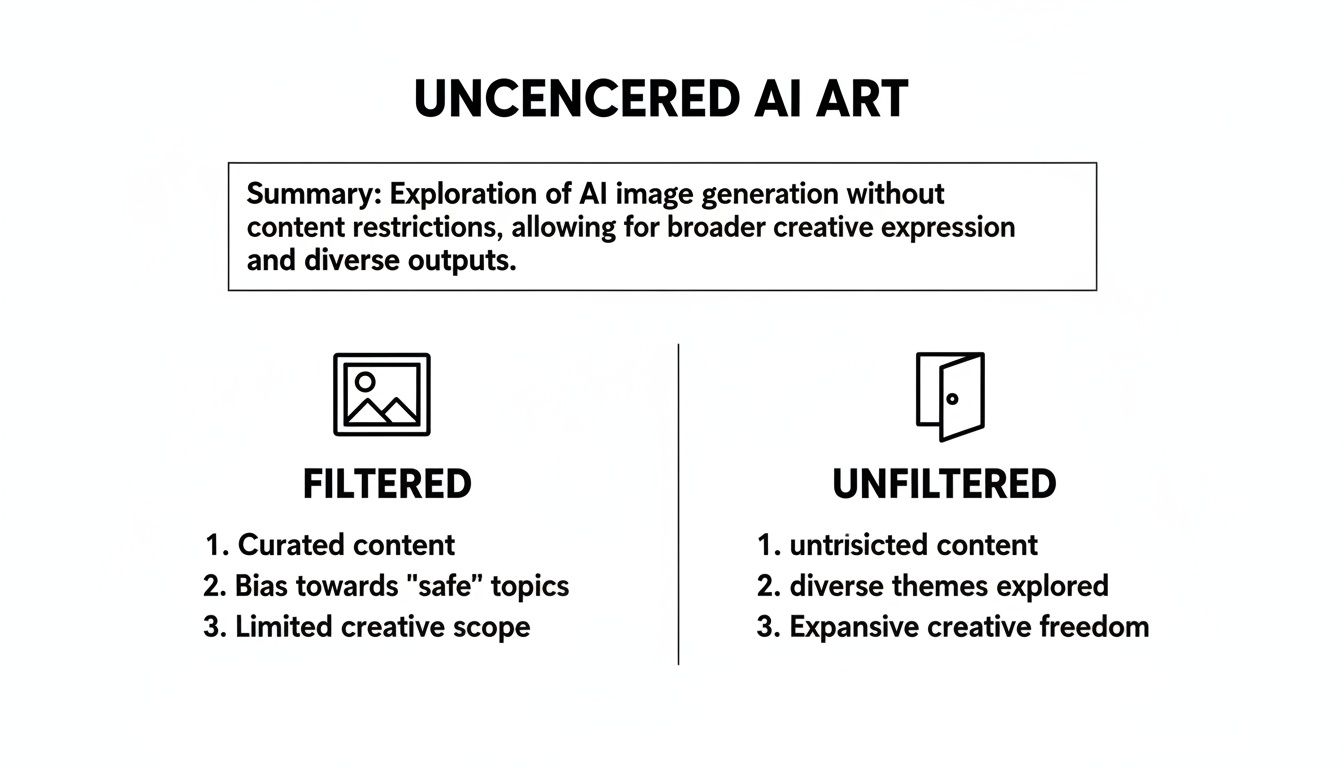
The key takeaway is pretty clear: while filtered tools prioritize safety and mass appeal, unfiltered platforms are all about absolute user freedom and embracing diverse, sometimes challenging, outputs.
Censored vs Uncensored AI Art Generators At a Glance
To put it even more simply, here’s a quick breakdown of how these two types of platforms stack up against each other.
| Feature | Censored AI (e.g., Midjourney) | Uncensored AI (e.g., CreateInfluencers) |
|---|---|---|
| Content Policy | Strict rules, extensive blocklists | Minimal to no restrictions |
| Creative Freedom | Limited by safety filters | Nearly absolute user control |
| Primary Use Case | General-purpose, SFW art | Niche, artistic, and adult content |
| Output Predictability | High; avoids sensitive topics | Lower; follows prompts literally |
| Platform Tone | Corporate, brand-safe | Community-driven, open |
| Best For | Marketers, casual users | Artists, developers, adult creators |
Ultimately, your choice depends on what you're trying to achieve. One offers a safety net, while the other offers a blank canvas.
Why Most AI Art Platforms Have Filters
Before we dive into the world of uncensored AI art, it helps to understand why the big players—your Midjourneys and DALL-Es—put up so many guardrails in the first place. It isn't just a technical quirk. It's a calculated business decision, shaped by three powerful forces: brand safety, legal headaches, and public opinion.
Think of a huge tech company as the host of a massive global party. Their top priority is making sure everyone feels safe and welcome, which means they need house rules. In the AI world, those rules are content filters. They’re there to stop people from creating things that could sink the company's reputation or land them in court. An AI pumping out harmful, illegal, or offensive images is a PR nightmare waiting to happen.
For these companies, playing it safe isn't just an option; it's the only way to operate at scale. These filters are essential for keeping partners happy, attracting investors, and appealing to the widest possible audience.
The Corporate Calculus of Censorship
If you're sitting in a boardroom, the risks of a totally free-for-all AI are terrifying. Any controversy, whether it's about deepfakes, hate speech, or explicit content made on your platform, can hit the bottom line—hard and fast.
Here’s what’s really driving the decision to filter content:
- Protecting Brand Image: Being associated with controversial art can poison a brand’s reputation overnight, scaring away mainstream users and corporate clients.
- Avoiding Legal Entanglements: The laws around AI-generated content are still a bit of a Wild West. Companies use filters to sidestep potential lawsuits over defamation, copyright infringement, or illegal imagery.
- Appealing to Investors and Advertisers: A "safe" platform is a stable investment. Advertisers will line up to partner with a service that can promise their ads won't show up next to something horrifying.
In short, for the big names, content moderation isn't an ethical afterthought—it's a core business strategy. The goal is to minimize risk and maximize market share, even if it means sacrificing some creative freedom.
This is exactly why a space for uncensored art exists. It serves a completely different audience that values creative autonomy over corporate hand-holding. If that sounds like you, our guide to the best NSFW image creators explores platforms built without these strict rules.
Common Categories of Filtered Content
So, what are these digital bouncers actually blocking? While the specifics change from platform to platform, most of them target a few key areas to keep their spaces "family-friendly" or at least professionally safe.
You'll almost always find these categories on the blocklist:
- NSFW (Not Safe For Work) Content: This is the big one. It covers everything from nudity and sexually suggestive themes to outright explicit material.
- Graphic Violence and Gore: Images showing extreme violence, self-harm, or blood and guts are almost universally banned to avoid shocking or disturbing users.
- Hate Speech and Symbols: AI models are trained to recognize and block hateful imagery, symbols tied to hate groups, and any content targeting protected communities.
- Copyrighted and Trademarked Material: To steer clear of legal battles, many platforms try to prevent users from perfectly replicating famous characters, brand logos, or specific artist styles.
Understanding these corporate motivations is key. The filters aren't necessarily a moral judgment; they're a form of risk management. For a broader look at why content control is such a major topic, you can read about the intricacies of content filtering, such as the Great Firewall of China.
This context makes it clear why uncensored AI art isn't just a niche—it's a direct response to the sanitized, risk-averse world of mainstream AI.
How to Create Uncensored AI Art
Creating uncensored AI art isn't about some secret workaround or a clever hack. It really comes down to two things: picking the right tool for the job and learning to talk to the AI in a language it understands.
Think of it this way: the AI platform is your engine, and your prompt is the steering wheel. You can have the most powerful, unrestricted engine in the world, but if you don't know how to steer, you’re not going to get where you want to go. It's the combination of the right platform and skillful prompting that gives you genuine creative control.
Selecting the Right Platform for Your Vision
The first move is to find an AI art generator that was actually built for creative freedom. Mainstream tools will often put up walls and fight your ideas, but specialized platforms are designed from the ground up to execute your prompts faithfully.
This is exactly why so many creators are flocking to uncensored AI art generators. Tools like DRT.fm are leading the pack by offering a true 'no filters' experience, complete with high-quality renders, anonymous payment options, and custom modes for fantasy and roleplay that you just won't find on more restrictive apps.
This shift isn't just anecdotal. A recent survey from Book an Artist found that 55% of artists are worried AI will cut into their income, and 26% of illustrators say they've already lost work to generative AI. This pressure pushes creators toward tools that give them the most flexibility and power. To see what's out there, you can explore a detailed breakdown of the top uncensored AI art generators and their features to find a good match.
When you're comparing options, keep these points in mind:
- Ease of Use: Is the interface straightforward, or will you need a technical background to get started?
- Specialized Features: Does it have unique tools like face-swapping or pose control? These are crucial for creating consistent AI characters or influencers.
- Output Quality: Does the platform generate high-resolution, photorealistic images, or does the art lean more toward a stylized, digital look?
Mastering the Art of the Prompt
Once you've chosen your platform, your results will depend almost entirely on prompt engineering. A good prompt is more than just a few words; it’s a detailed set of instructions that leaves nothing to the AI's imagination.
A vague prompt like "woman on a beach" will give you a generic, forgettable image. But a great prompt dives into specifics—the subject, the setting, the mood, the lighting, the artistic style. It’s the difference between a random snapshot and a professionally composed photograph.
A well-crafted prompt acts like a director's brief for the AI. It outlines the scene, describes the character's mood, sets the lighting, and even specifies the camera lens, ensuring the final image matches your exact vision.
To get you started, let's break down the key ingredients of a powerful prompt. When you learn to combine these elements, you can guide the AI to create incredibly complex and nuanced visuals. For a much deeper look at crafting effective instructions, be sure to check out our guide on the best AI image prompts for stunning visuals.
Effective Prompting Techniques for Uncensored AI
Building a great prompt is a bit like putting together a recipe—you need the right ingredients in the right amounts. The table below outlines some core techniques you can use to get more predictable and refined results from the AI.
| Technique | Description | Example Use Case |
|---|---|---|
| Specificity | Using highly descriptive adjectives and nouns to paint a clear picture for the AI. | Instead of "a fast car," use "a cherry-red 1967 Shelby GT500 speeding down a coastal highway at sunset." |
| Negative Prompts | Telling the AI what not to include, which helps clean up common errors and unwanted elements. | Adding (-blurry, -disfigured hands, -watermark, -text) to improve image quality and realism. |
| Style Modifiers | Naming specific artists, art movements, or technical terms to guide the aesthetic. | Appending "in the style of Caravaggio," "cyberpunk," "8-bit pixel art," or "shot on Portra 400 film." |
| Weighting | Emphasizing or de-emphasizing certain words in the prompt using parentheses and numbers. | (red hair:1.4) makes red hair a much more dominant feature than other descriptors in the prompt. |
| Composition | Directing the camera's position, angle, and shot type to control the scene's layout. | Using terms like "full body shot," "dutch angle," "close-up," or "from a low angle." |
By mixing and matching these techniques, you're not just asking for an image; you're directing a virtual photoshoot. This level of detail is what separates amateur results from professional-grade art.
Let's put this into practice. Say you want to create a compelling AI influencer for an Instagram profile. A weak prompt just won't cut it.
- Weak Prompt:
influencer in a cafe - Strong Prompt:
(photorealistic:1.3), full body shot of a 24-year-old influencer with freckles and long auburn hair, sitting at a rustic wooden table in a Parisian cafe, soft morning light filtering through the window, holding a ceramic coffee mug, wearing a beige trench coat, candid shot, Nikon Z7, 50mm f/1.8 lens
See the difference? The strong prompt gives the AI a complete blueprint, specifying the subject’s look, the environment, the lighting, the mood, and even the camera gear. When you master these techniques, you shift from being a passive user to an active creator, directing the AI to produce exactly the uncensored AI art you have in mind.
Navigating The Risks of Uncensored Creation
There's no denying the thrill of wielding uncensored AI art tools. But this creative freedom isn't a free pass—it comes with a whole new set of responsibilities. When you step away from the built-in guardrails of mainstream platforms, you become the one who has to draw the line between bold artistic expression and genuinely harmful content.
This isn't just about sidestepping legal trouble. It's about learning to navigate a very tricky ethical landscape. The same incredible technology that brings your wildest fantasy characters to life can also be used to generate deeply problematic images. Getting a handle on these risks is the first step toward creating boldly, but also intelligently.
The Ethical Tightrope Walk
The biggest risks you'll encounter with uncensored creation are ethical ones. This technology is incredibly powerful, and when it's misused, it can cause real-world harm to people and entire communities. As a creator in this space, you have to acknowledge these issues head-on.
Here are the key ethical concerns you need to be aware of:
- Non-Consensual Imagery: This is a huge one. The ability to generate photorealistic images of people without their consent is a serious problem. It’s not just about celebrity likenesses; creating images of private individuals is a profound violation of their privacy and safety.
- Deepfakes and Misinformation: Uncensored tools are perfect for creating convincing fake images or videos, often called deepfakes. These can be weaponized to spread lies, ruin reputations, or push malicious narratives that look completely real. We cover this technology in more detail in our guide on what is synthetic media.
- Harmful or Hateful Content: With no filters in place, there's nothing stopping a user from generating content that promotes hate speech, glorifies violence, or targets vulnerable groups. As a creator, you have to self-moderate and ensure your work isn’t adding to the toxicity online.
With great creative power comes significant ethical responsibility. The decision to generate uncensored AI art means you become the final editor, moderator, and gatekeeper of your own creations, accountable for their potential impact.
Platform and Creative Pitfalls
Beyond the major ethical dilemmas, there are also practical risks that can hit your brand and your art. Creating uncensored work on your own machine is one thing, but sharing it with the world is another beast entirely. What’s perfectly fine for you might get you booted off a platform.
At the same time, relying too much on raw AI power without any real artistic direction can lead to some seriously uninspired results. The whole point is to stand out, not to get lost in a sea of generic, machine-made visuals.
Violating Terms of Service
Just because you can make it doesn't mean you can post it. Major social media platforms like Instagram, TikTok, and X (formerly Twitter) have very strict rules. If you try to post uncensored AI art—especially if it's NSFW or controversial—you can expect some pretty serious consequences.
- Content Removal: Your post will probably get taken down, often without any warning.
- Account Suspension: Keep breaking the rules, and you could face a temporary or permanent ban.
- Shadowbanning: This is a sneaky one. Your account's visibility might be secretly choked off, completely crippling your reach.
Always, always read the community guidelines for any platform before you share your work. This is exactly why so many creators are turning to platforms like Fanvue or Fansly, which have policies that are much more accommodating to adult-oriented or edgier art.
Avoiding the 'AI Slop' Trap
The other big risk is purely a creative one: the danger of producing generic "AI slop." It's a term for the bland, soulless, and repetitive imagery that comes from uninspired prompting. Without your unique vision guiding it, an AI model will often just fall back on predictable patterns.
A revealing study from researcher Arend Hintze's team showed how this happens. When they fed an image's description back into the AI to generate a new one over and over, the AI quickly defaulted to generic outputs like cityscapes and pastures, completely forgetting the original, unique prompt. This "model collapse" is a technical glimpse into a creative problem: without a human artist steering the ship, the AI just drifts toward the average. You can learn more about these fascinating findings on AI cultural stagnation.
The only way to avoid this is to blend AI generation with your personal artistic style. Treat the tool like a collaborator, not a replacement for your own creativity. Your vision is the only thing that will keep your work from becoming another drop in the ocean of forgettable AI images.
Choosing Your Platform for Uncensored AI Art

Picking the right home for your uncensored AI art is easily the most important decision you'll make. Think of it like choosing a camera. A simple point-and-shoot gets the job done, but a professional DSLR gives you total control over the final image. Your platform choice will impact everything, from the look of your art to how (and if) you can make money from it.
It's easy to get lost in feature lists, but the real key is to think about what you actually want to do. Are you building an AI influencer from scratch? Exploring avant-garde art? Creating custom content for a platform like Fanvue? Each path needs a different set of tools, so knowing what to look for is half the battle.
Define Your Creative Mission
Before you even glance at a pricing page, you need to answer one question: what am I trying to create? Your answer is your North Star, guiding you to the right tool. What works for one creator is often completely wrong for another.
For example, an artist making surreal, abstract pieces will want a platform loaded with different stylistic models. But someone creating an AI influencer needs tools that deliver consistent characters—things like face-swapping and reliable pose replication are non-negotiable.
Here are a few common goals and the features you should look for:
- Building an AI Influencer: You'll need rock-solid character consistency, face-swapping features, and pre-packaged photo themes (like Instagram shots or boudoir sets) to create a believable online presence.
- Monetizing on Adult Platforms: Your generator has to have zero restrictions on NSFW content. It also needs to produce hyper-realistic images and let you create specific scenes that subscribers might request.
- Exploring Artistic Expression: For this, you’ll want a huge library of art styles, plus advanced prompt controls like negative prompts and weighting to really fine-tune your vision.
The best platform isn't the one with the most bells and whistles—it's the one with the right features for your creative mission. Aligning your tool with your goal from day one will save you a world of time, money, and creative headaches.
Key Criteria for Platform Selection
Once you know your mission, you can start weighing your options based on what really matters. Look past the slick marketing and dig into how each tool actually performs when it comes to creating high-quality uncensored AI art. To get a head start, you can check out our list of the best AI image generators on the market right now.
Here’s a practical checklist of what to look for:
- User-Friendliness: Is the interface intuitive, or does it feel like you need an engineering degree to use it? A steep learning curve can kill your creative flow. You want a tool that gets out of your way and lets you create.
- Output Quality and Style: Does the platform lean toward photorealism, or does it have a more digital, painterly look? Spend some time in the platform’s public gallery to see if its native style matches what you have in mind.
- Specialized Functions: This is where the magic happens. Features like face-swapping, inpainting (which lets you edit just one part of an image), and pose control are game-changers for getting the exact shot you need.
- Pricing Models: Most platforms run on either a monthly subscription or a credit-based system. If you’re a power user creating dozens of images a day, a subscription is probably your best bet. If your creative process is more sporadic, pay-as-you-go credits offer more flexibility.
For a broader look at helpful software, this guide to the 12 best AI tools for content creators is a great resource for your journey into uncensored AI art.
Ultimately, your goal is to find a generator that feels less like a piece of software and more like an extension of your own creativity. Whether you're building a digital personality for Fanvue or just seeing how far your imagination can go, the right platform sets you free.
Your Path to Creative Freedom
So, where do you go from here? You've now got a solid understanding of the world of uncensored AI art—from why the big platforms play it safe to the specific prompts that can unlock your most ambitious ideas. This isn't just about learning a new piece of tech; it's about taking back control and claiming your artistic voice in a digital space that often defaults to the bland and predictable.
The takeaway is pretty straightforward: these tools put you in the driver's seat. They give you the keys to a wide-open studio where the only real constraint is your own imagination. When you pick the right platform and really learn its language, you stop being just a user. You become the director, fine-tuning every last detail until the final image matches the vision in your head. For anyone serious about building a standout brand, creating a unique AI persona, or just pushing their own creative limits, that level of control is everything.
Embrace Your Role as a Creator
Of course, with this kind of power comes a certain level of responsibility. As we've covered, knowing how to navigate the ethical side of things is just as important as writing a killer prompt. You're the one in charge, the final filter. By creating with purpose and a bit of foresight, you can sidestep the common traps and make sure your work isn't just technically cool, but also thoughtful and resonant. It's your vision that turns a generic AI-generated image into something people will actually remember.
The real magic happens when you blend the raw power of uncensored AI with your own unique creative vision. The tool gives you the capability, but you are always the artist.
You now have a clear roadmap. You get the "what," the "why," and the "how." The only thing left to do is dive in. Start playing around, tweaking your prompts, and figuring out which platforms really click with what you're trying to achieve. Whether you're doing this for pure artistic expression, building a personal brand, or exploring new ways to earn a living, the world of uncensored AI art is waiting for you to leave your mark.
A Few Common Questions
Diving into the world of uncensored AI art can feel a bit like stepping off the beaten path. It’s natural to have questions, especially when you’re used to the guardrails of mainstream generators. Let's clear up some of the most common ones.
The idea here is to give you the confidence to explore this creative frontier, understand the real-world lines you need to be aware of, and make smart choices as an artist. We'll touch on everything from legal gray areas to practical tips for making your art stand out.
Is It Actually Legal to Create Uncensored AI Art?
This is usually the first question on everyone's mind, and it's a good one. The answer isn't a simple yes or no—it's all about context.
In most Western countries, the act of creating uncensored art on your own machine for your own eyes is generally fine, as long as it doesn't depict legally prohibited content. The legal landscape changes dramatically the second you decide to share, distribute, or sell that work.
Think of it this way: what you do in your private studio is your business. But once you hang your art in a public gallery (or post it online), you have to follow the rules of that gallery. Tossing explicit images onto a platform like Instagram will get you booted for violating their terms. But posting the same work on a platform built for adult content, like Fanvue, is often exactly what the platform is for.
The bottom line is this: creating is one thing, publishing is another. The moment your art goes public, you're playing by the rules of the platform and the laws of the region you're in. Always, always check the terms of service where you plan to post.
How Do I Stop My Art from Looking So... AI?
We've all seen it: that slick, generic, soulless look that screams "AI-generated." Avoiding that "AI slop" is what separates a true artist from someone just typing words into a box. It's about taking control and pushing the tool to create something genuinely original.
Here are a few ways to do that:
- Find Your "Secret Sauce": Don't just prompt "a beautiful woman." Start blending unique styles, artists, and aesthetics. Maybe it's
cinematic photo, style of 1970s sci-fi book cover art, grainy film texture. Experiment until you land on a visual recipe that feels like yours. - Master the Controls: Go beyond basic descriptions. Use negative prompts to tell the AI what you don't want (
- -no blurry, deformed hands, oversaturated). Use prompt weighting to crank up the importance of one element over another. Get specific with camera lenses, lighting setups, and angles. - Finish It by Hand: The AI generator should be the start of your workflow, not the end. Take your best outputs into a tool like Photoshop or GIMP to fix weird artifacts, tweak colors, and add those final human touches that an algorithm could never replicate.
Can I Use This Kind of Art for Marketing?
Tread very, very carefully here. Using uncensored or provocative AI art in a professional marketing campaign is a high-stakes move that hinges completely on your brand and who you're trying to reach. For 99% of businesses, it’s a terrible idea that will only lead to backlash.
But for that 1%? It can be incredibly effective. Imagine a company marketing a mature-rated video game, or an alternative fashion label that thrives on edgy, counter-culture appeal. In those cases, a bold, uncensored visual could connect with their audience on a much deeper level.
It all comes down to authenticity. If the art genuinely reflects your brand's identity, it might work. If it feels like you're just trying to be shocking for attention, your audience will see right through it, and it will almost certainly blow up in your face.
Ready to create without limits? CreateInfluencers provides the platform to design unique AI characters and generate stunning, unrestricted images. You bring the vision, we provide the tools. Sign up for free and start creating today.