What Is AI Generated Content Explained
Wondering what is AI generated content? This guide explains how AI creates text, images, and more, plus its real-world uses, benefits, and risks.
AI-generated content is any kind of media—text, images, music, you name it—that’s created by an artificial intelligence system instead of a person. The AI works by sifting through enormous amounts of data to pick up on patterns, styles, and structures. It then uses that knowledge to generate something entirely new based on a user’s instructions.
Unpacking AI Generated Content

Imagine an AI model as an apprentice who has spent a lifetime studying every book ever written, every painting ever created, and every song ever composed. This apprentice doesn't just copy what it sees. Instead, it internalizes the deep-seated rules and nuances that make a piece of content work. When you give it a command, it pulls from this vast mental library to build something new that fits your exact needs.
The magic happens through a prompt. This is simply the instruction, question, or bit of context you give the AI. To really get the hang of this, you have to understand what a 'prompt' means in AI, because it’s how you steer the ship. A great prompt is like giving a brilliant artist a clear and inspiring brief—the better your direction, the better the final piece.
To help break this down, let's look at the basic characteristics that define AI-generated content.
Key Characteristics of AI Generated Content
| Characteristic | Simple Explanation |
|---|---|
| Generative | The AI doesn't just find and copy information. It creates new content from scratch. |
| Pattern-Based | It learns by recognizing patterns in massive datasets (like the entire internet). |
| Prompt-Driven | It relies on human instructions (prompts) to know what to create. |
| Scalable | It can produce huge volumes of content much faster than a human ever could. |
| Adaptive | It can mimic different styles, tones, and formats based on the examples it has learned from. |
These core traits are what make AI a powerful tool for all kinds of creative and professional work.
The Core Idea Behind The Technology
At its heart, AI content generation is all about pattern recognition and prediction. When generating text, a Large Language Model (LLM) is essentially predicting the most likely next word in a sentence, over and over again, to form coherent paragraphs. For images, a diffusion model starts with a canvas of random digital noise and slowly refines it, step by step, into a clear picture that matches your prompt.
This process enables AI to handle an incredible range of tasks. Some of the most common uses we see every day include:
- Drafting Content: Spinning up first drafts for blog posts, marketing emails, or social media captions in seconds.
- Visual Creation: Making unique logos, illustrations, and digital art from a simple text description.
- Summarization: Boiling down dense reports or long articles into a handful of key takeaways.
- Brainstorming: Serving as a creative partner to kickstart ideas for new products or marketing angles.
From Jargon to Practical Understanding
You really don't need a Ph.D. in computer science to get what AI-generated content is all about. The main thing to remember is that the AI isn't just spitting back information it found online. It’s a truly generative process, meaning it synthesizes everything it’s learned to create something that’s statistically probable and makes sense in context.
The goal of generative AI is not to find existing answers but to create new ones. It functions less like a search engine and more like a creative partner, capable of building upon ideas and producing original work based on human guidance.
This is precisely what makes the technology so incredibly useful. It's a tool that can amplify human creativity and efficiency, helping professionals and creators do more, do it faster, and explore ideas they might not have thought of on their own. The secret is simply learning how to guide it well.
How AI Actually Learns to Create
So, what is AI-generated content, really? It's not magic, though it can certainly feel that way. At its core, it's a fascinating process where machines learn to mimic human creativity by sifting through staggering amounts of data. The whole system runs on powerful models that act as the AI’s “brain,” processing all that information to generate something new.
Think of an apprentice artist who studies thousands of paintings. They don’t just memorize every single one. They absorb the fundamentals—composition, color theory, brushwork—and eventually use that deep understanding to create their own original art. AI models do the exact same thing, just on a digital scale that’s almost impossible to wrap your head around.
These models are trained on massive datasets filled with text, images, or sounds scraped from across the internet and digital archives. The AI meticulously analyzes this information, spotting incredibly subtle patterns and relationships. This training is the crucial step that lets it go from just processing data to actually creating something new and coherent from scratch.
The Power of Predictive Text: Large Language Models
When it comes to writing, the heavy lifters are Large Language Models, or LLMs. An LLM is basically a super-sophisticated prediction engine for words. Its main job is surprisingly simple: it just predicts the next most likely word in a sentence.
You see a simpler version of this every day when your phone suggests the next word as you type a text message. An LLM does the same thing, but on a colossal scale. Having been trained on trillions of words from books, articles, and websites, it has built an incredible statistical understanding of how language fits together. Give it a prompt like, "The best way to start the day is with a…," and it instantly calculates the probability of every word that could follow.
Based on its training, it might figure out that "cup" has a high probability, followed by "smile" or "walk." It picks a word, then does it again for the next one, and the next, stringing words together until it forms a complete sentence, a paragraph, or even a whole article that sounds right and makes sense.
An LLM is like a master linguist who has read every book in the world. It doesn’t “understand” a story the way a person does, but it knows exactly which words should follow others to build a narrative that feels natural.
This predictive skill is what allows an AI to draft an email, write a block of code, or help you brainstorm marketing slogans. The real genius of models like GPT-4 is their ability to remember context over thousands of words, ensuring the text stays on topic and coherent from start to finish.
Crafting Images from Digital Noise: Diffusion Models
Creating images works on a completely different principle, often using a technology called a diffusion model. The best way to picture this is like a sculptor working in reverse. Instead of adding clay to a frame, they start with a solid block of marble and carefully chip away everything that doesn't look like a statue.
Here’s a simple breakdown of how it works:
- Start with Noise: The AI begins with a canvas of pure, random static, like an old TV screen with no signal. This is its "block of marble."
- Guided Denoising: Guided by your text prompt (e.g., "an astronaut riding a horse"), the AI slowly starts removing the noise, step by tiny step. With each pass, the image gets a little less random and a little closer to what you described.
- Image Emerges: After hundreds or even thousands of these tiny refinements, the static is gone. What’s left is a clear, detailed image that matches your prompt.
The AI knows how to do this because it was trained on billions of image-text pairs. It has seen countless pictures of "astronauts" and "horses," so it understands the visual concepts tied to those words. This lets it blend different ideas together to create something that has never existed before but perfectly matches your vision.
For more in-depth explanations on topics like these, you can explore various online AI content generation guides that break down these complex ideas. Building this foundational knowledge is what helps you go from being a casual user to a skilled creator who can write prompts that get amazing results.
The Real-World Impact of Generative AI
AI-generated content isn't some far-off concept from a sci-fi movie; it's here now, and it's already changing how people work. Across countless industries, professionals are weaving these tools into their daily routines to get more done, come up with fresh ideas, and tackle problems that used to take days or weeks to solve. This technology has officially left the lab and is delivering real results.
Think about a small marketing team launching a new product. Before, they might have spent the better part of a week brainstorming ad copy. Now, they can use an AI tool to spit out dozens of social media posts, email subject lines, and product descriptions in minutes. This frees them up to think about bigger-picture strategy and actually analyze the campaign's performance, making them far more effective.
This infographic gives a simple, three-step look at how these AI models learn from existing data to create something entirely new.
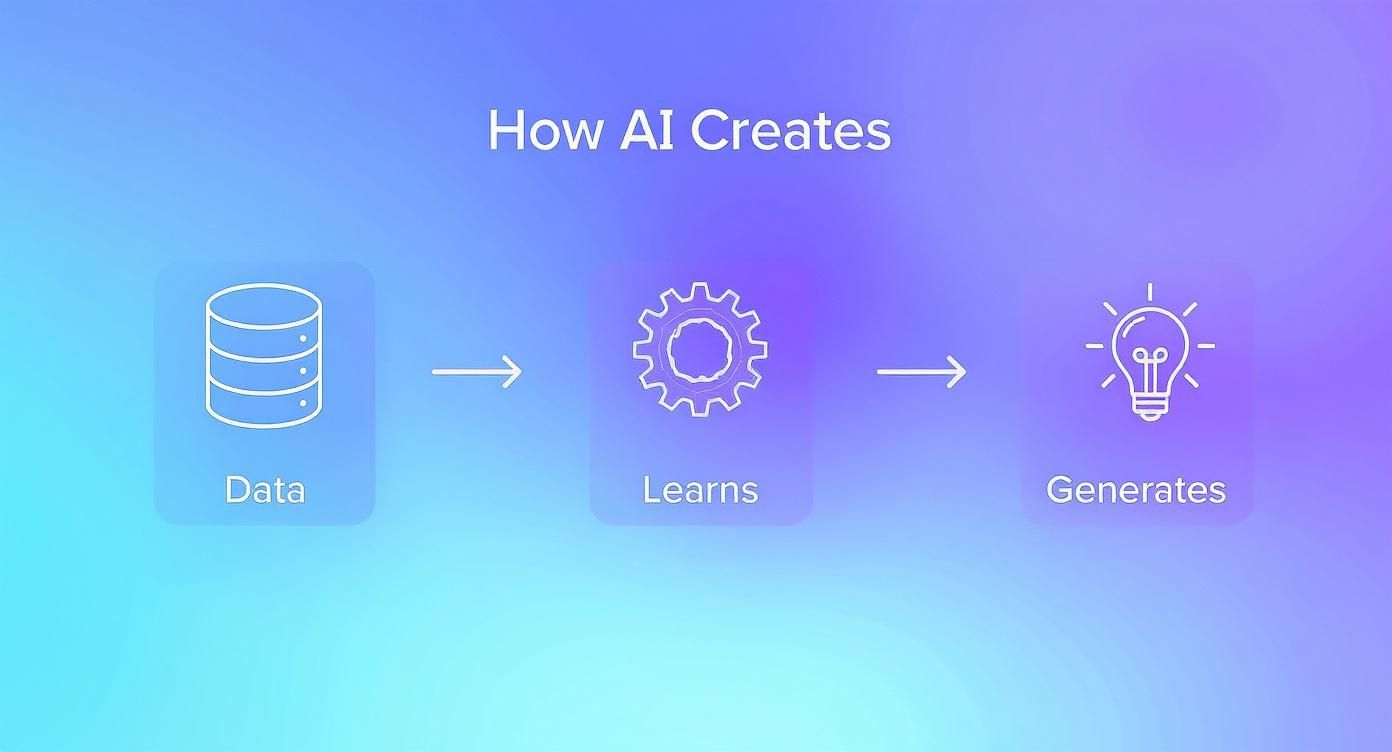
As you can see, it all starts with a learning phase. The AI has to digest and understand patterns from huge amounts of information before it can even begin to generate its own content.
A Game-Changer for Creatives and Coders Alike
The impact goes way beyond just marketing. In software development, AI has become a sort of digital co-pilot. Developers are using tools like GitHub Copilot to help them write, fix, and even document code much faster. It doesn't just accelerate project timelines; it also helps coders pick up new programming languages and better techniques as they go.
Independent artists are also seeing a massive shift. A graphic novelist, for instance, can now use an image generator to dream up entire worlds, sketch out character designs, and fill in detailed backgrounds. A project that might have been too expensive or time-consuming is suddenly within reach. We're even seeing amazing applications like AI for music creation, where musicians can compose original scores for videos or podcasts without booking a professional studio.
Generative AI is quickly becoming a must-have tool for both creativity and productivity. It's like having a collaborator that does the heavy lifting, allowing humans to focus on the creative direction.
This partnership between human and machine is popping up everywhere. Here are a few more concrete examples of how it's being used:
- Legal Professionals: AI can now draft the first version of a legal contract or summarize a mountain of case documents, saving lawyers countless hours of tedious work.
- Customer Support: Instead of canned responses, AI can generate personalized and genuinely helpful answers to common questions, leading to faster service and happier customers.
- Educators: Teachers can create custom quizzes, lesson plans, and learning materials that are specifically designed for each student's needs.
Fueling a New Wave of Growth and Innovation
The rush to adopt these tools is more than just a trend—it's driving serious economic growth. The global market for generative AI has exploded, recently hitting a value of around $44.89 billion. That’s a staggering 54.7% jump from $29 billion just a few years back, and it's on track to blow past $66.62 billion by the end of next year.
This kind of money shows just how much value businesses are getting from generative AI. For them, it’s a smart investment in becoming more efficient and innovative. By letting AI handle the repetitive tasks, companies can free up their people to focus on things that require uniquely human skills like critical thinking, strategy, and emotional intelligence. To see how this tech is even shaking up the world of personal branding, check out our guide on creating AI influencers over at our https://createinfluencers.com/blog.
Ultimately, this isn't about replacing people. It's about giving them superpowers to achieve more than ever before.
Why Businesses Are Embracing AI Content
The surge in AI-generated content isn't just about jumping on the latest tech bandwagon. It's a calculated business move, one driven by very real and measurable benefits. Companies are getting past the initial buzz and are now seeing AI tools for what they are: a powerful way to work smarter.
At its core, the appeal is simple. AI helps solve some of the oldest problems in content creation—namely, speed, scale, and the sheer resources required to do it well. From nimble startups to massive corporations, AI is becoming a non-negotiable part of the content workflow, acting as a force multiplier that lets teams do more without just hiring more people.
Achieving a New Level of Efficiency
The first thing most teams notice is the huge jump in efficiency. AI is brilliant at handling the repetitive, time-sucking tasks that can really drag down a creative team.
Imagine an e-commerce business with thousands of products. Writing a unique, compelling description for every single one is a soul-crushing task. An AI, on the other hand, can generate solid first drafts for all of them in the time it takes to make a coffee, freeing up human writers to polish the copy and focus on bigger-picture brand messaging.
This automation goes well beyond product descriptions. AI can tackle:
- First Drafts: Quickly producing outlines and initial versions of blog posts, emails, and reports.
- Content Repurposing: Spinning a single webinar into a dozen social media posts, a follow-up blog, and an email newsletter.
- Summaries: Boiling down lengthy research papers or meeting notes into need-to-know bullet points.
By taking this kind of grunt work off their plates, businesses can let their most valuable asset—their people—focus on the strategic thinking and creativity that humans do best.
Scaling Content Production on Demand
The other massive win is scalability. Think about a marketing team that wants to run a personalized email campaign for 10,000 customers. Crafting a unique message for even a handful of segments is a logistical nightmare. With AI, that same team can generate thousands of personalized variations in minutes, tailoring the content to each person's interests and past behavior.
AI content tools simply remove the old limits on scale. A single marketer can now produce a volume of content that used to require an entire team, allowing businesses to connect with bigger audiences in a far more relevant way.
This ability to scale content instantly changes the game for growth. Whether you're creating location-specific landing pages or just trying to maintain a consistent flow of social media updates, AI ensures your content engine can keep up with your ambitions. Anyone looking to build a real online presence needs to understand how to use tools like those from CreateInfluencers to make this happen.
Boosting Creativity and Cutting Costs
Finally, AI is proving to be an incredible brainstorming partner. When a creative team feels stuck, an AI can offer a jolt of inspiration by suggesting fresh headlines, new angles for a campaign, or different ways to frame a topic. It’s less about replacement and more about a new kind of collaboration that pushes creative boundaries.
All of this ties directly back to the bottom line. By cutting down the hours spent on first drafts and repetitive tasks, AI significantly lowers the cost of creating content. Teams can produce more, higher-quality work on the same budget, delivering a clear and compelling return on investment.
This financial reality is what's really driving the rapid adoption. In the U.S. alone, private sector investment in AI has hit a staggering $109.1 billion. Globally, 78% of organizations now report using AI, a big jump from just 55% the year before. You can discover more about these AI investment trends in the Stanford HAI report.
The Risks and Ethical Gray Areas
AI-generated content is an incredible tool, opening up all sorts of new possibilities for creativity and efficiency. But let's be realistic—like any powerful technology, it comes with its own set of problems and thorny ethical questions. We need to tackle these issues head-on, not to scare people away from using AI, but to make sure we're all using it responsibly.
You’ve probably heard about AI "hallucinations," and it's one of the biggest gotchas. This is when an AI model states something completely wrong but with total confidence. It happens because AI is a master of prediction, not a keeper of facts; it's just guessing the next most likely word in a sentence. The result can be a statement that sounds perfectly reasonable but is entirely made up, which is why a human eye is non-negotiable for fact-checking, especially for important or technical topics.
The Quality vs. Quantity Dilemma
The speed of AI is both a blessing and a curse. On one hand, you can create tons of content quickly. On the other, we risk drowning the internet in a sea of generic, soulless articles and social media posts. If we all use the same AI tools with basic prompts, we're just going to get more of the same, making it even harder for truly original, thoughtful work to get noticed.
This brings up a bigger question about what we value in creative work. As AI gets scarily good at creating art, music, and stories, it forces us to think about what makes human creativity special. The best way forward isn't to see AI as a competitor but as a co-pilot. It can handle the grunt work, freeing up the human creator to focus on the vision, emotion, and critical thinking that machines just can't replicate.
The most effective approach is keeping a human-in-the-loop. This simply means a real person is always there to guide, fact-check, and refine what the AI produces. It’s the only way to guarantee the final product is both accurate and genuinely insightful.
Think of it as augmenting human talent, not automating it. This partnership is how we can use AI's power without losing the quality and integrity our audiences deserve.
The Messy World of Copyright
Here’s where things get really complicated: copyright and intellectual property. Our current laws were written long before anyone imagined a machine could paint a picture or write a poem. This has thrown a massive wrench into the system, sparking legal battles and boardroom debates that are far from settled.
A few of the biggest questions everyone is wrestling with are:
- Who's the owner? If an AI creates an image, does it belong to the person who wrote the prompt? The company that built the AI? Or does it go straight into the public domain since a human didn't technically "author" it?
- What about the training data? AI models learn by analyzing billions of examples from the internet, including copyrighted text and images. Is this a "fair use" of that material for training, or is it mass copyright infringement?
- Can AI work even be copyrighted? The U.S. Copyright Office has leaned toward "no," stating that work needs significant human authorship to qualify for protection. But the line defining "significant" is still incredibly fuzzy.
These aren't simple problems with easy answers. The law is playing catch-up, and it will be a while before we have clear rules. For now, it’s smart to be cautious, especially if you're using AI-generated content for your business. The best policy is transparency—letting your audience know when AI was involved helps build trust and can protect you from potential legal headaches later on. A strong ethical compass is your best guide to using AI-generated content both effectively and responsibly.
The Future of Human and AI Collaboration
As we look to the horizon, the whole conversation around AI-generated content is changing. We’re moving past the idea of AI as just another tool and into a future built on a genuine partnership between human creativity and machine intelligence. The next phase isn't about spitting out text or images in a vacuum; it's about creating a true collaborative dynamic.
The goal isn't to replace people. It's about augmentation. Think of AI as a creative co-pilot, the one that handles the grunt work—the tedious, time-consuming parts of creation—while humans steer the ship, guiding the high-level strategy, making the ethical calls, and adding that irreplaceable emotional touch. This kind of partnership is poised to unlock levels of innovation that neither of us, human or machine, could ever reach alone.
The Rise of Multimodal AI
One of the most exciting developments on the cusp of becoming mainstream is multimodal AI. In simple terms, these are systems that can process and create content across different formats all at once—think text, images, audio, and video woven together. Imagine describing a scene in a few sentences and watching an AI instantly build the visual for it, maybe even composing a fitting soundtrack to go along.
This integrated approach makes our interactions with technology feel so much more intuitive and, frankly, more powerful. For creators, it means the walls between different types of media start to crumble. A podcaster could generate an animated video to accompany their latest episode, or a novelist could produce custom illustrations for their story, all from a single, unified interface.
The future of AI content creation lies in its ability to become a proactive assistant, deeply embedded in the software we use daily. It will anticipate our needs, suggest ideas, and automate complex tasks before we even ask.
This evolution will make AI feel less like a destination you have to go to and more like an ever-present, helpful companion in your digital life, ready to jump in on any creative or analytical task.
A New Era of Partnership
This powerful synergy between human ingenuity and artificial intelligence is already opening new doors in just about every field you can think of. The money trail certainly points in this direction. The global AI market is expected to rocket from around $638 billion to an estimated $3.68 trillion in the next ten years. You can discover more insights into the AI market's explosive growth on Precedence Research. That kind of investment isn't just a trend; it signals a future where human-AI teams are the new normal.
So what does this partnership actually look like on the ground?
- In Science: Researchers can lean on AI to crunch massive datasets and even generate new hypotheses, dramatically speeding up discoveries in areas like medicine and climate science.
- In Business: Marketers will work alongside AI to build hyper-personalized campaigns, crafting messages that connect with individual customers on a much deeper, more authentic level.
- In Art: Artists are already using generative tools to explore visual concepts that would have been impossible to create by hand, pushing the very boundaries of creative expression.
Ultimately, to really get a handle on what is AI generated content, you have to see it not just as a piece of technology, but as a collaborative partner. By leaning into this relationship, we can expand our own capabilities and start solving problems in ways we're only just beginning to imagine.
Got Questions About AI Content? We've Got Answers.
As people start to wrap their heads around what AI generated content really is, a handful of questions pop up over and over again. Getting these sorted is key to using this technology well, so let's tackle some of the big ones.
Will Google Punish Me for Using AI-Generated Content?
This is probably the number one question on every marketer's mind, and the answer isn't a simple yes or no. Google has been pretty clear about their stance: they care about high-quality, helpful content, not how you made it. They have no interest in penalizing you just for using an AI tool.
What they will come down on is low-effort, spammy content designed purely to game the system. So, the lesson here is simple. Focus on making great stuff that people actually want to read. If you use AI to help you create genuinely useful articles, you're playing by Google's rules.
Is AI Content Just Plagiarism in Disguise?
Nope, using an AI tool isn't the same as plagiarizing. Plagiarism is when you knowingly steal someone else's work and pass it off as your own. That's not what modern AI models do.
These systems, especially Large Language Models (LLMs), don't just copy and paste from their training data. They work by predicting the next most logical word in a sequence, creating entirely new sentences based on the patterns they’ve learned. The result is a fresh combination of words, not a rip-off. Still, it never hurts to run your final draft through a plagiarism checker for peace of mind.
What Are the Best AI Tools for a Beginner?
The AI tool market has exploded, so there's something out there for everyone. If you're just dipping your toes in, you can't go wrong with all-purpose writers like ChatGPT or Google Gemini. Their free versions are incredibly powerful and perfect for general writing and brainstorming.
Once you know what you need, you can look into more specialized tools:
- Jasper: A fan favorite for cranking out marketing copy and blog posts.
- Copy.ai: Excellent for short-form content like social media updates and ad headlines.
- Midjourney: A go-to for anyone wanting to create stunning, high-quality AI images.
How Do I Make Sure My AI Content Is Actually Good?
The real trick to producing top-notch AI content is to remember that the AI is your assistant, not your replacement. You always need a human involved in the process.
Think of the AI as your brainstorming partner or the tool that gets you past a blank page. It can generate the first 70-80%, but a human editor needs to come in and add the finishing touches. That means fact-checking, weaving in unique perspectives, and making sure it sounds like you or your brand.
This human-AI collaboration is fundamental to what we teach creators. If you're interested in turning this skill into income, check out our AI influencer affiliate program. By combining the efficiency of AI with your own unique creativity, you can produce content that really connects with people.
Ready to create your own unique AI personas and visuals? With CreateInfluencers, you can generate fully customizable AI characters, images, and videos in just minutes. Sign up for free and start creating today at createinfluencers.com.