Finding the Best AI Image Generators
Discover the best AI image generators for your creative needs. We compare Midjourney, DALL-E 3, and more on quality, features, and use cases.
Figuring out which AI image generator is "best" really comes down to what you're trying to accomplish. If you're chasing top-tier artistic quality and want to tap into a vibrant community for inspiration, Midjourney is hard to beat. For sheer ease of use and an incredible ability to understand exactly what you're asking for, DALL-E 3 (baked into tools like ChatGPT) is a fantastic starting point. And for those who want to get under the hood and have maximum control, the open-source power of Stable Diffusion is still the go-to for technical users.
Navigating the World of AI Image Generation
The world of AI-driven creativity is moving incredibly fast, and it can be tough to know which tool is the right one for the job. This guide is here to help you cut through the hype and find the generator that fits your specific needs. Forget about finding a single "winner"—the best choice changes depending on your goals.
Ultimately, your decision comes down to what you want to make. Are you a marketer who needs photorealistic product shots that align perfectly with your brand? Or maybe a digital artist looking to push boundaries with unique styles? Perhaps you're just curious and want a simple platform to play around with. Each of these paths leads to a different tool.
This massive interest is fueling some serious market growth. The global AI image generator market was valued at USD 9.10 billion in 2024 and is expected to rocket to USD 63.29 billion by 2030. That's a compound annual growth rate (CAGR) of 38.16%, which shows just how essential these tools are becoming across so many industries. You can dive deeper into these market growth projections from MarkNtel Advisors.
Key Differences at a Glance
To get started, it helps to see the big players side-by-side. Each one offers a different blend of user-friendliness, artistic style, and technical depth.
| Feature | Midjourney | DALL-E 3 | Stable Diffusion |
|---|---|---|---|
| Primary Strength | Artistic & Stylized Output | Ease of Use & Integration | Customization & Control |
| User Interface | Web App & Discord | Conversational (ChatGPT) | Varies (Requires Apps) |
| Ideal User | Artists, Designers | Beginners, Marketers | Developers, Enthusiasts |
This guide will give you the practical insights you need to look past the surface-level features. The goal is to help you make a smart choice that truly matches your creative vision and professional goals.
How AI Image Generators Actually Work
If you want to find the right AI image generator, it helps to peek behind the curtain and see how the magic actually happens. These tools aren't just grabbing photos from a library; they're creating brand-new visuals by understanding your text prompts. Think of it like a digital artist who’s studied millions of images to learn what a "dog," a "cyberpunk city," or "the style of van Gogh" really means.
The whole process kicks off with a sophisticated algorithm, usually what's called a diffusion model. Picture a crystal-clear photograph. Now, imagine slowly adding digital static or "noise" until it's completely obscured. A diffusion model learns to do the exact opposite: it starts with a canvas of random noise and refines it, step by step, until it becomes a coherent image that matches your prompt.
The Different Engines of Creation
While diffusion is the go-to method for most modern generators, the specific tech can vary. These tools run on advanced deep-learning neural networks like Generative Adversarial Networks (GANs), diffusion models, and transformer-based architectures. They’ve become workhorses in digital art, advertising, and entertainment, as detailed in these industry insights from Metatech.
An older, but still foundational, technology is the Generative Adversarial Network (GAN). The easiest way to think of a GAN is as a duel between two AIs.
- The Generator: This AI is the artist, trying its best to create a realistic image.
- The Discriminator: This one is the critic, meticulously checking if the image is real or AI-generated.
This diagram shows how they work in a constant feedback loop, with the generator learning from its mistakes to get better at fooling the critic.
After thousands and thousands of rounds, the generator gets remarkably good at producing convincing images.
Key Takeaway: The technology powering an AI generator directly shapes its output. Diffusion models are often fantastic for photorealism and fine detail, whereas other architectures might give you more stylized or abstract results.
Knowing the basics helps you understand why some platforms are better at certain styles than others. It’s not just the interface—it’s the "brain" bringing your ideas to life. This context is essential when you're weighing your options. For more deep dives, check out our other guides to AI tools. Having this knowledge helps you look past the marketing and pick a tool whose core technology truly fits what you want to create.
A Head-to-Head Comparison of Leading AI Generators
Choosing the right AI image generator isn't about finding the single "best" one—it's about finding the right tool for the job. It's like picking a paintbrush; the best one depends entirely on the masterpiece you envision. While the field is crowded, the real heavy-hitters are Midjourney, DALL-E 3, and Stable Diffusion.
Each of these platforms brings something unique to the table. They all have their own blend of artistic flair, user-friendliness, and technical power, which means they cater to very different creative needs. Let's dig into what really sets them apart: the quality of their images, how well they understand what you ask for, and where they genuinely shine in the real world.
Midjourney: The Artistic Virtuoso
If you’re after pure aesthetic quality and style, Midjourney is king. It has carved out a reputation for producing images that aren't just technically sound, but are genuinely beautiful and artistically compelling. There's a certain polished, almost cinematic quality to its outputs that many now recognize as the "Midjourney style."
It's the tool I turn to for highly detailed and imaginative visuals, whether that's a hyperrealistic portrait or a sprawling fantasy landscape. Midjourney, which started on Discord but now has a great web app, has also built a massive community where creators share prompts and get inspired.
Midjourney’s true magic is its opinionated artistic eye. It doesn't just execute your prompt; it interprets it, often delivering something far more stunning and coherent than you might have imagined yourself.
DALL-E 3: The Intuitive Communicator
DALL-E 3, especially inside tools like ChatGPT, is all about understanding you. Its biggest strength is prompt adherence. Where other generators might get confused by a complex request, DALL-E 3 nails the specifics. If you ask for a "red cube on top of a blue sphere next to a green pyramid," it's the most likely to get it right on the first try.
This makes it perfect for beginners, marketers, or anyone who needs to create precise visual content without a major learning curve. The conversational workflow in ChatGPT is a game-changer; you can ask for an image and then tweak it with simple follow-up requests. It’s incredibly user-friendly.
This chart gives you a quick, data-driven look at how these tools stack up on practical metrics like generation time, cost, and final resolution.
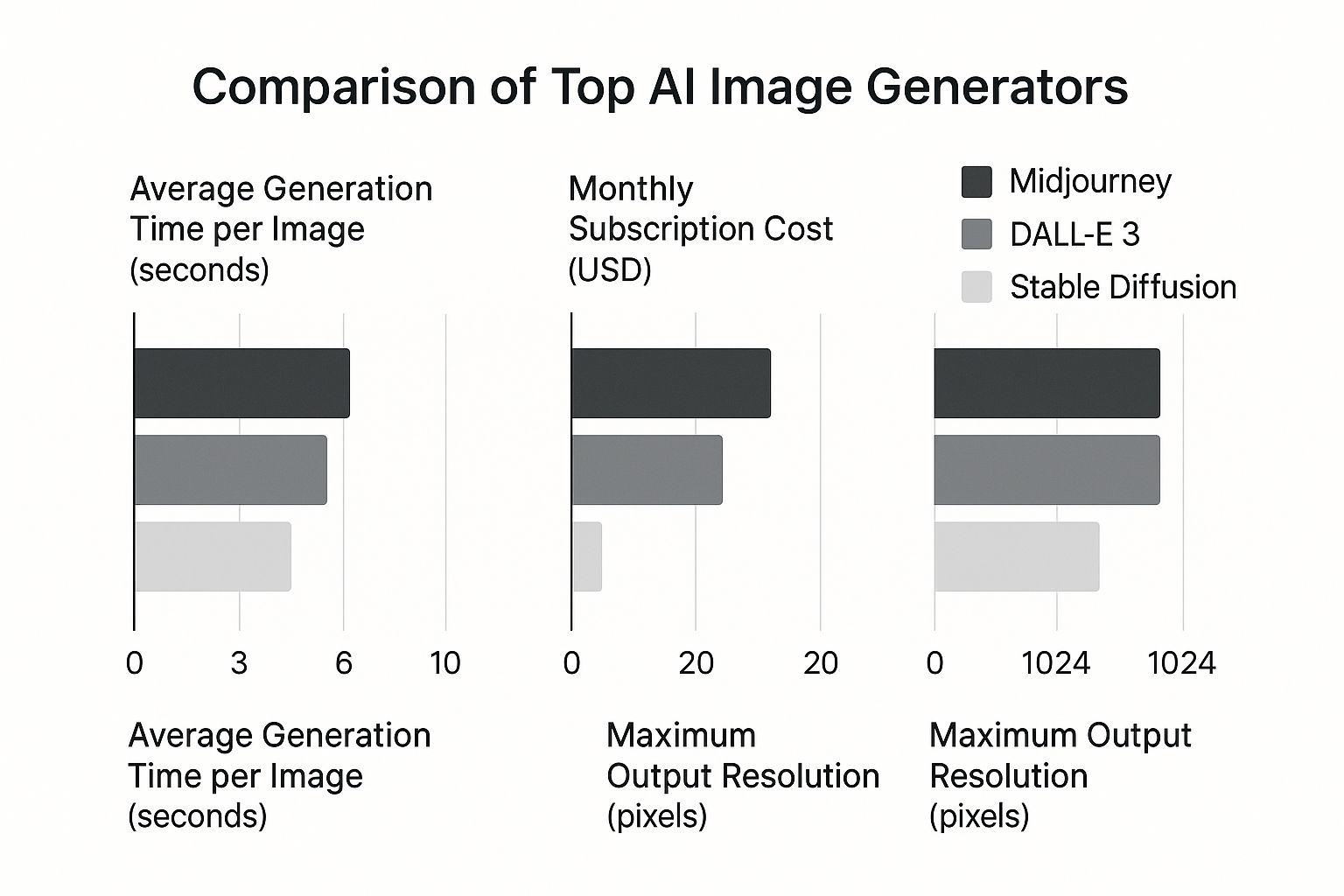
As you can see, there's a clear trade-off. Some tools are built for speed, while others focus on delivering higher-resolution images—a critical detail for any professional project.
Stable Diffusion: The Open-Source Powerhouse
For the tinkerers, developers, and creators who need total control, there's Stable Diffusion. It’s an open-source model, which means you can run it on your own computer and customize it to your heart's content. You can train it with your own images, fine-tune it for a specific art style, and plug it into custom workflows without any platform restrictions.
Of course, that freedom comes at a price: a much steeper technical learning curve. Forget the polished interfaces of its competitors. To get the most out of Stable Diffusion, you’ll likely be using third-party apps like Automatic1111 or ComfyUI. But for those willing to put in the time, the creative ceiling is practically nonexistent. It’s the undisputed champion for creating consistent characters (using LoRAs) or perfectly replicating niche artistic styles.
Stable Diffusion’s open-source DNA is what sets it apart. It offers infinite customizability, letting you build highly specialized models for your exact needs, completely free from the creative guardrails of a closed platform.
Comparing the Top AI Image Generation Tools
To make sense of it all, it helps to see these tools side-by-side. Each one excels in different areas, and knowing their strengths will help you pick the right one for your next project.
Here's a breakdown of how they compare on the most important factors.
| Tool | Output Quality & Realism | Artistic Style Versatility | Ease of Use | Pricing Model | Best For |
|---|---|---|---|---|---|
| Midjourney | Highest for artistic quality; very polished and coherent. | Excellent, but often has a recognizable "Midjourney" aesthetic. | Moderate; requires Discord or a dedicated web app. | Subscription | Digital artists, designers, and concept creators. |
| DALL-E 3 | Very high realism and good quality; excels at prompt accuracy. | Broad range of styles, from photorealistic to cartoon. | Very Easy; conversational interface via ChatGPT. | Subscription (ChatGPT Plus) | Beginners, marketers, and rapid prototyping. |
| Stable Diffusion | Varies widely based on model and user skill; can be exceptional. | Limitless; can be fine-tuned for any conceivable style. | Difficult; requires technical setup and knowledge. | Free (if run locally) | Developers, tech-savvy artists, and custom projects. |
Ultimately, the best AI image generator is the one that aligns with your goals. Whether you value pure artistic expression, dead-simple usability, or deep technical control, there’s a tool out there ready to bring your vision to life.
For more deep dives and hands-on comparisons, check out more articles on the CreateInfluencers blog.
When a Specialized AI Image Tool is the Smarter Choice
General-purpose generators like Midjourney and DALL-E 3 are undeniably impressive creative sandboxes. They’re fantastic for exploration and can produce jaw-dropping, one-off visuals. But they often act like a jack-of-all-trades, master of none. When your project demands precision and consistency—especially for commercial work—a specialized tool is almost always the better bet.
Think about it. If you need a dozen images of the same character for a marketing campaign, a general model will likely spit out a different face every single time. That lack of control can completely derail a project, eating up your time and budget. Consistency is king in branding, and that’s where the all-purpose tools stumble.
Solving Real-World Commercial Problems
This is precisely where specialized platforms come in. They’re built to solve the exact problems that creative professionals and marketers face daily. They go beyond basic text-to-image prompts to offer features designed for practical, commercial applications.
Here are a few common business needs where a general-purpose generator just doesn't cut it:
- Consistent Characters: You need to create a virtual influencer or brand mascot with the same face, hair, and style across countless images and scenarios. A general tool makes this a nightmare of prompt engineering.
- On-Brand Aesthetics: Your visuals must stick to a strict style guide, with specific color palettes, lighting, and moods. Leaving this up to the randomness of a general AI is a recipe for disaster.
- Professional-Grade Quality: You need images ready for high-stakes use, like social media ads or website banners, without losing quality or looking unprofessional.
Platforms like CreateInfluencers were engineered from the ground up to solve these issues. Features like one-click character creation and themed photo packs let you generate an entire suite of on-brand assets in minutes. It turns the AI from a fun toy into a reliable production tool.
For marketing teams, the question isn't just about image quality. It's about workflow efficiency and protecting brand integrity. A specialized generator gives you the guardrails to scale content production without sacrificing the consistency your brand depends on.
How to Choose the Right Tool for the Job
So, how do you decide? It really comes down to your primary goal. If you're just exploring artistic ideas or need a single, unique image for a blog post, a powerhouse like Midjourney is a great choice.
However, if you're producing structured, repeatable, and brand-focused content, a specialized generator gives you a massive advantage. These tools offer a predictable and controlled environment, which is absolutely critical for achieving business goals. By focusing on specific use cases, they deliver a refined solution that general models just can't match.
And if you’re looking to monetize your AI-generated content, you can even explore options to join an affiliate program and earn revenue. The best AI tools for professional use are the ones that fit right into a commercial workflow, giving you reliability when it counts.
AI Image Generation in the Real World
https://www.youtube.com/embed/Y1SIY0TnXII
So, beyond all the hype and cool tech demos, how are people actually using these AI image generators on a daily basis? Their real power shines when they start solving practical problems—saving money, speeding up projects, and opening up creative doors that used to be completely out of reach. These aren't just toys for artists anymore; they're becoming indispensable tools in marketing meetings, design studios, and boardrooms.
Let's take a real-world scenario. Imagine a small marketing agency lands a new skincare client. They need a whole campaign's worth of diverse, high-quality lifestyle photos, but they're working with a tight budget and an even tighter deadline. A traditional photoshoot would eat up thousands of dollars and take weeks to plan.
Instead, they fire up a tool like CreateInfluencers. In just one afternoon, they can generate a series of unique AI models that perfectly fit the brand's ideal customer profile. They can create dozens of on-brand images showing their new AI influencer using the product everywhere—from a bright, sunny café to a minimalist bathroom or a serene yoga studio. Just like that, they've got a full campaign's worth of content for a tiny fraction of the usual cost and time.
Speeding Up Workflows Across Industries
But it’s not just about marketing. Game developers are using AI to brainstorm concept art for characters, weapons, and entire worlds, which drastically cuts down on pre-production time. A designer who once spent days sketching a single character can now whip up ten different versions in less than an hour, letting the team see and refine their ideas almost instantly.
The same thing is happening in architecture and real estate. Professionals are using AI to create photorealistic visualizations of their projects. They can generate images of a new building from any angle, at any time of day, and even test out different interior design concepts. This gives them a powerful way to present their vision to clients and investors without sinking tons of time and money into complex 3D rendering.
What we're seeing is a fundamental change in how creative work gets done. AI image generation isn't here to replace human artists or designers. It’s here to supercharge their creativity, giving them a powerful tool for quick brainstorming, visualization, and creating content at a scale that was never possible before.
The demand for this kind of technology is exploding. In 2022, North America was the biggest player, holding 39.99% of the global AI image generator market. This boom is a direct result of the growing need for top-tier digital content in everything from advertising and architecture to healthcare, where AI even helps visualize medical scans. If you want to dive deeper into the numbers, you can check out the market dynamics at Fortune Business Insights. It all points to one thing: these tools are quickly becoming a core part of how modern professionals get their work done.
Making Your Final Decision
So, how do you actually pick the right AI image generator? The truth is, the "best" one really just comes down to what you're trying to accomplish. With so many powerful tools out there, the right choice is the one that slots perfectly into your workflow, budget, and creative vision. To cut through the noise, you just need to ask yourself a few pointed questions.
First off, what's your main goal? Are you an artist chasing that perfect, stylized aesthetic? If you're looking for unique, cinematic visuals, a tool like Midjourney is probably your best bet. Its knack for turning prompts into art is really unmatched for purely creative work.
But what if you're trying to create a steady stream of on-brand content for your marketing channels? That's a completely different ballgame. The real challenge isn't just making one cool image; it's producing a whole set of them that look like they belong together and keep your characters looking consistent.
Tailoring Your Choice to Your Workflow
Next, think about your own technical skills and how much control you really want. Are you looking for something that just gets it? Something where you can type in plain English and get exactly what you asked for without a ton of tweaking? DALL-E 3's connection with ChatGPT makes it a fantastic option for beginners or anyone who just needs accurate images fast.
On the flip side, maybe you're a developer or a creator who loves to get under the hood and tinker. If you want to push the limits and build something custom, the open-source world of Stable Diffusion is your playground. It takes more know-how, for sure, but the control you get is nearly endless.
The "best" AI image generator isn't a title held by one platform, but a description of the tool that most effectively closes the gap between your idea and the final image. Your goal dictates the best tool for the job.
When it comes to commercial work, consistency is everything. If you're creating a brand mascot or a virtual influencer who needs to look identical in every single post, the general-purpose tools often start to show their cracks. This is where specialized platforms become a smart investment.
- For artistic exploration: You'll want a tool that lives and breathes style and aesthetics.
- For precise marketing assets: Go with a generator known for following your prompts to the letter.
- For brand campaigns: A specialized tool that locks in character consistency is non-negotiable.
When you line up what you need with what each tool does best, you can pick a platform with confidence. You’ll end up saving a ton of time and money by getting it right from the start.
For marketers and creators who need consistent, high-quality, on-brand visuals without the hassle, CreateInfluencers is the definitive solution. Generate unique AI influencers, create entire themed photoshoots in minutes, and maintain perfect character consistency across all your campaigns. Start creating for free today at https://createinfluencers.com.