How to Create Brand Identity for Your Influencer Brand
Learn how to create brand identity with our guide for influencers. We cover purpose, audience, voice, visuals, and using AI tools to build a standout brand.
Building a standout brand identity isn't just about pretty graphics and a catchy name. It’s a process that breaks down into a few key stages: getting clear on your purpose, figuring out who you're talking to, nailing your voice, and then, finally, designing the visuals.
The real secret? You have to build that strategic foundation before you even dream of designing a logo. This ensures every single choice you make is intentional, authentic, and actually works.
Defining Your Brand's Foundational Purpose
Before you pick a single color or font, you’ve got to get to the heart of your "why." This isn't about slapping a generic mission statement on your website's "About" page. It's about digging deep to find the one thing that truly sets you apart in a ridiculously crowded creator space.
This foundational work is your strategic compass. It guides every post, every video, and every interaction, making sure your brand has real substance. Without it, your brand is just a collection of nice-looking visuals with no soul—the difference between an influencer who's forgotten tomorrow and one who builds a fiercely loyal community.
Find Your Mission
Your mission is your brand’s entire reason for being, all boiled down into one powerful statement. It's your North Star, the thing that keeps you from getting lost. To nail it down, you have to ask yourself some tough questions:
- Beyond the money, what impact do I actually want to have?
- What change do I want to see in my followers?
- If my brand could accomplish only one thing, what would it be?
A fitness influencer’s mission might be "To make fitness accessible and joyful for busy professionals." A gaming creator’s could be "To build an inclusive community where everyone feels welcome to play." This isn't just a tagline—it's the internal filter for every single decision you make.
Uncover Your Core Values
Your values are the non-negotiable principles that shape how your brand acts. They're the personality traits that your ideal audience will be drawn to. Try to land on three to five words that define what you stand for.
Are you all about:
- Authenticity? If so, your content will lean into unfiltered, behind-the-scenes moments.
- Creativity? Then your visuals and storytelling need to be unconventional and artistic.
- Empowerment? This means your content should focus on giving your audience tools and confidence.
These aren't just abstract ideas. They directly inform your content strategy and are your shortcut to forging a much deeper connection with your audience. As you work through this, these essential small business branding tips can offer some great broader guidance on building a brand that truly connects.
A brand with clear values doesn't have to chase trends. It creates its own path because its followers aren't just there for the content—they're there for what the brand represents.
Solve a Specific Problem
Every single successful creator brand solves a problem for its audience, even if that problem is simply curing boredom. When you identify this problem clearly, you give your content a purpose and make your brand feel indispensable.
What pain point are you actually addressing? Are you helping people learn a new skill, making them feel less alone, or helping them discover new products they can trust? By clearly articulating the problem, you immediately position your brand as the solution.
This simple chart shows how it all flows together, from your mission to solving a real problem.
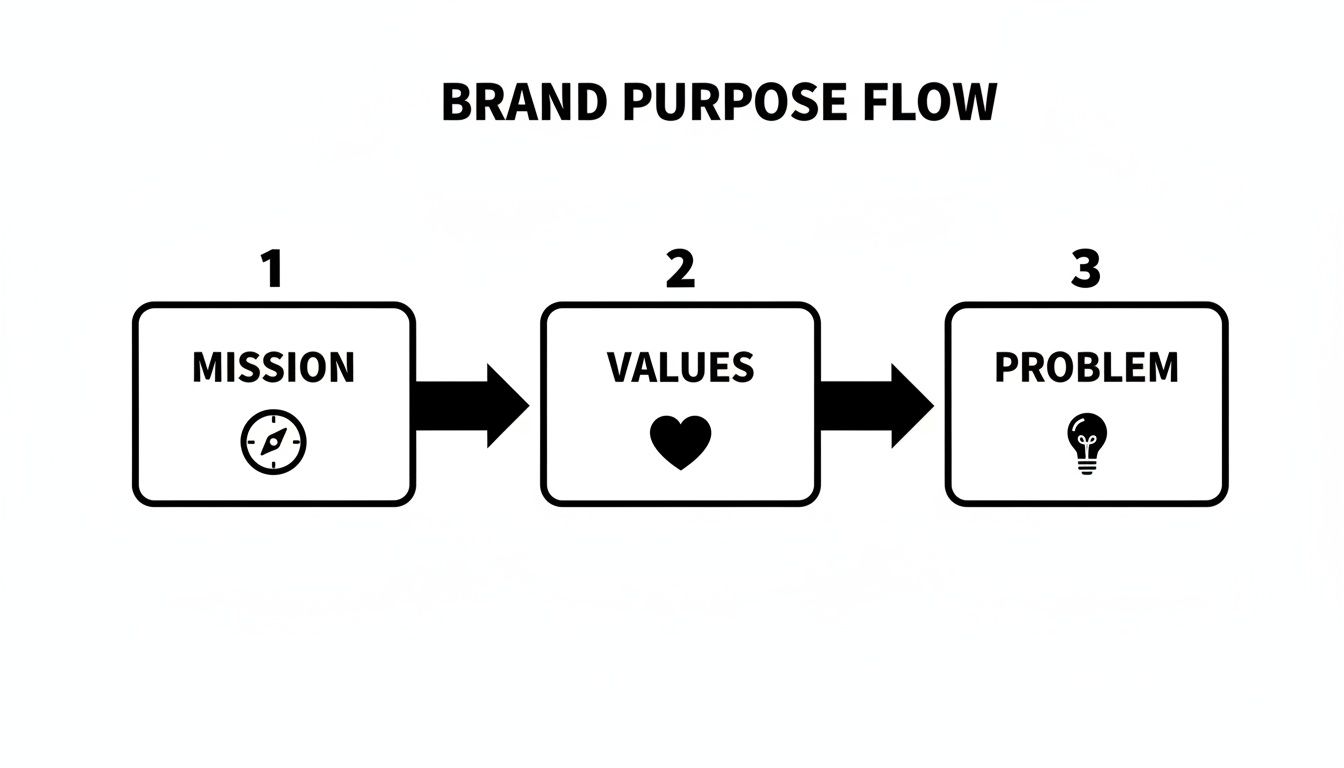
You can see how your internal mission and values directly lead to solving an external problem for your audience. For any creator looking to build an online presence, this is easily the most critical work you'll do.
Pinpointing Your Ideal Audience
A powerful brand doesn't try to be for everyone. It's for someone. After you’ve nailed down your purpose, the very next move is to get an incredibly clear picture of who you're creating for. This isn't just about surface-level details; it’s about building a complete profile of your ideal follower.
This is the secret sauce. When you know exactly who you're talking to, every piece of content you create—every caption, every video, every story—feels less like a broadcast and more like a real conversation.

Go Beyond Basic Demographics
Sure, things like age, gender, and location are a starting point. But they don't tell you what makes someone tick. The real breakthroughs happen when you dig into their psychographics—their values, their hobbies, what they worry about at 3 a.m., and what they're passionate about.
Don't just settle for "millennial women." Get specific. Your ideal follower isn't just a demographic; she's a 28-year-old graphic designer living in a big city, obsessed with sustainable fashion, who uses yoga to de-stress and secretly dreams of launching her own Etsy shop. See the difference? That level of detail changes everything.
To get there, you have to ask better questions:
- What are their biggest, most annoying daily frustrations?
- What do they secretly hope to achieve in the next year?
- Where do they actually spend their time online? Are they scrolling Instagram for inspiration but asking for advice on Reddit?
- What type of content genuinely makes them stop their scroll? Funny memes? In-depth tutorials? A raw, honest story?
Conduct Actionable Research
You don't need a huge budget for this. The clues are usually hiding in plain sight.
Start with the audience you already have. Who’s liking, commenting, and saving your posts? Click on their profiles. Look for patterns in their bios, their interests, and the other accounts they follow.
Then, become a digital anthropologist. Lurk in the online spaces where your ideal audience hangs out. Join the same Facebook groups, browse the relevant subreddits, and read the comment sections on your competitors' posts. You’ll find unfiltered insights into their language, their pain points, and what they're desperate for help with.
When you truly get your audience's challenges and dreams, you stop just making content for them and start creating content with them in mind. That subtle shift is what separates a good creator from an unforgettable one.
Build Your Audience Persona
Now, pull all that research together into a single, easy-to-reference document: your Audience Persona. This is a semi-fictional character who represents your perfect follower. Give them a name, a photo (a stock image works fine), and a quick bio that covers their goals and frustrations.
Let's say you're a finance influencer. Your persona might be "Alex, the Ambitious Saver."
- Who is Alex? A 25-year-old software developer. He's making good money but feels completely overwhelmed by student loan debt and the pressure to start investing.
- His Goals: He wants to pay off his loans in five years, figure out retirement investing, and save for a down payment without giving up his social life.
- His Frustrations: He finds traditional financial advice stuffy and full of jargon he doesn't understand. He's terrified of making a big, costly mistake.
This persona is now your north star. Before you hit "publish" on anything, ask yourself a simple question: "Would Alex find this valuable? Would this speak to him?"
This check keeps you honest and ensures every single thing you create is perfectly tuned to attract the right people. As you get more specific, you can apply these insights to master different platforms. For example, learning how to grow your Instagram organically becomes much easier when you know exactly who you're trying to reach.
Crafting A Memorable Brand Voice And Persona
Alright, you’ve nailed down your "why" and you know exactly who you're talking to. Now for the fun part: deciding how your brand actually sounds.
This is your brand voice—that distinct personality that shines through in your captions, your videos, and every single comment you post. It's the secret sauce that makes your content instantly recognizable, even if your logo isn't in sight.
A powerful voice isn't just about the words you choose; it's the feeling behind them. It's the difference between sounding like a trusted friend and coming across like a corporate brochure. Getting this right is how you start building real, lasting connections.
Defining Your Brand Voice Dimensions
Think of your brand voice like a sound mixing board. You don't just pick one setting like "friendly" and call it a day. Instead, you get to slide different faders up and down to create a communication style that's uniquely yours.
Let's start by looking at a few of these spectrums:
- Funny vs. Serious: Are you all about cracking jokes, sharing memes, and finding the humor in things? Or do you approach your topics with a more straightforward, authoritative tone?
- Casual vs. Formal: Is your vibe more "hey, what's up?" with slang and emojis, or do you prefer to keep it professional with well-structured sentences and polished language?
- Irreverent vs. Respectful: Do you love to challenge the status quo with a bit of a rebellious, edgy attitude? Or is your style more diplomatic, polite, and aimed at finding common ground?
- Enthusiastic vs. Matter-of-fact: Are you the high-energy type, using exclamation points and a ton of passion? Or do you present information in a calm, direct, and no-fluff way?
By figuring out where you land on each of these, you build a much richer voice profile. For example, your brand could be mostly casual and funny, but you might switch to a more serious tone when talking about important issues. This creates a voice that feels authentic and human—not one-dimensional.
A consistent brand voice isn't just a "nice-to-have." It can actually increase revenue by over 20%. It builds a deep sense of trust and makes your brand feel dependable, and when your audience knows what to expect, they're far more likely to stick around.
Translating Voice Into A Compelling Persona
If your brand voice is the how, your persona is the who. The persona is the character—whether that's you or a creation—that brings your voice, values, and purpose to life.
For most creators, this persona is just an amplified, more focused version of their true self. For others, especially those venturing into AI-generated content, it's a character built from the ground up.
Either way, the goal is the same: make the persona consistent and relatable. A solid persona has a backstory, opinions, quirks, and a unique way of looking at the world. If you're building a character from scratch, you can even explore using an online persona creator to help flesh out the details and bring them to life.
To get the wheels turning, I've put together a simple worksheet. It's designed to help you think through the specific attributes that will define your brand's unique communication style and personality.
Brand Voice & Persona Development Worksheet
| Attribute | Spectrum (e.g., Formal vs. Casual) | Your Brand's Position | Examples in Action |
|---|---|---|---|
| Humor | Witty vs. Goofy | Leans witty and sarcastic | Using clever wordplay in captions; responding to comments with dry humor. |
| Language | Simple vs. Technical | Simple and accessible | Breaking down complex topics using analogies; avoiding industry jargon. |
| Tone | Authoritative vs. Nurturing | Primarily nurturing and encouraging | Starting videos with "You've got this!"; framing advice as shared learning. |
| Pacing | Fast vs. Deliberate | Fast-paced and energetic | Using quick cuts in videos; writing short, punchy paragraphs and sentences. |
Working through a table like this forces you to move from vague ideas to concrete examples, which is where your brand voice really starts to take shape.
Bringing Your Persona To Life
Let's put this into practice. Imagine you're creating an AI fitness influencer named "Anya." After filling out the worksheet, you decide her brand voice is enthusiastic, casual, and matter-of-fact.
So, how does that actually look in her content?
- An Instagram Caption: "Leg day wrecked me, not gonna lie. 😅 But feeling that burn is how you know it's working! Grab your water, throw on your favorite playlist, and let’s get it done. No excuses today."
- A YouTube Video Intro: "Alright team, what's up! Today we're doing a 15-minute HIIT workout. It’s gonna be tough, it’s gonna be sweaty, but it's gonna be over before you know it. Let's go!"
- A Response to a Comment: "Totally normal to feel sore! Means you pushed yourself. Make sure you stretch and get some protein in. You killed it!"
See the pattern? The casual slang ("gonna lie," "what's up"), the energetic encouragement ("let's go!"), and the direct advice are always there. This consistency is what makes Anya feel like a real, trustworthy person, cementing her brand identity in the minds of her followers.
Designing a Visual Identity with AI Tools
Alright, you’ve done the foundational work. Now it's time for the fun part: bringing your brand to life visually. This is where your brand's purpose, personality, and audience knowledge all come together into something people can actually see, recognize, and connect with.
A powerful visual identity does more than just look pretty. It’s your silent ambassador, communicating your core message in an instant.
The best part? You no longer need a design degree or a massive budget to create a professional-grade look. AI tools have completely leveled the playing field, making it possible to generate stunning, on-brand visuals in a fraction of the time it used to take.

Harnessing the Psychology of Color and Typography
Before you fire up any AI generator, let’s talk about the two most fundamental building blocks of visual design: color and typography. These aren’t just aesthetic choices; they are packed with psychological meaning and are your secret weapons for setting a mood without saying a single word.
Think of your color palette as the emotional background music for your brand. Trying to build a sense of trust and calm? You'll want to lean into blues and greens. Looking to project high energy and excitement? Reds and oranges are your go-to.
- Warm Colors (Reds, Oranges, Yellows): These scream energy, happiness, and even urgency. They're perfect for brands that are bold, playful, and want to stop the scroll.
- Cool Colors (Blues, Greens, Purples): These shades often signal calm, trust, and professionalism. They work beautifully for brands in the wellness, tech, or finance spaces.
- Neutral Colors (Black, White, Gray, Brown): Simplicity, sophistication, and timelessness live here. Minimalist and luxury brands often build their entire identity around these.
In the same way, typography—the fonts you choose—is your brand’s voice made visible. A clean, modern sans-serif font like Helvetica feels direct and no-nonsense. A classic serif font like Garamond, on the other hand, can feel more traditional and authoritative. The trick is to pick fonts that feel like a natural extension of the brand persona you’ve already defined.
Creating a Versatile Logo and AI Avatars
Your logo and your primary brand image, like an AI avatar, are the face of your operation. They’ll be everywhere, so they need to be simple enough to be memorable and flexible enough to work on a tiny profile picture or a giant banner.
While you can brainstorm logos with AI, the real game-changer for modern creators is the AI avatar. Platforms like CreateInfluencers let you generate a consistent, incredibly lifelike avatar that becomes the central character of your brand. You’re no longer limited to a static logo; you have a dynamic, relatable personality you can place in any scenario imaginable. This is how to create a brand identity that forges a genuine, personal connection with an audience.
If you want to get into the nuts and bolts, we have a complete guide on how to make an AI avatar that truly feels like you.
The global branding industry is a behemoth, with advertising and marketing spend soaring past $1.65 trillion in 2023. That’s a 5% annual jump, showing just how vital a strong identity is in a saturated market. For creators, this isn't just a statistic; it's a massive opportunity to get noticed. You can dig into more of this data over at We Are Tenet.
Mastering AI Prompts for Themed Content
Here’s where AI’s true power for visual branding shines: producing huge volumes of themed content with uncanny consistency. This is where learning to write great prompts becomes your creative superpower.
Crafting detailed, descriptive prompts is the key. You're not just asking for a picture; you're directing a full-blown photoshoot. Instead of a vague prompt like "woman on a beach," you need to get specific.
Example Prompt for an 'Old Money' Aesthetic: "Photorealistic full-body shot of a sophisticated AI woman in her late 20s, exuding quiet luxury. She is wearing a cream-colored cashmere sweater, tailored white linen trousers, and classic leather loafers. Posed elegantly on a vintage wooden sailboat at sunset on Lake Como. Soft, golden hour lighting, cinematic quality, shot on a 50mm lens, capturing a timeless and aspirational mood."
See the difference? That level of detail leaves nothing to chance and ensures the AI delivers the exact vibe you're chasing.
Tools like CreateInfluencers push this even further by offering pre-themed packs designed for specific platforms and goals.
- Instagram Starter Pack: Instantly generate a perfectly cohesive nine-image grid to launch your profile with a polished, professional look right out of the gate.
- Tinder Profile Photos: Get a full set of engaging, high-quality photos that show off different sides of your AI persona’s personality.
- Boudoir Shoot: Create tasteful, artistic, and intimate images perfect for platforms like Fanvue or OnlyFans, all while keeping your character and aesthetic perfectly consistent.
By mastering prompts and using the right tools, you can build an entire visual universe around your brand. It’s this consistent visual language across every platform that builds recognition and turns casual followers into a loyal community.
Putting It All Together: Your Brand Kit and Content Templates
Alright, you've done the heavy lifting. You've pinpointed your purpose, nailed down your audience, and defined your unique voice and visual style. So, what's next? It's time to build the system that makes it all work day in and day out. This is where we create your brand kit and a set of plug-and-play content templates.
Think of it this way: consistency is the secret sauce that turns a passing interest into a loyal following. These tools are what will keep your brand cohesive, professional, and instantly recognizable, which can ultimately boost your revenue by up to 23%.
Building Your Essential Brand Kit
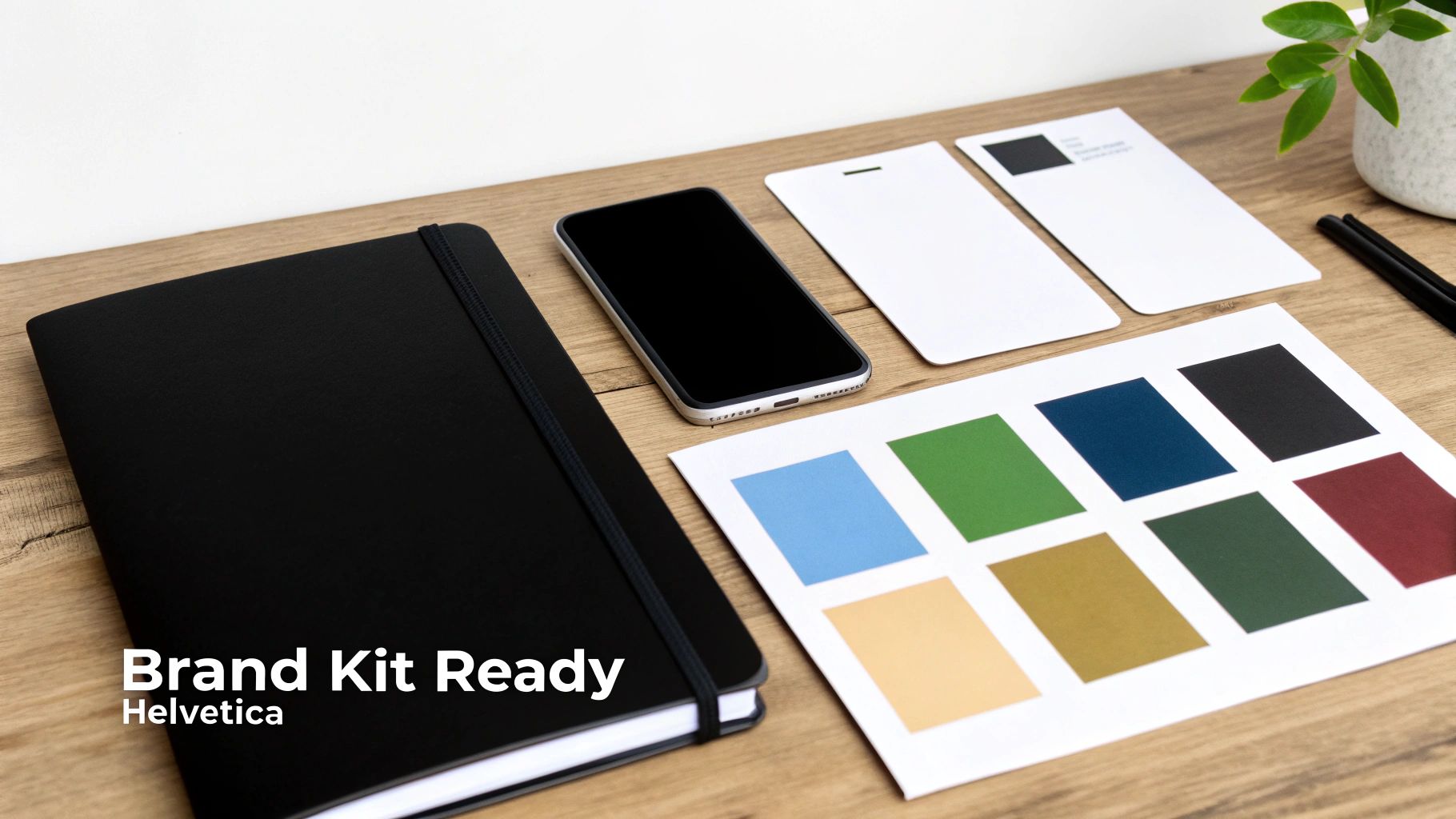
Your brand kit is your operational headquarters. It's a single, organized folder that holds every piece of your brand's DNA. Whether it's you posting on the fly, a new VA jumping in, or a brand collaborator, this kit ensures everyone creates content that looks and feels like you.
Here’s a simple checklist of what every creator needs in their brand kit:
- Logo Variations: Don't just save one file. Have your primary logo, a secondary version, and any icons ready to go. Make sure you have them in different formats (PNGs with transparent backgrounds are a must) and colors (full-color, all-black, and all-white versions).
- Color Palette: This is non-negotiable. List your primary, secondary, and accent colors with their specific codes—HEX for web, RGB for digital, and CMYK for any print needs. This guarantees your signature blue is the exact same shade on Instagram, your website, and a business card.
- Typography Files: Drop the actual font files (.OTF or .TTF) into the folder. Include clear instructions on which font is for headlines, which is for body text, and the specific weights and sizes to use.
- Imagery & AI Avatar Guide: This is your visual vibe check. Create a small gallery of approved photos, graphics, or your go-to AI avatar poses. Add a few notes describing the mood and style—is it bright and airy, dark and moody, clean and minimalist?
- Brand Voice Cheat Sheet: A simple one-pager can be a lifesaver. Summarize your brand's personality, list your core messaging themes, and provide a few quick examples of "say this, not that."
As you pull this together, remember to include comprehensive brand guidelines templates which formalize all these rules into a shareable document.
A well-organized brand kit isn't just about storage; it's about empowerment. It lets you delegate tasks without worry, onboard collaborators in minutes, and maintain the rock-solid consistency that builds real audience trust.
Speeding Up Your Workflow with Reusable Templates
Now that your brand kit is ready, let's put it to work. Creating templates is how you turn all those strategic decisions into a fast, efficient content machine. No more starting from a blank canvas every single day.
Templates are just pre-designed, on-brand layouts for your most frequent posts. You can build them in tools like Canva, Figma, or your favorite design software. The goal is to spend a little time now to save a ton of time later.
Focus on creating templates for your bread-and-butter content:
- Instagram Post Templates: Start with 3-5 core layouts. Maybe one for sharing quotes, another for new blog post announcements, and a third for showcasing a photo.
- Instagram Story Templates: Stories are all about engagement, so build templates for polls, Q&As, behind-the-scenes moments, and sharing other creators' posts.
- Video Thumbnail Templates: For YouTube or even Reels covers, a consistent thumbnail is gold. Your template should have a placeholder for a killer image (like your AI avatar), a spot for your headline in the right brand font, and use your brand colors.
Investing just a few hours here pays off massively. It eliminates decision fatigue and frees you up to focus on the part that actually matters—creating awesome content. To learn more about formalizing all these rules, check out our deep-dive on how to create branding guidelines for any project.
Your Top Questions About Brand Identity, Answered
Even with a solid plan, building a brand identity from the ground up can feel a little daunting. It’s a big deal! And naturally, questions are going to pop up along the way. I see the same concerns from creators time and time again, so let's tackle them head-on.
We’ll get into the practical stuff that can slow you down, from worrying you don't have the design chops to figuring out how to make an AI character feel genuinely real.
How Long Does It Take to Create a Strong Brand Identity?
This is the big one, but the honest answer is: it depends. Putting together a solid foundational brand identity can take anywhere from a few days to several weeks. The real variable isn't the design work; it's the depth of your initial thinking and research.
The strategic part—nailing down your purpose, truly understanding your audience, and crafting your unique voice—is where you should spend the most time. Rushing this is a recipe for a weak brand. The good news? The visual creation part has gotten incredibly fast. With AI tools, you can now shrink the design timeline from weeks to just a few hours.
A brand identity isn't a "one-and-done" project. It’s a living thing. Focus on getting the foundation right first, and know that you’ll iterate and refine it as your brand grows and changes.
That initial time investment pays off huge dividends later, giving you a clear direction that saves countless hours of second-guessing.
Can I Build a Brand Identity with No Design Experience?
Yes, absolutely. This is a huge fear that stops so many talented creators before they even get started. The truth is, modern tools are built for people just like you.
Here’s the secret: brand strategy comes before brand design.
Your most important job is to define your purpose, audience, and voice. That’s all about deep thinking and research, not a single ounce of design skill. Once you have that clarity, bringing it to life visually becomes much simpler.
Here's how you can do it:
- Lean on User-Friendly Platforms: Tools like Canva have made design accessible to everyone. Their templates are intuitive and a fantastic starting point for logos, social graphics, and more.
- Embrace AI-Powered Generation: This is the real game-changer. Advanced platforms like CreateInfluencers let you generate professional-quality photos and lifelike AI avatars with simple text prompts. This completely sidesteps the need for expensive photoshoots or complex design software.
You bring the strategy; the tools will help you execute the vision. Don't let a lack of formal training be your roadblock.
How Do I Ensure My AI-Generated Influencer Feels Authentic?
Making an AI influencer feel authentic isn’t about tricking people into thinking they're human. It's about consistency and depth. An AI persona can feel just as real and relatable as any fictional character if you build their world with intention.
First, give your character a detailed backstory. Where are they from? What are their passions, their little quirks, their core values? Treat this process like you're a novelist creating a main character—the more detailed their profile, the more authentic they’ll feel.
Next, be a stickler for your brand voice. Every single caption, comment, and DM has to sound like it’s coming from this specific character. This verbal consistency is what breathes life into the personality.
Finally, use AI to create visual variety. Show your avatar in different places, expressing a whole range of emotions, and doing different things. This visual diversity makes the character feel dynamic and three-dimensional, not like a static, one-note cardboard cutout. You're aiming to create a true brand character, not just a folder of random images.
What Is the Most Important Element of a Brand Identity?
While a slick logo or a gorgeous color palette is what people often notice first, the single most critical element of a powerful brand identity is consistency.
A brand’s strength is built through repetition. It’s the cohesive application of all its parts—purpose, voice, and visuals—across every single touchpoint. Think about it: a simple logo and a basic color scheme used consistently will build a much stronger, more recognizable brand than a brilliant logo and stunning visuals that are applied randomly.
Consistency is what builds the two most valuable assets a creator can have:
- Recognition: Your audience knows it’s you in a split second, without even seeing your name.
- Trust: When your message and appearance are reliable, your audience learns they can count on you.
Ultimately, consistency is the glue that holds everything together. It turns all your hard strategic work into a brand that people actually remember and connect with.
Ready to bring your unique visual identity to life without the design headaches? CreateInfluencers allows you to generate stunning, lifelike AI avatars and themed photo packs in minutes. Start creating for free today and build the face of your brand.