what is personal branding: unlock your career potential
Explore what is personal branding and why it matters for your career. Learn to build an authentic brand that opens doors.
So, what exactly is personal branding?
It’s the story people tell about you when you're not in the room. It’s the deliberate, thoughtful process of shaping the public's perception of who you are, what you stand for, and what makes you unique. Think of it as taking control of your own narrative—your skills, your values, and your unique point of view—so you can stand out from the crowd.
What Is a Personal Brand, Really?
Forget logos and taglines for a second. Your personal brand is your professional reputation in the modern world. It’s the sweet spot where your authentic self—your passions, knowledge, and personality—meets how others see you. The goal isn't to invent a character; it's to amplify who you already are.
Simply put, your brand is the promise of an experience.
When someone reads your content, watches your videos, or works with you, what can they count on? That consistency is what builds a powerful brand. It creates trust and cements your status as a go-to authority in your field.
This isn’t a new-fangled idea. The concept really took off after Tom Peters published his famous 1997 article, "The Brand Called You." He made a compelling case that we should all manage our reputations as carefully as big companies manage their brands. And he was right. In just the last few years, Google searches for "personal brand" have more than quadrupled, showing just how essential it's become.
Personal vs. Corporate Brands
While they both involve building a reputation, a personal brand and a corporate brand are two very different things. A corporate brand is built around a company—its mission, products, and a collective identity. A personal brand, on the other hand, is built entirely around you.
The key difference lies in the human element. A personal brand allows for a genuine, one-on-one connection that a big, faceless company often struggles to achieve. It’s more flexible, more authentic, and built on the foundation of an individual's unique story and voice.
Here’s a quick breakdown to make the distinction crystal clear.
Personal Brand vs. Corporate Brand at a Glance
| Attribute | Personal Brand (You) | Corporate Brand (A Company) |
|---|---|---|
| Foundation | Your personality, values, and expertise. | The company's mission, vision, and values. |
| Voice | Authentic, individual, and often informal. | Carefully crafted, consistent, and professional. |
| Flexibility | Highly adaptable; can evolve with your career. | Rigid; rebranding is a major, costly process. |
| Connection | Builds deep, personal trust with an audience. | Aims for customer loyalty and brand recognition. |
| Face | It's you—your face, your name, your story. | A logo, a team, or a spokesperson. |
Understanding this distinction is key because it puts the power back in your hands. Your unique story, your quirks, and your perspective are your most valuable assets. For creators, this is where specialized tools come into play. Platforms like CreateInfluencers are designed to help you build a distinct visual identity that perfectly captures your personal narrative, making your brand memorable and instantly recognizable.
At the end of the day, you already have a personal brand, whether you’ve been managing it or not. The real question is whether you're going to let it be defined by chance or shape it with intention.
Why Your Personal Brand Matters More Than Ever
Let's be honest: your first impression happens online long before you walk into a room. Because of this, a strong personal brand isn't just a nice perk anymore—it's a career essential. It’s no longer about a static resume; it’s about the full, living story of your professional journey that anyone can find with a quick search.
Think of your personal brand as your silent ambassador, working for you around the clock. It builds your credibility and opens doors you didn't even know were there.
So, when a potential employer or a new client Googles your name, what pops up? A well-defined brand ensures they find a professional, consistent story that highlights exactly what you bring to the table. It puts you in the driver's seat, allowing you to shape your own narrative instead of leaving it to a random jumble of search results.
Your Digital Handshake
These days, your online presence is your handshake. This is especially true on professional networking sites. Consider this: 98% of employers are looking you up online before they even think about an interview. What's more, 47% admit they're less likely to call someone in who has no online presence at all.
And when it comes to professional platforms, LinkedIn is king. A staggering 89% of B2B professionals use it, and users who take the time to complete their profiles are 40 times more likely to get hit up with job opportunities.
These numbers tell a pretty clear story. Your digital footprint has a direct and powerful impact on where your career is headed.
Your personal brand is the single most important investment you can make in your career. It’s your reputation, your legacy, and your gateway to opportunities you might not even know exist yet.
This whole idea has been gaining steam since it first emerged back in 1997. In fact, online searches for the term "personal brand" have quadrupled across the globe since then.
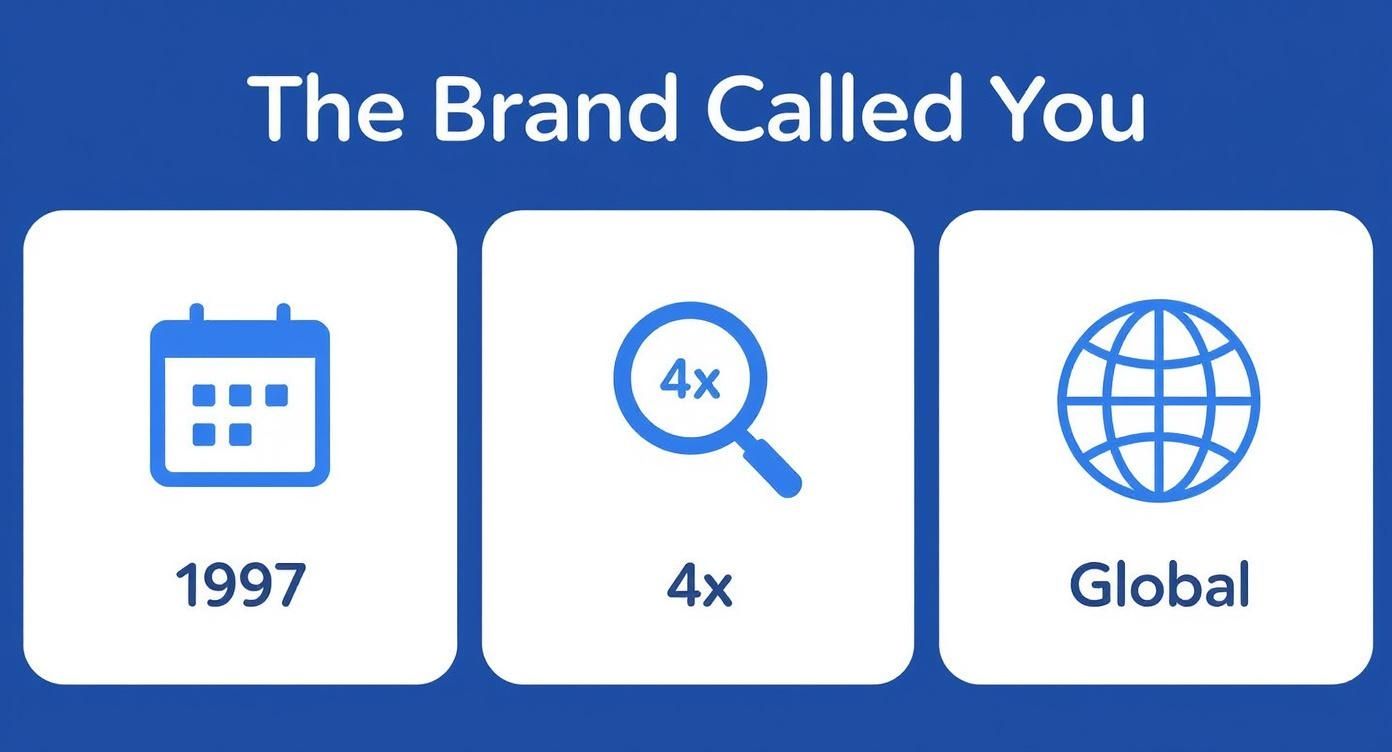
The data makes it obvious: what started as a niche concept for executives is now a fundamental part of being a professional in any field.
Ultimately, your personal brand matters because it drives real, tangible results. It gives you the credibility and leverage you need during crucial career moments, showing you how to counter a job offer and win better terms. If you're looking for more ways to build your brand with smart content, check out the articles on the CreateInfluencers blog. Every bit of effort you put into your brand is a direct investment in your future success.
Getting to the Core of Your Authentic Brand
A powerful personal brand isn't about inventing a new character to play online. It's about digging deep and amplifying the person you already are. The brands that truly connect with people feel genuine because they're built on a foundation of truth. This is the point where we stop talking theory and start taking action to define the core components that make you, you.

The journey begins with a bit of self-discovery. It means looking inward to figure out your unique value proposition—that special cocktail of skills, passions, and life experiences that nobody else on the planet has.
Finding Your Unique Value Proposition
Your unique value proposition (UVP) is the absolute heart of your personal brand. It’s the clear, compelling answer to the question, "What do I bring to the table that is both distinct and valuable?"
Think of it as your professional superpower. It’s not just what you do, but how and why you do it that sets you apart.
To start mapping out your UVP, grab a notebook and reflect on a few key questions:
- What problems do I actually enjoy solving? Think about the challenges that genuinely get you excited, whether at your desk or in your personal life.
- What skills feel effortless to me? Consider the things people are always complimenting you on or asking for your help with.
- What am I truly passionate about? Your passions are the fuel that will make your brand feel authentic and keep you from burning out.
- What unique experiences have shaped my worldview? Your personal story is a goldmine of insights and perspectives that are 100% yours.
Answering these helps you find that sweet spot where what you're good at, what you love, and what other people need all come together. That intersection is the fertile ground where your brand will thrive.
A strong personal brand stands on three pillars: authenticity, consistency, and visibility. Authenticity is your foundation, consistency builds trust, and visibility creates opportunity.
This focus on being real isn't just some feel-good advice; it's exactly what modern audiences are looking for. The stock value of authenticity has gone through the roof. People are tired of overly polished, perfect online personas and are now drawn to real human stories—the kind that includes struggles and vulnerabilities right alongside the wins.
We see this shift everywhere, especially with the explosion of podcasting, a medium that lets professionals build incredibly close connections by just having real, expert conversations. You can find more great insights on the future of personal branding at ChrisDucker.com.
Defining Your Core Values
Once you have a better handle on your unique strengths, the next step is to anchor them to your core values. Your values are your non-negotiables—the principles that guide every decision, action, and piece of content you create. They're your brand's compass.
For instance, if "simplicity" is one of your core values, your content will naturally focus on breaking down complicated subjects into easy-to-follow guides. If "innovation" is your thing, you'll always be the one sharing new ideas and thinking about what's next.
Here’s a simple way to bake your values into your brand:
- List Your Top 3-5 Values: Pick words that genuinely represent what you stand for. Think: integrity, creativity, community, growth, or curiosity.
- Define What They Mean to You: For each value, jot down a quick sentence on what it actually looks like in practice.
- Weave Them into Your Story: Use these values to shape your entire professional narrative, from your LinkedIn bio to the articles and posts you share.
Going through this process ensures your brand isn't just unique, but also meaningful. When you build on a foundation of who you really are and what you believe in, you create a personal brand that connects with the right people and feels effortless to live out every single day.
A Step-by-Step Guide to Building Your Brand
Okay, so you've done the soul-searching and figured out what makes your brand authentic. That's the hard part, but now comes the fun: turning those ideas into something real. Building a personal brand isn't some mystical secret; it’s a process. Let’s break it down into clear, manageable steps you can start on today.

This framework is all about moving from thought to action. Each step builds on the one before it, helping you construct a brand that’s not just an accurate reflection of you, but one that genuinely connects with the right people.
Step 1: Conduct a Personal Audit
Before you can build anything, you have to know what you’re working with. A personal audit is really just a candid look at your current online presence. What story are you already telling, whether you realize it or not?
Go ahead and Google yourself. Search your name on the social media platforms you use. Take a hard look at your profiles, the stuff you’ve shared, and your past comments and interactions. This simple act often uncovers inconsistencies or old information that might be sending the wrong message.
The whole point here is to spot the difference between the brand you want and the brand you have. This audit gives you a clear and honest starting line.
Step 2: Define Your Niche and Audience
Here’s a hard truth: you can’t be everything to everyone. Trying to appeal to a massive, generic audience is the fastest way to become invisible. The secret to getting noticed is to zero in on a specific niche where your unique talents can truly stand out.
Your niche is that sweet spot where you can become the go-to expert. Ask yourself: who do I want to help, and what specific problem can I solve for them? Getting crystal clear on this lets you create super-relevant content that speaks directly to a focused group.
Defining your audience isn't about exclusion; it's about connection. When you know exactly who you're talking to, your message becomes exponentially more powerful and effective.
Once your niche is set, sketch out your ideal audience member. Who are they? What do they care about? What keeps them up at night? Creating a simple "audience persona" makes it so much easier to craft every piece of content with their needs in mind.
Step 3: Craft Your Content Strategy
Content is how your brand speaks. A content strategy doesn’t have to be some massive, complicated document—it just needs to be consistent and genuinely helpful. Your mission is to share what you know in a way that benefits your audience.
A great way to start is by picking three core content pillars. These are the main topics you'll talk about over and over again. For a graphic designer, these pillars might look like this:
- Branding Fundamentals: Sharing quick tips on color theory or logo design.
- Design Tool Tutorials: Creating short videos showing how to use popular software.
- Client Success Stories: Showcasing how their work solved a real-world business problem.
This approach keeps your content focused and constantly reinforces your expertise. For more deep-dives into building influence, we’ve got a ton of resources in our extensive CreateInfluencers guides.
Step 4: Choose Your Platforms and Build Your Presence
Finally, you need a place for your brand to live online. A personal website or blog is the perfect home base—it’s the one space you have complete control over. You can find all sorts of great starting points, like these handy personal portfolio website templates, to get things rolling.
From there, pick just one or two social media platforms where your target audience actually hangs out. Don't try to be everywhere at once. It's so much more effective to be deeply engaged on a couple of platforms than to be barely present on five.
Every platform has its own vibe and audience. It’s crucial to pick the ones that fit your brand and help you reach the right people.
Platform Strategy for Your Personal Brand
| Platform | Best For | Primary Audience |
|---|---|---|
| Professional networking, B2B content, and establishing industry authority. | Professionals, recruiters, B2B decision-makers, and industry leaders. | |
| Visual storytelling, creative portfolios, and lifestyle or product-based brands. | Gen Z and Millennials, creatives, B2C brands, and influencers. | |
| X (Twitter) | Real-time updates, industry news, short-form thoughts, and engaging in public conversations. | Journalists, tech professionals, marketers, and a broad, news-focused audience. |
| TikTok | Short-form video, creative trends, and showing a more authentic, personal side. | Primarily Gen Z and younger Millennials looking for entertainment and education. |
| YouTube | In-depth tutorials, long-form educational content, and building a community through video. | A very broad audience searching for "how-to" content, reviews, and entertainment. |
| Personal Blog/Website | The central hub for your brand, long-form content, and owning your audience (email list). | A dedicated audience that you direct from other platforms; your core followers. |
Choosing the right platforms is less about being everywhere and more about being in the right places, consistently.
Powerful Personal Brands in Action
It’s one thing to talk about personal branding in theory, but seeing it done right is where the magic really clicks. The best way to understand its impact is to look at people who have masterfully turned their skills and personality into their biggest professional asset.
These folks don’t just broadcast what they do; they share who they are. They build communities around their story, their values, and their unique point of view. By looking closely at how they operate, we can pick up some brilliant ideas for our own journey. They prove that a great personal brand isn’t about being famous—it’s about being known for something specific and incredibly valuable.
Lessons from Industry Leaders
Think about the leaders you admire, whether they're in tech, art, or marketing. You'll probably notice they all tell a consistent story, but they use different platforms to do it. A startup founder might share quick, sharp industry takes on X (formerly Twitter) and then publish deeper thoughts on leadership over on LinkedIn. Meanwhile, a chef might use Instagram for stunning photos of their food and TikTok to show off their fun, chaotic energy behind the scenes.
This is a masterclass in being strategic. It’s not about shouting from every rooftop; it’s about knowing where your people are and showing up there in a meaningful way.
An exceptional personal brand humanizes expertise. It transforms a name into a trusted resource by consistently delivering value wrapped in an authentic, relatable voice.
That human connection is where the real power lies. When people feel like they know the person behind the brand, they're far more likely to trust them. In fact, a whopping 70% of consumers say they feel more connected to a company when its CEO is active on social media.
And when it comes to content, video is king. With 64% of consumers admitting they've made a purchase after watching a branded video, you can’t ignore the power of showing, not just telling. You can dig into more of these numbers and see how branding statistics shape consumer trust at ExplodingTopics.com.
The takeaway here is pretty clear: a memorable personal brand is built on a foundation of consistency, authenticity, and smart content. By sticking to these principles, creators can build a loyal audience and open up new doors for monetization. You can even earn with the CreateInfluencers affiliate program by building your own powerful brand presence.
Common Branding Mistakes and How to Avoid Them
Building a personal brand that truly resonates is a marathon, not a sprint. Along the way, it’s all too easy to stumble into a few common traps that can derail your progress. Knowing what these pitfalls look like is the best way to sidestep them and build a brand that's authentic, effective, and has real staying power.
One of the most frequent mistakes I see is inconsistency. It’s jarring. Imagine a LinkedIn profile that’s buttoned-up and corporate, but the person's X (formerly Twitter) feed is a wild mix of unfiltered rants and memes. This creates a disconnect that leaves potential followers, clients, or employers confused about who you really are and what you represent.
The Self-Promotion Trap
Another classic blunder is turning your brand into a non-stop advertisement for yourself. People are drawn to value, not a sales pitch. If every post is about your services or how great you are, you’re not building a brand; you’re just running a commercial. And let’s be honest, most of us tune commercials out.
Your personal brand should be a magnet, not a megaphone. Focus on pulling people in with value, not pushing them away with constant promotion.
Finally, and this one is crucial, don't make the mistake of ignoring your audience. Your brand isn't a monologue shouted into the void; it's a conversation. When you neglect to answer comments, respond to questions, or simply engage with the people who follow you, you're missing the entire point. Engagement is what turns a passive audience into a loyal community.
So, how do you steer clear of these problems? Boil it down to three simple guidelines:
- Stay consistent: Make sure your core message, voice, and values shine through everywhere you show up online.
- Give first, ask later: Focus the vast majority of your energy on sharing helpful, interesting content. The "ask" will feel much more natural when the time is right.
- Engage genuinely: Treat your online interactions like real conversations, because that’s exactly what they are.
Your Personal Branding Questions Answered
As you start putting together your personal branding plan, you're bound to have some questions. It’s totally normal. Think of this as your personal FAQ, designed to tackle those common uncertainties so you can move forward with confidence.
Let's dive into some of the questions I hear most often.
How Long Does Building a Brand Take?
I get this one all the time. The honest answer? Building a brand that people recognize and trust doesn't happen overnight. There’s no magic number, but with consistent effort, you can expect to see real momentum in about 6 to 12 months.
Consistency is the name of the game here. It's about showing up regularly with valuable content and genuinely connecting with your audience. A steady, sustainable pace will always beat a frantic sprint that leads to burnout.
Think of your brand like a garden. You can't plant a seed today and expect a tree tomorrow. It requires consistent watering, sunlight, and patience to grow strong.
Can I Change My Personal Brand Later?
Absolutely. In fact, you should. Your personal brand is a living, breathing thing that reflects who you are and where you're going. As your skills, interests, and career goals change, your brand should evolve right along with them.
Pivoting your brand isn't about starting over; it's about a gradual, transparent transition. You can start by weaving new topics into your content, updating your bios across different platforms, and simply telling your audience about the new direction you're taking. As long as you're authentic about the shift, your audience will come along for the ride.
Is Branding Important Even If I’m an Employee?
Yes, a thousand times yes. Personal branding is just as critical for employees as it is for founders or freelancers. Inside a company, a strong personal brand makes you the go-to expert in your field. It gets you noticed for promotions, interesting projects, and leadership roles.
It also acts as your professional safety net. If you ever decide to look for a new job or change careers, you won't be starting from square one. Your reputation, network, and body of work will follow you, opening doors you might not have even known were there.
Ready to build an unforgettable online identity? With CreateInfluencers, you can design stunning AI-powered visuals and characters that perfectly capture your unique brand. Start creating for free at https://createinfluencers.com.