Unlocking the virtual outfit creator: AI-Powered Fashion
Discover how a virtual outfit creator uses AI to craft digital fashion from photos or text. See features, uses, and tips to start creating.
Ever wondered how influencers create those stunning, unique outfits that seem to appear out of thin air? A lot of the time, they're using a virtual outfit creator—a powerful AI tool that lets you design and apply digital clothing to avatars or even your own photos. It's like having a limitless digital wardrobe where you can turn simple text descriptions into wearable art.
What Is a Virtual Outfit Creator?
Imagine a digital closet where you can dream up any clothing item, and it instantly appears, perfectly fitted to your model. That’s the magic of a virtual outfit creator. This is far more than a simple dress-up game. It’s a sophisticated platform that uses artificial intelligence to generate completely unique clothing from scratch.
You can feed it a simple text prompt, like "a vintage black leather jacket with silver zippers," or upload a picture for inspiration. The AI then gets to work, constructing a digital garment that drapes realistically on an avatar or a person in a photo.
This technology is a game-changer for anyone who needs a constant stream of fresh, high-quality visual content. Instead of shelling out thousands for photoshoots and physical garments, influencers and brands can produce an endless variety of unique looks for their digital personas in a matter of minutes.
The Technology Behind the Digital Wardrobe
So, how does it all work? At its core, a virtual outfit creator blends several key technologies to translate a creative idea into a visual reality. They work together seamlessly to bring your fashion concepts to life.
Before we dive deeper, let's break down the essential pieces that make these platforms tick. The table below gives a quick snapshot of the core components and what they do.
Core Components of a Virtual Outfit Creator
| Component | Function | Example Application |
|---|---|---|
| Generative AI | The creative engine. It interprets text or image prompts to design the actual clothing from scratch. | You type "red silk evening gown," and the AI generates a unique visual representation of that gown. |
| Pose Replication | Analyzes the posture in a source photo and ensures the digital clothing hangs and folds realistically on the body. | An influencer in a photo is leaning to one side; the AI makes the digital shirt wrinkle naturally at the waist. |
| Texture Mapping | Applies lifelike fabric details to the generated outfit, making it look authentic. | Adds the rough texture of denim to a pair of jeans or the subtle sheen of silk to a blouse. |
Each of these elements plays a crucial role in creating a believable and visually stunning result. And the best part? These tools are becoming incredibly accessible. Platforms like the CreateInfluencers AI model generator are putting this power into everyone's hands, making it possible to build unique digital identities from the ground up.
The Exploding Digital Fashion Scene
The appetite for this kind of technology is absolutely booming. The creator economy within virtual and augmented reality is on a massive upward trajectory, projected to skyrocket from USD 91.2 billion in 2024 to over USD 1.15 trillion by 2034.
What’s driving this explosive growth? It's the consumer desire for hyper-personalized avatars and new forms of digital self-expression. Virtual outfit creation is a key engine powering this expanding market.
A virtual outfit creator isn't just about making cool pictures; it's about storytelling. It gives you the power to craft a narrative, define a brand, or explore an identity without the constraints of the physical world.
You might have seen something similar in a virtual clothing try-on app, which lets shoppers see how existing clothes look on them. But this is the next level. Instead of just trying on what already exists, you are inventing entirely new pieces. This fundamental shift from consumption to pure creation is what makes these platforms so incredibly powerful.
How AI Is Powering Digital Fashion
Ever wonder what’s actually happening under the hood when a virtual outfit creator generates a stunning image? It’s not just a fancy filter. It’s a sophisticated interplay of different artificial intelligence systems working together to turn a simple text description into a photorealistic piece of clothing, perfectly fitted to a specific person.
Think of it like having a highly skilled creative team on call. One part of the AI, often a model like Stable Diffusion, acts as the initial designer. You give it a prompt—say, "a vintage brown leather jacket with a shearling collar"—and it generates the first draft. It taps into its massive visual library to get the basic look right: the color, the texture, and the general shape of the jacket.
But a first draft is never the final product. That’s where the real magic begins.
The Artist and the Critic
Many of these platforms use a clever concept called Generative Adversarial Networks (GANs). This is the "creative team" I mentioned. One AI, the generator, is the artist creating the image of the clothing. The other AI, the discriminator, is a tough, sharp-eyed critic.
The critic's sole purpose is to look at the generated jacket and compare it against thousands of real photos, trying to spot if it’s a fake. It sends feedback to the artist, which then tweaks its design over and over. This back-and-forth happens in a flash, with the artist constantly trying to fool the critic until the final image is so good it looks like a real photograph.
It’s this relentless process of refinement that creates such incredible realism. The AI doesn't just slap a texture on a shape; it learns what makes a garment look authentic, right down to the tiny details like the stitching on a seam or the glint of light on a button.
Ensuring the Perfect Fit
Creating a realistic piece of clothing is only half the job. The other half—and arguably the more impressive part—is making it look like it actually belongs on your photo. This is where specialized AI models like ControlNets step in.
A ControlNet is essentially a digital tailor. It meticulously analyzes the pose in your uploaded picture—the exact bend of an elbow, the curve of a waist, the turn of a shoulder—and uses that information as a blueprint. This forces the AI-generated clothing to drape, fold, and stretch exactly as it would in the real world.
- No more floating clothes: The outfit hugs the body's natural contours.
- Realistic wrinkles and folds: Fabric bunches up convincingly around joints.
- Accurate lighting and shadows: The lighting on the new clothing perfectly matches the original photo.
This is what elevates a simple image overlay into a completely believable scene. It’s the same core idea behind the AI virtual try-on technology that many fashion brands are now using to let customers see how clothes would fit without ever stepping into a store.
This simple infographic breaks down the workflow, from your initial input to the final, ready-to-use digital outfit.
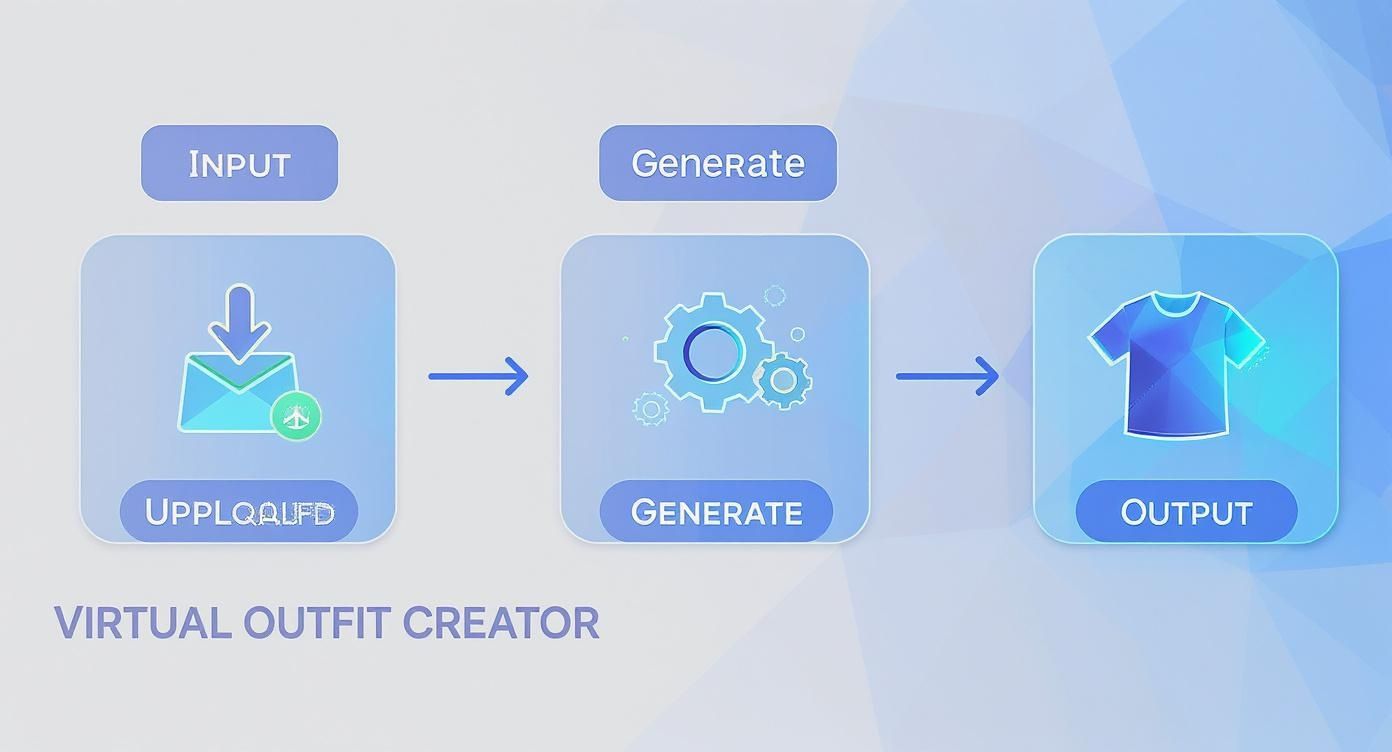
As you can see, a whole lot of complex AI work is neatly packaged into a straightforward, user-friendly process.
By blending generative models for the initial creation with control models for a precision fit, these platforms give you an incredible amount of creative power. You’re not just a passive user; you’re the director, guiding the AI to bring your exact vision to life.
This technology is moving fast, with new models and techniques making the results more lifelike all the time. As these tools get better, the line between a real photoshoot and a digital creation will only get blurrier. To keep up with what's new in AI-powered creativity, check out the latest guides and trends on our blog at https://createinfluencers.com/blog.
What to Look for in a Virtual Outfit Creator
When you start exploring the world of digital fashion, you'll quickly realize that not all virtual outfit creators are built the same. Some are fun novelties, while others are powerful, professional-grade tools. If you're serious about creating high-quality content for your brand, profile, or creative work, you need to know what features actually matter.
Think of it this way: the basic apps are like point-and-shoot cameras, while the advanced platforms are like a full DSLR kit. Both take pictures, but only one gives you the precision and control to create something truly stunning and believable.
The Core Creative Toolkit
First, let's talk about the absolute essentials. These are the foundational tools that let you get your ideas out of your head and onto the screen. Without these, you’re basically flying blind.
A solid platform will give you a few different ways to create:
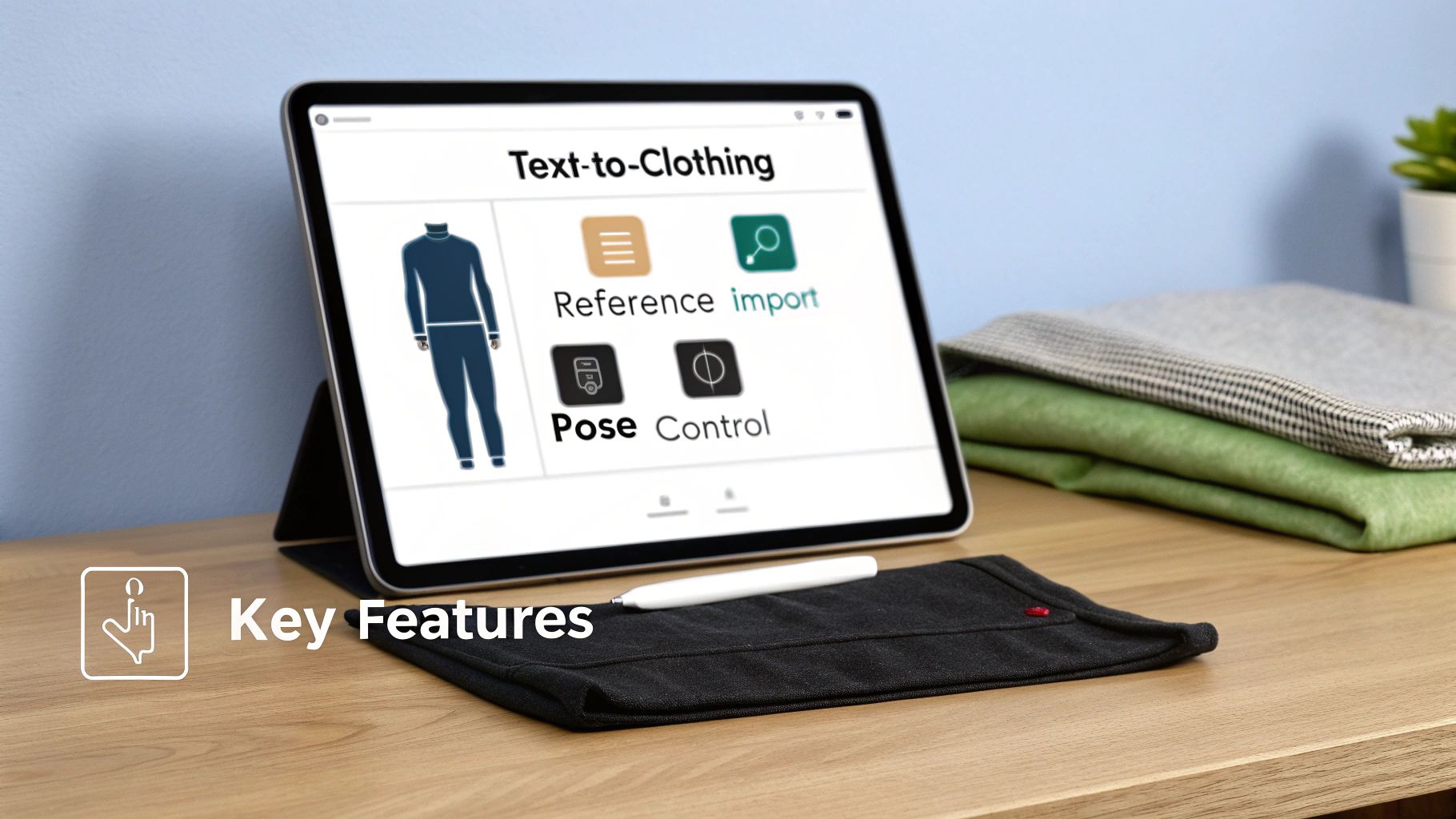
- Text-to-Clothing: This is the most straightforward feature. You simply type what you want—say, "a navy blue wool peacoat with gold buttons"—and the AI gets to work. The magic here is in how well the AI understands the little details in your description.
- Image-to-Clothing: Ever see an outfit online and wish you could create something similar? This feature lets you upload a reference photo. The AI uses it as inspiration, capturing the style, cut, and vibe without just making a direct copy.
- Negative Prompts: This is just as crucial as telling the AI what to do. A negative prompt tells it what not to do. You can exclude things like "blurry," "extra fingers," or "clashing colors" to steer the AI away from common mistakes and get a cleaner result.
These three tools are your creative starting line. You might start with a text description, use an image to nail the aesthetic, and then use negative prompts to polish the final output.
Features for Precision and Realism
Getting a cool design is just the first step. Making it look real is the hard part. This is where the truly advanced platforms pull away from the pack, offering tools that make the digital clothing look like it was genuinely part of the original photo.
The real goal here is to close the gap between a digital concept and a believable photograph. These advanced controls are what allow you to fine-tune the details until the final image feels completely authentic.
These are the features that give you true artistic control.
Look for these controls to achieve next-level realism:
- Precise Pose Replication: The AI has to understand the person's body in the photo. A great tool will perfectly match the pose, making the clothes hang, fold, and stretch just like they would in real life.
- Realistic Fabric Draping and Texture: This is more than just slapping a pattern onto a shape. It’s about simulating the actual physics of different materials. Silk should look soft and reflective, denim should look stiff, and leather should have a subtle sheen.
- Inpainting and Outpainting: These are your editing power tools. Inpainting lets you select and regenerate just one part of the image, like swapping out a shirt without touching anything else. Outpainting lets you expand the canvas, adding more to the background or changing the scene entirely.
This drive for personalization is making a huge splash in the real world, too. The custom apparel market is set to grow by a massive USD 2.45 billion between 2025 and 2029, all because people want unique products that express who they are. AI-powered tools are at the center of this movement, bridging virtual design with real-world style. You can read more on how AI is transforming the market to see just how big this is getting.
How People Are Actually Using Virtual Outfits
The real magic of a virtual outfit creator isn't in the tech itself, but in how it’s being used to solve real-world problems, spark creativity, and even build entire brands. This is no longer just a futuristic novelty; it's a practical tool for a whole range of people who are finding new ways to express themselves and get work done.
Instead of just talking about a "digital closet," people are actively building and using them. The applications are as diverse as the outfits you can dream up, signaling a major shift in how we think about creating visual content.
Influencers and Content Creators
For social media influencers, staying relevant means a never-ending stream of fresh, eye-catching content. A virtual outfit creator is like an infinite wardrobe without the cost, the clutter, or the environmental footprint of fast fashion. An influencer can literally create a week's worth of completely unique looks in a single afternoon, all while staying perfectly on-brand.
This opens up a ton of possibilities:
- Test new styles: They can jump on bold or niche fashion trends without having to actually buy the clothes.
- Keep their brand tight: It's easy to generate dozens of images for a campaign with a consistent, branded look, even in different settings.
- Create more, faster: High-quality visuals for daily posts and big campaigns can be produced for a fraction of what a traditional photoshoot costs.
This efficiency lets creators worry less about wardrobe logistics and more about telling a great story. They can react to trends instantly, putting together a "look of the day" that’s genuinely of the moment.
Marketing Agencies and Brands
Agencies are all over this tech, using it to churn out dynamic campaign visuals at a speed that was once unimaginable. Forget coordinating complex photoshoots with models, stylists, and photographers. Now, an agency can generate an entire campaign's worth of images starring AI models in custom, branded clothing.
This is about more than just saving a buck; it’s about creative speed. An agency can A/B test different outfits or color palettes for an ad campaign in hours, not weeks, letting data drive the design choices that get the best results.
This approach is a game-changer for creating targeted ads. A brand can effortlessly showcase its product being used by different customer personas without ever needing to hire another model.
Perfecting Your Personal Online Profile
It’s not all about professional use, either. Everyday people are using virtual outfit creators to level up their personal online presence, especially on platforms where first impressions count for everything.
Take dating apps, for instance. You can upload a favorite photo and try on different outfits to see what really captures your personality—maybe a sharp suit for a more polished look or a casual jacket for a laid-back vibe. It lets you put your best foot forward without buying a whole new wardrobe. The same logic applies to professional sites like LinkedIn, where a professional headshot is a must.
This personal touch is a huge reason the digital fashion market is booming. Valued at around USD 1.2 billion in 2023, the sector is on track to more than double to nearly USD 2.9 billion by 2025. This explosive growth is being driven by a generation that sees digital self-expression as just another part of life. You can dive deeper into the numbers with these digital fashion consumption statistics.
Photographers and Digital Artists
Finally, photographers and digital artists are pushing creative boundaries with these tools. A photographer can now offer "digital styling" as a premium service, letting clients pick from a massive catalog of virtual outfits to be added to their portraits after the shoot. It's a huge value-add that makes their work stand out.
Digital artists are using these same tools to quickly mock up character designs, create costumes for virtual worlds, and produce stunning visual art without needing to be an expert in complex 3D modeling software. It's a powerful way to bring ideas to life, turning a rough concept into a finished piece with incredible speed.
To see it all in one place, here's a quick breakdown of how different users are getting the most out of virtual outfit creators.
Virtual Outfit Creator Benefits by User Type
A comparative look at how different professionals leverage virtual outfit creators to achieve their goals.
| User Type | Primary Benefit | Key Feature Used |
|---|---|---|
| Influencers | Endless content creation without physical wardrobe costs. | Rapid outfit generation, style consistency tools. |
| Marketing Agencies | Fast, scalable campaign visual production. | AI model integration, custom branding on apparel. |
| Dating Profile Users | Presenting the best version of oneself without new clothes. | Photo-realistic outfit swapping on personal photos. |
| Adult Content Creators | Privacy protection and exploring unique visual themes. | Anonymous AI models and imaginative costume generation. |
| Photographers | Offering unique "digital styling" as a premium service. | High-fidelity outfit rendering on client photos. |
As you can see, the core benefit changes depending on the goal, but the underlying power is the same: the ability to create high-quality, customized fashion visuals quickly and affordably.
Creating Your First Digital Outfit
So, you're ready to jump in and actually design something. Awesome. This is where the magic happens, where your ideas meet the AI's power to create. Think of it less like using a complex tool and more like having a conversation with a digital stylist. The clearer you are about what you want, the more incredible the final outfit will be.
Let's walk through it.
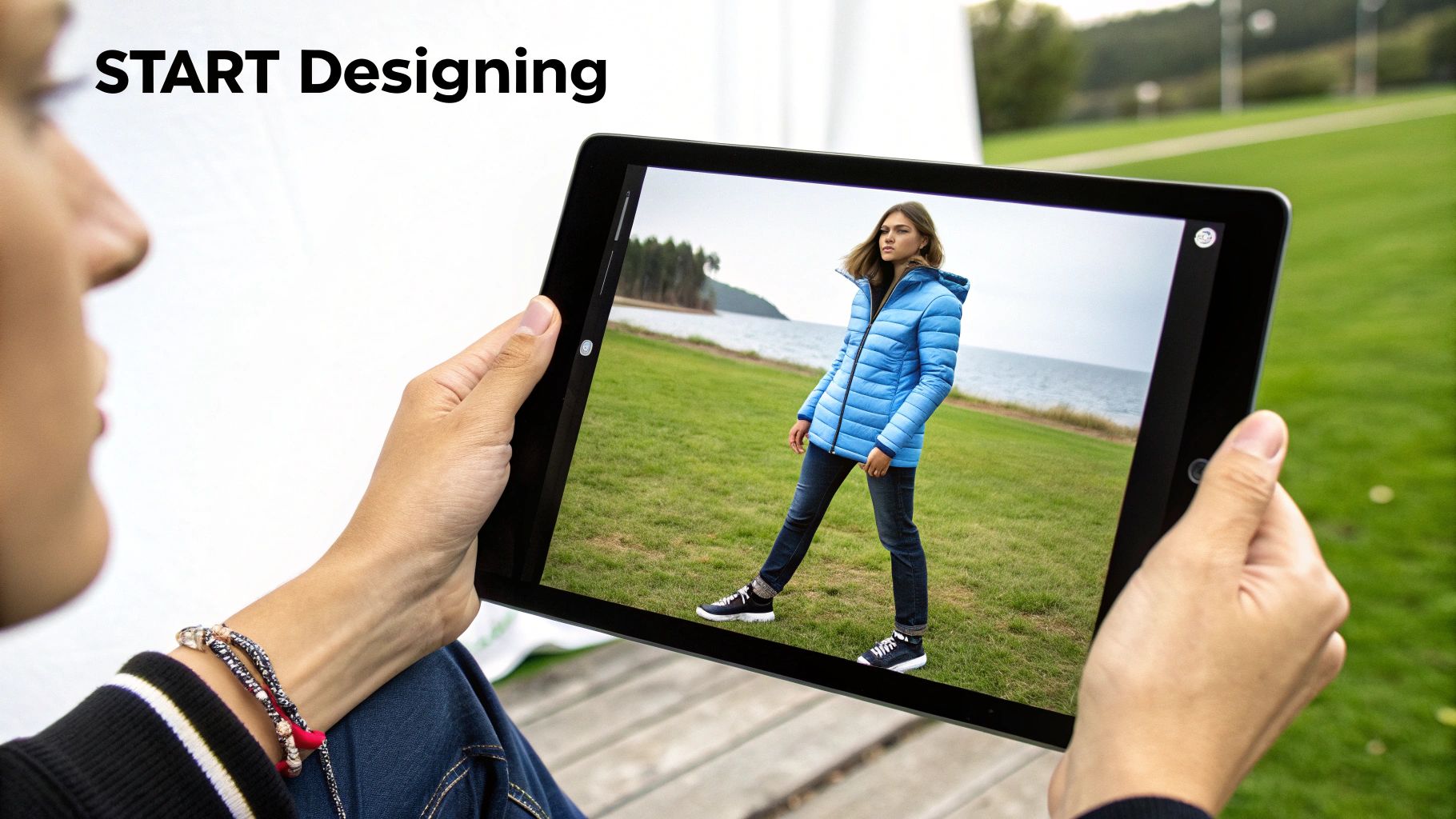
The whole process starts with a foundation—you need someone to dress. This is your digital mannequin, and the quality of this starting point is everything. It directly affects how realistic the final image looks. You've got two main routes here: use your own photo or grab a pre-made AI model.
Step 1: Choose Your Base Image
First things first, you need a canvas for your creation. If you're jazzing up a personal profile, using your own photo makes the most sense. But for things like brand campaigns or more artistic concepts, a clean, professional AI model is often a better starting point.
- Using Your Own Photos? Pick a high-quality picture. Good lighting and a clear pose are non-negotiable. The AI has to clearly "see" the shape of the body to make the clothes hang and drape properly. Also, try to avoid cluttered backgrounds that can throw the AI off.
- Using an AI Model? Just find one that already fits the vibe you're going for. Matching the model's aesthetic and pose to your intended style right from the start makes the whole composition feel much more natural.
Once you’ve got your base image locked in, it's time to tell the virtual outfit creator what to make. This is all done through a text prompt, and honestly, this is the most important part of the entire process.
Step 2: Write a Powerful Text Prompt
Your text prompt is your direct line to the AI. If you're vague, you'll get vague, generic results. But if you're detailed and descriptive? You'll get something truly unique. You have to think like an art director giving a brief.
Your prompt is the creative brief for the AI. The more vivid and specific your language, the closer the AI will get to bringing your exact vision to life on the first try.
Here’s a simple way to build a great prompt:
- Start with the Main Piece: Name the core garment. Think "a silk blouse."
- Add Descriptive Words: Now, layer on the details. What color? What material? What style? Now it's "an emerald green silk blouse."
- Get Specific: What are the little things that make it special? "An emerald green silk blouse with mother-of-pearl buttons and a ruffled collar."
- Set the Mood (Optional): You can even hint at the environment or lighting to influence the overall look, like adding "golden hour lighting."
See how that builds a much richer picture? That level of detail gives the AI a ton to work with and takes you from a fuzzy idea to a fully fleshed-out piece of digital fashion.
Step 3: Refine with Reference Images and Negative Prompts
Sometimes, words just don't cut it. You might have a very specific texture or pattern in mind that’s hard to describe. This is where a reference image is a game-changer. You can upload a photo of a style, a fabric, or a pattern to give the AI a strong visual hint. It won't copy the image, but it will use it as its main inspiration.
Just as important is telling the AI what not to do. That's what a negative prompt is for. It’s a list of words or concepts you want the AI to avoid, acting as your personal quality control filter.
Common Negative Prompts to Use:
- For Image Quality: blurry, low-resolution, grainy, pixelated
- For Body/Anatomy: extra limbs, mutated hands, disfigured, poorly drawn hands
- For Unwanted Styles: cartoon, 3d render, drawing, watermark, text
When you put all these pieces together—a solid base image, a detailed prompt, a helpful reference photo, and a smart negative prompt—you get an incredible amount of control over the final result. For a deeper dive into these techniques, our library of AI influencer creation guides has tons of advanced tips to perfect your process.
From here, it's all about hitting "generate" and tweaking things until your virtual outfit is absolutely perfect.
How to Use Virtual Outfit Creators the Right Way
These tools hand you a ton of creative power, but just like any powerful tool, it's not a free-for-all. Using this tech well goes way beyond just writing a good prompt. It’s about understanding where the ethical lines are drawn so you can create content that’s both amazing and authentic.
Let's be real: you're trying to build a positive reputation, not a deceptive one. Getting this right means your digital creations will actually boost your brand instead of tanking it.
Don't Copy, Get Inspired
One of the first things everyone wants to do is recreate a famous design. And yeah, it’s tempting to generate a perfect copy of a designer bag or a specific look straight off the runway. But doing that is a fast track to legal headaches. Copyright and trademark laws are very real, and they protect original designs and brand logos.
Instead of trying to make a digital knockoff, think like a real designer. Use the tool to capture a vibe or an aesthetic without directly ripping off someone else's work.
- Try this: "a leather jacket in the style of a classic biker design" or "a floral dress with a bohemian vibe." This lets the AI get the essence you're after without illegally cloning a specific item.
- Avoid this: "a Gucci handbag with the GG logo." That's not inspiration; that's asking for trouble, especially if you're using the image for anything commercial.
The big difference here is inspiration versus imitation. You want to use existing styles as a launchpad for something new and uniquely yours, not just a digital counterfeit.
This way, you can play with popular trends and classic looks while making sure your final image is all yours. It’s the smart and safe way to build out your virtual wardrobe.
Be Honest and Build Trust
When you post an image with an AI-generated outfit, just be straight up with your audience about it. Trying to pass off a completely digital creation as a real photoshoot is a bad look. If your followers find out, it can seriously damage your credibility. In a world where everyone is craving authenticity, honesty is always the best move.
People are actually pretty open to AI-generated content, as long as they don't feel like they're being tricked. A simple hashtag or a quick note in the caption is all it takes.
Simple Ways to Be Transparent:
- Use Clear Hashtags: Add tags like
#AIart,#DigitalFashion, or#VirtualOutfitto your post. It's an easy, low-key way to signal that AI was involved. - Say It in the Caption: Something as simple as, "Loving this virtual look I designed with AI!" works perfectly. It's direct and builds trust.
- Don't Lie: Never, ever claim you bought or wore a physical item that was created digitally. That's not just creative content anymore—it's straight-up deception.
Being transparent doesn't make your work less creative. In fact, it highlights your skill in using cool, new tools. Your audience will respect the honesty and probably be even more curious about how you do it.
Make it Look Real
Finally, a big part of using these tools responsibly is aiming for quality. A sloppy-looking image with weird lighting or fabric that looks like plastic can make you look unprofessional. The whole point is to create visuals that are believable, even if you and I know they're digital.
You've got to sweat the small stuff. Pay close attention to details like:
- Lighting and Shadows: Does the light on the AI clothes match the lighting in the original photo?
- Fabric Texture: Get specific in your prompts. Ask for "rough tweed," "shiny satin," or "matte leather."
- Fit and Drape: Make sure the clothes hang and fold naturally on the body in that specific pose.
Nailing photorealism takes practice and a good eye. But when you focus on getting these details right, you create digital outfits that aren't just ethical, but also professional and genuinely impressive.
Common Questions About Virtual Outfit Creators
As you get ready to dive into the world of digital fashion, you've probably got a few questions. That's completely normal. Getting a handle on what these tools can (and can't) do is the first step to really making them work for you.
We've gathered some of the most common questions people ask. Think of this as your final briefing before you jump in and start creating with confidence.
Can I Use These Tools on My Own Photos?
Yes, you absolutely can. In fact, many of the best platforms are built specifically for this. You just upload your own pictures, and the AI gets to work, analyzing your pose to fit the new clothes onto your body in a surprisingly realistic way. It's a fantastic feature for anyone looking to give their social media a quick makeover or just try on a new style without the hassle of a photoshoot.
For the best results, start with a high-quality photo where your body and pose are clearly visible. Good lighting and a simple background give the AI the best chance to work its magic, making sure the final outfit looks natural.
Do I Need to Be a Designer to Use This?
Not in the slightest. One of the best things about virtual outfit creators is how they democratize design. You don't need to know your way around complicated software like Photoshop or have any 3D modeling experience.
Your main skill is your imagination. The ability to describe the outfit you envision in clear, descriptive language is far more important than any traditional design training. Your creativity is the input that drives the AI’s output.
So, while you don't need to be a professional, having a good eye for style will definitely help you write better prompts and get more compelling results.
Is Recreating Designer Outfits Legal?
This is where things get a bit tricky, so it's an important question. Directly copying a protected design—especially if it features a brand's logo or a famous, trademarked pattern—is a bad idea and can get you into hot water with copyright infringement. It's best to steer clear of making exact replicas for any commercial purpose.
What you can do is create an outfit that's "inspired by" or "in the style of" a designer. The key is to use well-known designs as a creative launchpad for something new and original. If you're looking to make money from your work, it's worth exploring partnerships. You can see how this works by checking out our guide on the CreateInfluencers affiliate program.
Ready to stop wondering and start creating? CreateInfluencers gives you all the tools you need to design stunning virtual outfits, generate unique AI models, and bring your creative vision to life in minutes. Sign up for free and start building your digital identity today at https://createinfluencers.com.