A Guide to Using AI to Make Money
Discover how using AI to make money is a reality. This guide covers actionable strategies for AI content, services, and niche ventures to build real income.
It's easy to get lost in the buzz around AI, but making money with it isn't some far-off dream. It's happening right now. The whole idea is to use these incredibly smart tools to build things or offer services that people actually want and are willing to pay for. And the best part? You can get started with way less cash than you'd think, as long as you have a solid game plan.
What AI Income Streams Actually Look Like
We've entered a different kind of entrepreneurial world, one where artificial intelligence is genuinely changing how money is made. It’s not just hype. The real magic is how AI tools are making complex skills accessible to everyone.
Just a few years ago, you needed years of practice and pricey software to create professional-looking designs, write persuasive copy, or edit a decent video. AI has dramatically lowered that bar.
This change opens the door for anyone to build a real, profitable side hustle or even a full-time business. The secret isn't just having access to the tools; it's about using your own creativity and strategic mind to steer them. Success hinges on knowing how to direct the AI, not just that it exists.
The New Lay of the Land
The economic impact is already huge, and it’s only getting bigger. By 2025, the global revenue from AI software alone is expected to hit nearly $100 billion. What's more, a whopping 80% of retail executives plan to be using AI automation by 2025. This tells us one thing loud and clear: the demand for people who know their way around AI is about to skyrocket.
For anyone looking to start a business, this is a golden opportunity. Companies, big and small, need help figuring out these new technologies, and that creates a massive market for services. You can get in on the ground floor. For instance, people are already successfully:
- Selling AI-Enhanced Services: Think copywriting, social media management, or video editing, but supercharged. AI tools help you get more done, faster, without sacrificing quality.
- Building Unique Digital Products: This could be anything from AI-generated art for print-on-demand T-shirts, ebooks co-written with an AI assistant, or unique design templates for other creators.
- Automating Businesses: Savvy consultants are helping small businesses set up things like AI chatbots for customer service or automated marketing campaigns, saving them a ton of time and resources.
The most important thing to remember is that AI is a force multiplier. It takes the skills you already have and amplifies them, or it helps you pick up new ones faster than ever. It lets a single person deliver value on a scale that used to be reserved for entire teams.
If you're interested in building a brand around these skills, you can learn how to build your own digital presence and brand by exploring guides for aspiring influencers.
In the end, the most successful ventures are the ones that combine AI’s raw processing power with a distinctly human touch. That could mean your strategic vision, your creative flair, or your ability to provide amazing customer service. That blend is the real foundation for making money with AI today.
Finding Your AI Monetization Path
Jumping into the world of AI-driven income can feel like trying to drink from a firehose. The secret isn't to master everything at once, but to find a path that clicks with your skills and what you genuinely enjoy doing.
Most successful approaches boil down to one of three main strategies. Each one offers a different mix of effort, income potential, and day-to-day work. It's about finding the right fit for your goals and personality.
Create and Sell AI Products
This is the path for the makers—the artists, writers, and designers who love the idea of building something once and selling it over and over. You’d use tools like Midjourney or ChatGPT to create digital assets like unique art prints, ebooks, stock music, or even design templates.
Think about a graphic designer. Instead of one-off client projects, they could use AI to generate a huge bundle of social media graphics specifically for local coffee shops and then sell that bundle on a marketplace like Etsy. The real human skill here isn't just pressing a button; it's having a great eye for what people want and knowing how to craft the right prompts to get high-quality, desirable results.
Startup costs are usually low—often just your AI tool subscriptions. The income can be a bit unpredictable at first, but it's all about volume and smart marketing.
The real game with AI products is creating assets that can generate passive income over time. It requires a significant upfront investment of creative energy, but a single successful product can sell for months or even years with minimal ongoing effort.
Offer AI-Enhanced Services
If you prefer working directly with clients and want to see a return on your time much faster, this is your lane. This model is all about using AI to make a skill you already have way more efficient and powerful.
For example, a freelance writer can use AI to research and draft articles in a fraction of the time, allowing them to take on 3x the clients without burning out. An SEO specialist could use AI to analyze complex data sets in minutes, a task that used to take days of manual work.
Here, your client management and communication skills are just as important as your technical expertise. You can often charge a premium because you’re delivering better, faster results than competitors still doing everything by hand. It’s one of the quickest ways to start earning money with AI.
Build Automated Niche Businesses
The third path is for the strategists and system-builders out there. This involves creating a business that runs mostly on its own, like an affiliate marketing blog or a niche content site where AI does the heavy lifting on content creation.
You could, for instance, build a website that reviews eco-friendly home gadgets. An AI could help write the initial reviews, create comparison charts, and even draft the social media posts to promote your articles.
Success here really comes down to finding a profitable niche and getting a handle on SEO. Your main job is to steer the ship—setting the strategy, editing and fact-checking the AI's work, and managing the overall system. To get some ideas flowing, you can check out AI-generated business samples for specific industries to see what this looks like in practice.
This chart shows a few of the niches where AI-driven content is really taking off.
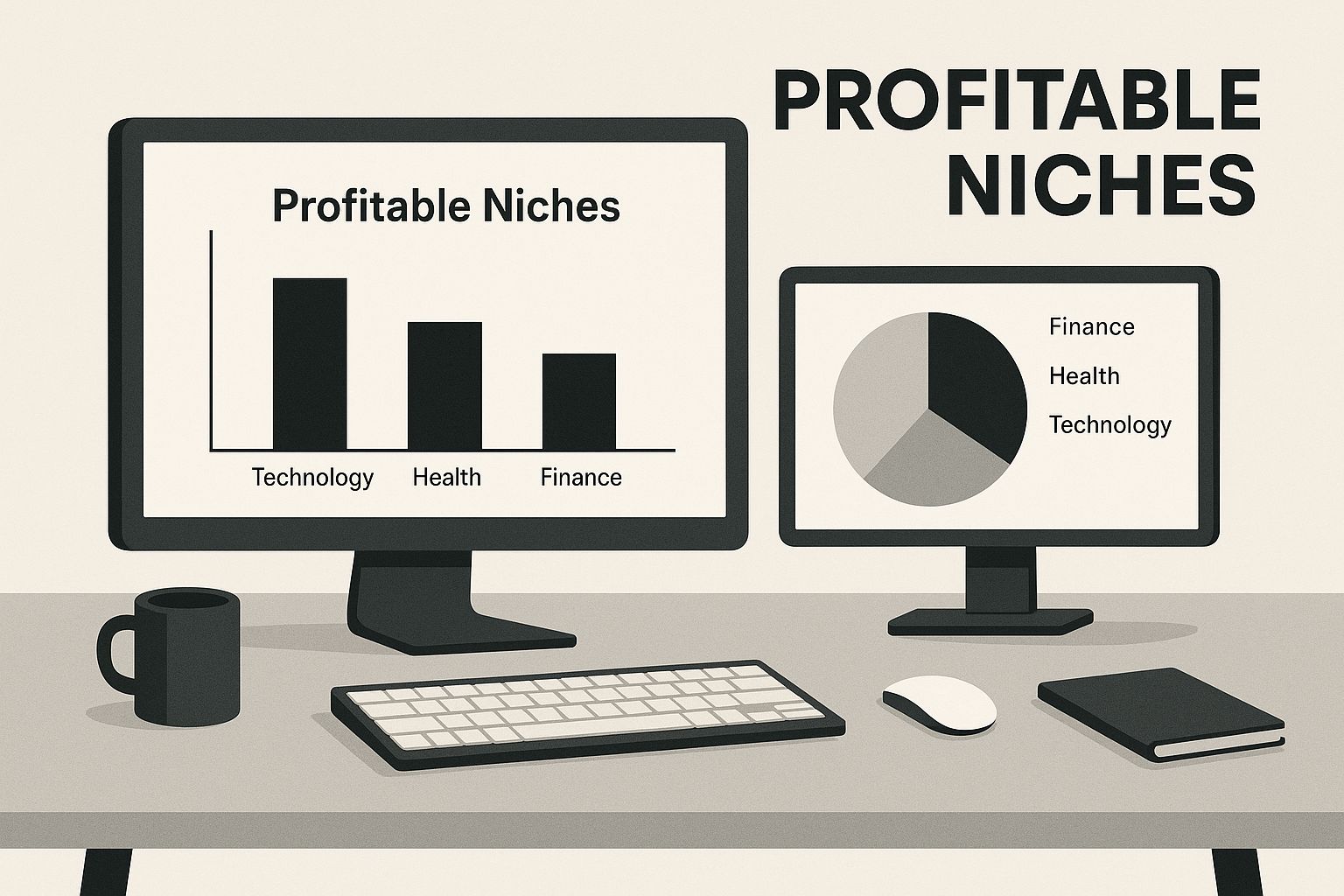
As you can see, areas that blend high consumer interest with a need for lots of content—like personal finance or sustainable living—are proving to be goldmines. This approach has massive potential for passive income, but be prepared for a longer journey to profitability. It’s less about a single creative burst and more about building a machine that works for you.
Comparison of AI Monetization Models
To help you decide which direction to take, here's a quick breakdown of these three models. Think about where your skills and goals align best.
| Monetization Model | Potential Income | Required Skill Level | Best For |
|---|---|---|---|
| AI Products | Moderate to High (Passive) | Low to Medium (Creative/Marketing) | Artists, designers, writers, and anyone wanting to create sellable assets. |
| AI-Enhanced Services | High (Active) | Medium to High (Client Skills) | Freelancers and consultants looking to boost efficiency and income quickly. |
| Automated Businesses | Very High (Passive) | High (Strategic/SEO) | Entrepreneurs and system-builders who enjoy long-term strategy and optimization. |
Each path offers a legitimate way to build an income stream with AI. The best choice depends entirely on whether you see yourself as a creator, a service provider, or a strategist.
Building Your AI Content Creation Workflow
Once you've decided on your monetization strategy, it's time to build a repeatable system for creating great content. And I mean at scale. This isn't about pushing a button and letting an AI do all the work. It’s about creating a smart, efficient workflow that blends AI's power with your own human expertise. A solid process is what separates the hobbyists from the pros who are actually making money with this stuff.
Your workflow really starts with picking the right tools. The AI space is crowded and noisy, so tune it out and focus on the tools that directly support your business model. For example, if you're offering SEO writing services, a workhorse text generator like ChatGPT is your foundation. But if you’re launching a print-on-demand store, a top-tier image generator like Midjourney is non-negotiable.
Here’s what a modern AI interface looks like—in this case, ChatGPT.

Don't let the simple chat window fool you. Mastering the art of the prompt is what turns this from a fun toy into a real revenue-generating machine.
Selecting Your Core AI Tools
Be strategic here. Don't fall into the trap of signing up for every new, shiny AI app that hits the market. You'll just end up with a dozen subscriptions and a messy process. Instead, build a lean, mean stack of just a few core platforms that handle the heavy lifting.
- For Written Content: Something like ChatGPT or Jasper is a must for drafting blog posts, ad copy, or social media captions. They're incredible for getting the structure and basic ideas down fast.
- For Visuals: Midjourney and Adobe Firefly are the front-runners for a reason. They can generate stunning digital art, product mockups, and illustrations perfect for digital products, marketing, and eye-catching social media posts.
- For Video: If you need video content but don't have a studio, tools like Synthesia or InVideo are game-changers. You can create surprisingly professional videos with AI avatars and automated editing, which is a lifesaver for online courses or video ads.
To pull everything together, it's worth checking out some of the top social media content creation tools. Many of them are now integrating AI features that can seriously streamline your workflow. The goal is to find tools that play nicely together and meet the quality standards your audience expects.
Mastering Prompt Engineering for Superior Output
If there's one skill to master in this whole game, it's prompt engineering. This is simply the art of giving the AI crystal-clear instructions to get the exact result you want. A lazy, vague prompt will give you generic, unusable garbage. A well-crafted prompt, on the other hand, can get you 80% of the way to a finished piece of content.
Think of it like this: you're the director, and the AI is your infinitely talented (but very literal) actor. You have to give it precise direction.
Blog Post Prompt Example:
"Act as an expert SEO copywriter with a friendly, encouraging, and slightly humorous tone. Write a 1,200-word blog post titled 'Beginner's Guide to Indoor Herb Gardening.' Your audience is millennials living in small apartments who think they kill every plant. Include sections for 'Choosing Your Herbs,' 'The Right Lighting,' and 'Watering Without Drowning Your Plants.' Weave in these keywords naturally: 'indoor herb garden,' 'small space gardening,' and 'kitchen herbs.'"
Digital Art Prompt Example:
"Generate a photorealistic digital art piece. The scene is a futuristic cyberpunk city street at night, drenched in neon light, with reflections glistening on the wet pavement. There's a lone figure in a trench coat walking away from the camera. The style needs to be cinematic and highly detailed. Set the aspect ratio to 16:9."
See the difference? Specificity is king. You're dictating the persona, audience, tone, structure, and keywords. This is how you get professional-grade output. To go even deeper, check out these https://createinfluencers.com/guides on refining your content creation and prompting skills.
Your Human Touch is the Secret Sauce
No matter how advanced these AI models get, your human oversight is what makes the final product valuable. That last 20% of the work—the editing, the fact-checking, the personal flair—is where you earn your money. This is where you inject your unique perspective and guarantee quality.
Your human-in-the-loop process should always include a few key steps:
- Edit for Flow and Voice: AI-generated text can sound a bit... well, robotic. Your job is to smooth it out, inject your brand's personality, and make sure it sounds like a real person wrote it.
- Fact-Check Everything: AI models can confidently make things up, a phenomenon known as "hallucinating." Always, always verify any statistics, dates, or important claims with a reliable source.
- Add Personal Stories and Insights: Share a quick personal anecdote, a hard-won tip from your own experience, or an opinion the AI could never have. This is what builds trust and makes people want to follow you, not just your content.
This hybrid approach is already becoming the norm. A 2024 McKinsey survey found that 42% of businesses are already using generative AI in their marketing and sales efforts, leading to real revenue growth. By building a workflow that uses AI for the grunt work, you free yourself up to focus on strategy and creativity—the high-value tasks that truly move the needle.
How to Market Your AI Products and Services

So, you’ve built something amazing with AI. That's a huge win, but it’s really just half the battle. To actually make money, you have to get your creation in front of the right people. Marketing isn't just a final step; it's the bridge between your brilliant idea and a paying customer.
The cool part? You can use AI to market your AI. This creates a powerful cycle where you can pump out compelling ad copy, find hidden audiences, and fine-tune your campaigns faster than ever before.
Choosing the Right Platforms
Where you decide to sell is just as critical as how you sell. Different platforms are built for different audiences and products. Picking the right one means your message actually lands with people who want what you're offering, instead of just shouting into the digital void.
- For Digital Products (Art, Ebooks, Templates): Places like Etsy and Amazon KDP are your best friends. Their built-in search functions are your primary marketing engine. To win here, you need to get good at platform-specific SEO—think keyword-stuffed titles, descriptions, and tags that help you pop up in searches.
- For Niche Websites (Affiliate Blogs): Your marketing strategy is almost entirely SEO. The whole game is about getting your AI-generated content to rank high on Google for specific, valuable keywords. This means creating genuinely helpful articles that solve problems for your target reader.
- For Professional Services (AI Consulting, Copywriting): You’ll want to live on platforms like LinkedIn and Upwork. Marketing here is all about establishing yourself as an authority. Share case studies, post your thoughts on how AI is changing business, and jump into conversations with potential clients.
Your marketing platform should be where your ideal customers already spend their time. Don't try to force an audience onto a new platform; meet them where they are.
Think about it: an artist selling AI-generated sticker designs will get way more traction by optimizing their Etsy shop than by writing long-form thought leadership on LinkedIn. On the flip side, an AI consultant absolutely needs the professional credibility that LinkedIn offers.
Using AI to Fuel Your Marketing Efforts
Once you know where you’re marketing, it’s time to put AI to work. Modern marketing demands a ton of content—social posts, email newsletters, blog articles, ad copy. AI can slash the time it takes to produce all this stuff, giving you more time to think about the big picture.
A great way to start is with affiliate marketing. By recommending tools or services you already use and love, you can build another income stream while strengthening your brand. You can check out our guide on affiliate programs to get a feel for how this can work alongside your main hustle.
Let’s walk through a real-world example. Say you created an AI-illustrated children’s book and you're selling it through Amazon KDP.
Marketing Funnel Case Study: The AI-Illustrated Children's Book
- Awareness (Top of Funnel): First, you’d use an AI video generator to create short, animated clips from the book's illustrations. Post these on TikTok and Instagram Reels using trending audio and hashtags like
#childrensbookand#AIart. The only goal here is to get eyeballs. - Interest (Middle of Funnel): In your social media bio, you link to a simple landing page. Here, you use ChatGPT to write a captivating summary of the book. You also offer a free, AI-generated coloring page as a download in exchange for an email address.
- Conversion (Bottom of Funnel): Now you have an email list. Use an AI copywriter to draft a quick email series. The first email sends the coloring page, and the next few share some behind-the-scenes stories about how you made the book, with a clear link to buy it on Amazon.
This entire process uses AI at every single stage—from creating the marketing assets to capturing leads and closing the sale.
Optimizing and Measuring Your Success
Marketing isn't a one-and-done deal. To really make it work, you have to pay attention to what's resonating and what's falling flat. The economic impact is real; 71% of businesses using AI in marketing and sales have already reported revenue increases. As the Stanford University AI Index report shows, even small gains prove that these strategies deliver tangible results.
Here are the key things you should be tracking, depending on your business:
- Etsy/Amazon: Keep an eye on your views, click-through rates (CTR), and sales. If views are low, your keywords need work. If your CTR is low, your main product photo isn't grabbing enough attention.
- Niche Site: Use something like Google Analytics to watch your organic traffic, keyword rankings, and affiliate clicks. This data tells you what content is working.
- Consulting Services: Pay attention to your LinkedIn profile views, connection requests, and direct messages from potential clients.
By regularly looking at this data, you can stop wasting time on what isn't working, double down on what is, and build a reliable system for turning your AI creations into consistent income.
Scaling Your AI Income and Avoiding Common Pitfalls
Making that first dollar with AI is a huge rush. But going from a single sale to a reliable income? That's a whole different ballgame. This is the point where you stop dabbling and start building a real business. The secret to making money with AI for the long haul is growing smart and dodging the traps that trip up most people.
It all begins with a hard look at what’s actually working. When you get a sale, don't just pop the champagne—put it under a microscope. Where did that client find you? What exact service did they buy? If you're selling AI art on Etsy, did one particular style or theme outsell everything else? This isn't just data; it's your treasure map.
Once you spot your bestsellers, you know exactly where to focus your energy. If your AI-powered blog posts for SaaS companies are flying off the shelves, it’s time to pour your marketing efforts there instead of trying to be a generalist.
Reinvesting Profits for Smarter Growth
When the money starts trickling in, it’s tempting to treat it as a personal bonus. The savvier play is to funnel a good chunk of it right back into the business. I'm not talking about buying every shiny new tool that comes out, but making targeted upgrades that make you faster or your final product better.
Think about making strategic reinvestments like these:
- Upgrading Your Toolkit: Jumping from a free plan to a pro subscription on a tool like Midjourney or ChatGPT can unlock features that literally buy back hours of your time. We're talking higher-res images, priority access, or more powerful models.
- Buying Specialized Tools: Are you manually editing podcast audio for two hours? A $20/month subscription to an AI-powered audio editor that does it in ten minutes is an absolute no-brainer.
- Investing in Your Own Brain: This field changes at lightning speed. Spending a little on a course for advanced prompt engineering or learning a new AI video platform isn't an expense; it's an investment that keeps you ahead of the pack.
The whole point of reinvesting is to trade money for time and quality. Every dollar you put back in should either help you do more work in the same number of hours or create a better product that you can charge more for.
Avoiding the Most Common AI Pitfalls
As your business grows, so do the challenges. Knowing the common mistakes ahead of time can mean the difference between stalling out and soaring. I’ve seen these trip up even the most talented creators.
The absolute biggest mistake is relying too heavily on raw AI output. Never, ever just copy and paste what an AI gives you and send it to a client. AI makes things up, it lacks subtlety, and it has zero real-world experience. Your actual value is in that final 20% of human touch—the editing, the fact-checking, and the creative spin that makes it yours.
You also have to be incredibly careful with copyright and ethics. Just because an AI can mimic a famous artist's style doesn't give you the green light to sell it. Always read the terms of service for your tools to understand their commercial use policies. And be transparent with clients about your process; honesty builds trust.
Finally, failing to adapt is a death sentence in this space. The AI tool that's the best on the market today could be old news in six months. Set aside a few hours every week to keep up. Read the news, test new platforms, and be ready to change how you work. Being adaptable isn't just a nice skill to have—it's the only way to stay competitive.
Answering Your Burning Questions About Making Money With AI
Jumping into AI to make money is exciting, but let's be real—it can also feel like a maze. You're not alone if you've got questions. I've pulled together the most common ones I hear from people just starting out, with some straight-to-the-point answers to get you on the right track.
What’s the Most Profitable Way to Make Money With AI?
This is the big question, and the honest answer is: it depends on you. There's no magic bullet, but the most profitable path almost always builds on the skills you already have.
If you've got a creative streak, selling AI art on Etsy or offering AI-enhanced graphic design services can be a goldmine. For the writers and marketers out there, churning out SEO-optimized content for businesses or running AI-powered ad campaigns is where the real money is.
The trick is to find where you can add your unique human touch—whether that's strategy, a keen eye for quality, or pure creativity—on top of what the AI spits out. Generally speaking, services tend to bring in more cash upfront compared to digital products, which usually need more time and volume to scale.
Do I Need to Know How to Code?
Not at all. This is probably the biggest myth that stops people in their tracks. The overwhelming majority of AI tools you'll use for making money are designed for everyday people, with no coding required.
Platforms like ChatGPT, Midjourney, and Synthesia all work with simple text commands. The most crucial skill you'll develop is prompt engineering—which is really just the art of giving clear, smart instructions to the AI to get exactly what you want. While coding can open up more advanced doors down the line, it’s definitely not a ticket to entry.
The barrier to entry for making money with AI is the lowest it's ever been for a new technology. Your ability to communicate clearly with the AI is far more valuable than knowing how to write code.
What Are the Biggest Legal and Ethical Risks I Should Know About?
Okay, this is important, so pay attention. The rules around AI are still being written, but two major risks you need to watch out for right now are copyright and transparency.
A lot of AI models learned from massive datasets that scraped a lot of copyrighted material. This makes the legal ground for AI-generated work a bit shaky and different depending on where you are. Your best bet is to always read the terms of service for any tool you use. You need to know their rules on commercial use inside and out.
On the ethics side, just be honest. If you’re using AI to help a client, tell them. Don't use this tech to create harmful deepfakes or spread misinformation. Staying on top of the latest rules is the best way to run a responsible business people will trust. You can find more practical advice on this by checking out the CreateInfluencers blog.
How Much Can I Realistically Make in the First Few Months?
Let’s manage expectations here. Your earnings at the start will be all over the place. A solid, realistic goal for your first one to three months is to bank your first few hundred dollars.
It all comes down to your niche, the quality of what you produce, and how well you market yourself. Someone offering a hot service like AI video editing for social media could absolutely land a client and make $500 in their first month. On the other hand, a person selling AI art prints on Etsy might need a couple of months to build momentum and see their first $100.
Focus on building a killer portfolio and getting the word out consistently. Think of it like any other new venture—it might start small, but with persistence and smart work, it can really grow.
Ready to bring your own AI characters and visuals to life? With CreateInfluencers, you can design stunning AI influencers, generate high-resolution images, and produce dynamic videos in minutes. Start building your digital presence today. Get started for free on CreateInfluencers