How to Monetize Social Media a Creator's Guide
Discover how to monetize social media with proven strategies. This guide covers affiliate marketing, brand deals, digital products, and subscriptions.
So, you want to make money on social media? Before you even think about your first dollar, we need to talk about the foundation. Trying to monetize an account without this groundwork is like building a house on sand. It’s a recipe for failure.
The real currency here isn't just a high follower count; it's trust. It’s having a community that actually listens to you. This first phase is all about laying the strategic groundwork that turns a side hobby into a real, income-generating business.
Building Your Foundation for Monetization
Your journey starts with finding your corner of the internet—your niche. This isn't just about chasing trends. It's about finding that sweet spot where your passions, your skills, and what an audience is desperately looking for all intersect. A sharp, well-defined niche makes you the go-to expert, attracting loyal followers who genuinely trust what you have to say.
Pinpoint a Niche You Actually Care About
Let's be real: choosing a niche you're passionate about is non-negotiable. Creator burnout is a massive problem. If you’re faking enthusiasm for a topic, your audience will sniff it out a mile away, and your own motivation will crater.
Think about what you could talk about for hours without getting bored.
When you're brainstorming, consider these angles:
- Your Expertise: What do you know that other people find valuable? Maybe it's personal finance, sourdough baking, or restoring vintage furniture. Everyone's an expert in something.
- Your Hobbies: What do you do for fun? Things like gaming, hiking, or crafting are fantastic niches because your authentic excitement will shine through effortlessly.
- Audience Problems: What problem can you solve? Content that offers a clear solution—like "how to edit videos on your phone" or "meal prep for busy professionals"—is a magnet for a motivated audience.
Got a few ideas? Great. Now, do a quick reality check to see if they're profitable. Are other creators making a living in this space? Are there brands or products that align with the niche? A passion with no path to income is a hobby, not a business.
Craft a Brand That Sticks
Once you've locked in your niche, it's time to build a brand that people remember. Your brand is so much more than a cool logo or a pretty color palette; it's the entire vibe you create for your followers. It’s what makes you stand out from the thousands of other creators in your space.
A strong brand identity needs to be consistent everywhere you show up online. It’s a combination of:
- Your Unique Angle: What makes you different? Spell out what people get from your content that they can’t find anywhere else.
- Your Visual Style: Develop a consistent look for your photos and videos. Think specific filters, fonts, and colors that become instantly recognizable as yours.
- Your Voice: How do you talk? Are you sarcastic and witty? Or are you more motivational and educational? Your tone should feel natural to you and connect with your target audience.
The goal is to build a brand so distinct that your followers can spot your content in their feed before they even see your name. That level of recognition is what attracts premium brand deals and a loyal community.
The potential here is massive. By 2025, an estimated 5.45 billion people will be on social media, and more than a quarter of them are already using these platforms to shop. A well-built brand isn't just for looks—it's your direct line to a global audience that's ready to buy.
Building that authentic brand and engaged community is the most important first step. For creators who want to jumpstart their visual branding, tools like CreateInfluencers can give you a serious creative advantage by helping you generate unique AI influencer characters that perfectly match your vision.
So, you've built a real community and a loyal following. That's the hard part. Now, it's time to start thinking about turning that influence into income. Two of the most common and effective paths are landing brand deals and jumping into affiliate marketing.
This isn't about just slapping ads on your profile and calling it a day. The real magic happens when you weave these partnerships into your content so seamlessly that they feel like genuine, valuable recommendations to your followers. Get it right, and you're not just selling—you're being a trusted guide.
Mastering Affiliate Marketing Authentically
For many creators, affiliate marketing is the first real taste of monetization. The idea is simple: you talk about a product or service you love, share a unique link, and earn a commission whenever someone makes a purchase through it.
But the real skill isn't just dropping links; it's choosing the right partners. It can be tempting to go for the brand offering the highest commission, but that's a short-term game. Your audience follows you for your taste and your honesty. Promoting a shoddy product for a quick paycheck is the fastest way to burn that trust to the ground. Stick to products you actually use and stand behind.
Here are a few ways to make affiliate promotions feel natural, not salesy:
- Show, Don't Just Tell: Create tutorials or how-to guides that feature a product in action. If you're a food blogger, film a recipe video using a specific mixer and drop the affiliate link in the description. It's helpful and drives sales.
- Give Your Honest Take: Write an in-depth, balanced review. Talk about what you love and what you don't. This builds incredible credibility and helps your followers make smart buying decisions.
- Curate "Must-Haves" Lists: Pull together a list of your go-to tools, favorite books, or everyday essentials. It’s a great way to share multiple affiliate links in a single piece of high-value content.
A quick but crucial tip: Always be upfront about your affiliate links. A simple note like "(Heads up: this post contains affiliate links!)" is all it takes to maintain transparency, and in many places, it's a legal requirement.
The rise of social commerce is making this approach more powerful than ever. As you can see from the infographic below, affiliate marketing often acts as a bridge between early ad revenue and more advanced monetization strategies.
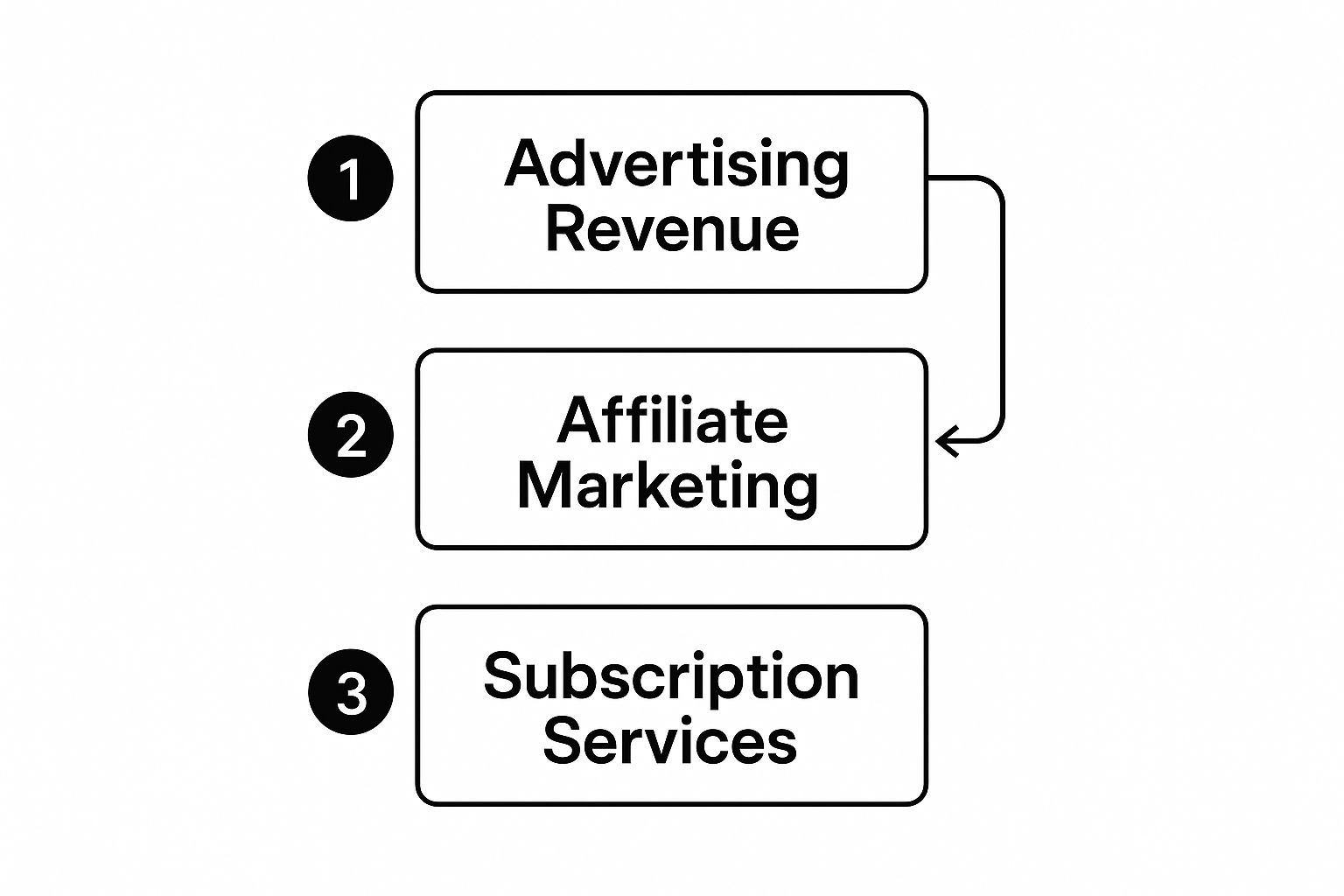
This visual shows how creators often progress, with affiliate partnerships playing a key role in building a sustainable income stream before exploring things like paid subscriptions.
Landing Your First Sponsored Content Deal
Sponsored content is the next level. Instead of just a commission, a brand pays you directly—often a flat fee—to create content featuring their product. To get on a brand's radar, you need to look the part.
Think of your media kit as your creator resume. It’s a snapshot that tells a brand everything they need to know about you.
A killer media kit must include:
- A quick bio that captures your personality and niche.
- Key audience stats (age, gender, location—brands love this).
- Your numbers: follower counts, engagement rates, and monthly reach.
- A showcase of your best work.
- A clear list of the services you offer and your starting rates.
The social commerce market is projected to explode, hitting $1 trillion by 2028, and influencers are at the heart of it. A staggering 61% of consumers say they trust recommendations from creators more than a brand's own ads. That trust is your most valuable asset—don't forget it when you're negotiating.
Comparing Affiliate Marketing and Sponsored Content
Trying to decide where to focus your energy? Both affiliate marketing and sponsored content are great, but they serve different purposes and fit different stages of a creator's journey. Here's a quick breakdown to help you see which one might be the right fit for you right now.
| Aspect | Affiliate Marketing | Sponsored Content |
|---|---|---|
| Payment Structure | Commission-based (you earn a percentage of sales). | Typically a flat fee, paid upfront or upon completion. |
| Control | You have full creative freedom to promote products as you see fit. | Brands often have guidelines, review processes, and specific talking points. |
| Income Potential | Can be inconsistent at first but offers long-term, passive income from evergreen content. | Provides predictable, upfront income, but it's a one-time payment per campaign. |
| Best For | Creators starting to monetize or those who want to build a passive income stream over time. | Established creators with a proven track record of engagement and a strong media kit. |
| Relationship | More of a performance-based partnership. | A direct collaboration, often involving contracts and closer communication. |
Ultimately, you don't have to choose just one. Most successful creators use a mix of both, balancing the steady potential of affiliate links with the larger paydays from brand deals.
Pitching Brands with Confidence
Don't just sit back and wait for opportunities to fall into your lap. The best deals often come from being proactive. Make a list of brands you genuinely admire and whose products would be a perfect match for your audience.
When you reach out, make it personal. A generic, copy-pasted email will get deleted instantly. Show them you've done your homework. Mention a recent campaign of theirs you loved, or explain exactly why your audience is their ideal customer. A tailored pitch shows you're a serious partner, not just another creator blasting out emails.
For those ready to team up with us, our own affiliate program offers a great opportunity to monetize your network.
Figuring out your rates can feel like a guessing game at first. A common benchmark to start with is the "1 cent per follower" rule (so, $100 for a post if you have 10,000 followers). But this is just a starting point. Your engagement rate is a much more important metric. A highly engaged micro-influencer is often far more valuable to a brand than a macro-influencer with millions of passive followers. Factor in your engagement, the amount of work required, and how the brand can use your content when setting your final price.
Time to Build Your Own Thing: Selling Digital and Physical Products

Look, brand deals and affiliate commissions are great. They pay the bills. But at the end of the day, you're still relying on other companies. The real game-changer for creators is building something you truly own—an asset that brings in money completely on your terms.
This is where creating and selling your own products comes in. When you sell your own stuff, you shift from being a promoter to being a business owner. This gives you a much more stable, predictable income that doesn't fluctuate with a brand's marketing budget or an affiliate program's commission changes. You're in the driver's seat.
Your First Digital Product: Low Risk, High Reward
Digital products are the perfect place to start. Why? Because the overhead is incredibly low and you can scale them infinitely. You make it once, and you can sell it forever without a single thought about inventory or shipping.
The secret is to package your unique knowledge into something that solves a real problem for your audience. Think about it: what do your followers always ask you about? That's your goldmine.
Here are a few ideas to get the wheels turning:
- E-books & Guides: If you’re a fitness coach, a "30-Day Home Workout Plan" e-book is a no-brainer. A travel influencer? Your audience would probably love a detailed guide to your favorite city.
- Templates & Presets: Are you a graphic designer? Sell slick social media templates. As a photographer, you can package your signature photo editing styles as Lightroom presets.
- Online Courses or Workshops: For those with a deeper skill set, a video course can be a huge value-add. A personal finance expert, for example, could create a fantastic course on "Budgeting for Freelancers."
The best digital products aren't trying to be everything to everyone. They zero in on a specific pain point for your niche audience. This focus makes them far easier to create and, more importantly, to market.
Before you spend months building something, validate your idea! Don't create in a vacuum. Toss up a poll on your Instagram Stories, ask for honest feedback in your Facebook group, or even set up a pre-sale at a discount to see who's actually willing to pay. If people buy it before it’s even finished, you’ve got a winner.
Launching Physical Merch Without Filling Your Garage
The idea of selling physical products can be scary. Nobody wants a garage overflowing with unsold t-shirts. Thankfully, print-on-demand (POD) services have completely changed the game, making this a totally risk-free way to offer merch.
Here’s how it works: you only pay for a product after a customer buys it. A third-party company handles all the printing, packing, and shipping directly to your customer. You never have to see or touch the inventory.
This lets you play around with different designs and products without any upfront cost. Some of the most popular POD items for creators include:
- Apparel: T-shirts, hoodies, and hats with your logo or a favorite catchphrase.
- Accessories: Mugs, phone cases, and tote bags are easy ways for fans to show their support.
- Art Prints: If you're an artist or photographer, you can easily sell high-quality prints of your work.
The Right Tools for the Job
Choosing the right platform is key to making this whole process smooth for both you and your customers. You need something that's simple to set up and even simpler to buy from.
| Product Type | Recommended Platforms | Key Features |
|---|---|---|
| Digital Goods | Gumroad, Sellfy, Podia | Simple setup, direct payments, handles file delivery |
| Online Courses | Teachable, Thinkific | Robust course builders, student management, video hosting |
| Print-on-Demand | Printful, Printify | Integrates with e-commerce platforms like Shopify or Etsy |
No matter which path you take, creating a library of high-quality content is what fuels long-term success. For those looking to get better at the art of storytelling, we've got plenty of resources to help. You can check out our other guides at https://createinfluencers.com/guides for more tips.
Ultimately, launching your own product line is about building true independence. It's a huge step toward creating a sustainable business that can support you for years, giving you complete ownership over your career.
Generating Recurring Revenue with Subscriptions

While brand deals and product sales are fantastic, they can feel like a feast-or-famine cycle. One month you’re swamped, the next it's quiet. If you want to build a truly sustainable business as a creator, you need a steady, predictable income stream. This is where memberships and subscriptions change the game.
By offering exclusive perks to your most dedicated followers for a small monthly fee, you build a solid financial foundation. This strategy turns your most engaged fans into paying patrons, giving you the security to create bigger and better things without constantly chasing the next sponsored post.
What Is Actually Worth Paying For?
The secret to a successful membership is offering value that feels genuinely special and worth the price. Your free content is what gets people in the door; your premium content is what convinces them to stick around and invest in you.
This isn't just about putting your regular videos behind a paywall. People are paying for a deeper connection and a look behind the curtain.
Here are a few ideas that I've seen work time and time again:
- Behind-the-Scenes Access: Show them your creative process—the good, the bad, and the ugly. These raw, unfiltered glimpses build an incredible sense of intimacy and community.
- In-Depth Tutorials: Go way beyond what you share publicly. If your free video covers the basics of a skill, your members-only version could be a two-hour masterclass diving into advanced techniques.
- Exclusive Community: A private Discord server or Facebook Group just for members can be a massive draw. It becomes a hub for direct interaction with you and other hardcore fans.
- Early & Ad-Free Content: Don't underestimate the simple stuff! Giving your biggest supporters early access to videos or an ad-free experience is an easy but powerful perk.
The best subscription offerings give your superfans more of what they already love about you. It's not about inventing something totally new, but about adding a deeper, more exclusive layer to what you already do.
Structuring Your Subscription Tiers
You don’t need to overcomplicate things. Most platforms, like Patreon, YouTube Channel Memberships, or Instagram Subscriptions, make setting up tiers pretty straightforward. In my experience, a simple three-tier model is the most effective place to start.
- Tier 1 (The Supporter): Think of this as your entry-level option, usually around $3-$5 per month. It’s for people who just want to show their support. Offer a small thank-you, like a special badge in comments, access to the community server, or a shout-out.
- Tier 2 (The Insider): This is your sweet spot, priced in the $10-$15 range. It's where you put your core exclusive content—the BTS videos, detailed tutorials, and early access. This tier should feel like the absolute best value.
- Tier 3 (The VIP): Your premium tier, which could be $25 or more. This includes everything from the lower tiers plus something that offers direct access or high-value, like a monthly group Q&A call, one-on-one feedback on their work, or exclusive merch.
This tiered approach lets fans support you at a level they’re comfortable with, while clearly showing the added value as they move up.
How to Promote Your Membership Without Annoying People
This is the biggest hurdle for most creators. You don't want to come off as pushy or make your free audience feel left out. The trick is to frame it as a friendly invitation, not a hard sell.
Always lead by reinforcing the value you provide for free. Make it clear that your public content isn't going anywhere. Then, you can introduce your membership as an optional way for people who want more to get just that, all while supporting the work you do for everyone.
The social media ad market is enormous—global spending is projected to hit $276.7 billion in 2025. But relying solely on ads or brand deals leaves you vulnerable to algorithm shifts and market swings. Direct revenue from subscriptions gives you a safety net. If you want to dive deeper into these trends, check out this breakdown of social media statistics.
Ultimately, a subscription model transforms your relationship with your most loyal fans. They’re no longer just followers; they become patrons who are directly invested in your journey. That's a powerful dynamic that can fuel your creative career for years to come.
Using Analytics to Optimize Your Earnings
Once your income streams are up and running, the real work begins. It’s no longer just about getting paid; it's about making every effort count. To really make money on social media, you have to stop guessing and start making decisions based on cold, hard data.
This means getting comfortable with your analytics. Every platform gives you a dashboard full of numbers, and those numbers tell a story about what your audience loves and what falls completely flat. Flying blind without this data is like trying to navigate a new city without a map—you might get somewhere eventually, but it won’t be the fastest or most profitable route.
What Numbers Actually Matter?
It’s easy to get lost in a sea of data, so you need to zero in on the key performance indicators (KPIs) that directly affect your bank account. A high like count is a nice ego boost, but it doesn't always translate to revenue.
To keep things simple, here are the most important metrics for each monetization strategy you might be using.
Key Monetization Metrics to Track
Understanding which numbers to watch is the first step toward optimizing your earnings. This table breaks down the essential performance indicators for the most common social media revenue streams, helping you focus your efforts where they'll have the biggest impact.
| Monetization Method | Primary KPI | Secondary KPI |
|---|---|---|
| Affiliate Marketing | Click-Through Rate (CTR) on your links | Conversion Rate (how many clicks become sales) |
| Sponsored Content | Engagement Rate on sponsored posts | Reach and Impressions to show brands your value |
| Digital Products | Landing Page Views from social media | Sales Conversion Rate on your product page |
| Subscriptions | Monthly Recurring Revenue (MRR) | Churn Rate (percentage of subscribers who cancel) |
Focusing on these specific metrics helps you diagnose problems and spot opportunities. If an affiliate link in your Instagram Stories gets a high CTR but a terrible conversion rate, the issue probably isn't your promotion—it's the product's sales page. That's a powerful insight you can act on.
Tying Content Performance to Revenue
The next move is to connect the dots between what you post and what you earn. Your analytics will show you which posts drive the most traffic, engagement, and—most importantly—conversions. This is how you find your winning formula.
Start looking for patterns. Do your short, snappy video tutorials lead to more affiliate sales? Do your in-depth carousel posts drive more sign-ups for the newsletter where you sell your digital products?
Once you spot these high-performing content types, the strategy is simple: do more of what works. If you realize that behind-the-scenes content on your Instagram Stories always causes a spike in new Patreon subscribers, make it a regular part of your schedule. Doubling down on proven formats makes your workflow more efficient and a lot more profitable.
Your goal isn't just to create content your audience likes; it's to create content that inspires them to take the specific actions that grow your business. Analytics is the bridge between those two things.
The Power of Simple A/B Testing
You don't need a fancy lab to figure out what works best. A/B testing can be as simple as trying two different calls-to-action (CTAs) to see which one gets a better response. This one small tweak can make a huge difference in your earnings over time.
Here's a real-world example:
- Week 1: In your YouTube video description, you write, "Check out my favorite camera gear here."
- Week 2: In a similar video, you change it to, "Get the exact camera I use to film my videos."
Track the clicks on both links. The second option is more direct and personal, so it will almost certainly perform better. You can apply this same thinking to your sponsored post captions, the headlines for your digital products, and even how you ask for support on your subscription page.
By embracing a data-driven mindset, you can systematically improve every part of your monetization plan. You’ll negotiate better brand deals with confidence, create products your audience actually wants to buy, and build a more resilient business as a creator. For more deep dives into creator strategies, check out the articles on the CreateInfluencers blog.
Frequently Asked Questions About Monetizing Social Media

Once you start thinking about making money from your social media, the questions start popping up. It's totally normal. Getting those questions answered is how you build a real strategy and start moving forward with confidence.
Let's break down some of the most common hurdles creators face when they first decide to monetize.
How Many Followers Do I Need to Monetize?
This is easily the biggest myth out there. Let's be clear: there is no magic number. You don't need a massive, six-figure following to start earning an income.
Many of the most successful creators are actually micro-influencers. They have smaller, tight-knit communities that are incredibly engaged. Brands often love working with them because their followers genuinely listen and act on their recommendations—something you don't always get with giant, faceless accounts.
Forget the vanity metrics. Focus on your engagement rate and how well your content serves a specific niche. A thousand true fans who hang on your every word are infinitely more valuable than 100,000 followers who scroll right past.
What Are the Easiest Ways to Start Earning Money?
Diving headfirst into creating a full-blown course or a complex subscription model is a recipe for burnout. For most creators just starting out, the best path is affiliate marketing.
It's a brilliant way to test the waters without having to create your own product. You just share and recommend products you already use and trust. When someone buys through your unique link, you get a commission. It's a low-risk way to figure out what your audience is actually willing to buy.
Another great starting point is a simple digital product. Think small and high-value:
- A PDF guide solving one specific problem your audience has.
- A pack of Lightroom presets that helps them achieve your signature photo style.
- A simple checklist or template that makes a complicated process easier.
Do I Have to Disclose Sponsored Posts?
Yes. 100%. This isn't just good etiquette; it's a legal requirement in most places, like with the FTC guidelines in the U.S. Your audience follows you because they trust you, and transparency is the foundation of that trust.
Be upfront and clear. Hiding #ad at the very end of a long list of hashtags doesn't cut it. Use the built-in branded content tools on platforms like Instagram and TikTok, or put your disclosure right at the beginning of your caption. If you don't, you risk destroying your credibility and landing in legal hot water.
How Do I Set My Rates for Brand Deals?
Pricing your work can feel like guessing in the dark at first, but it doesn't have to be. Your rates aren't just about your follower count; they're a reflection of the total value you bring to the table.
When you're putting together a quote, you need to factor in a few things:
- Audience Size: The raw number of followers is a starting point, but it's just one piece of the puzzle.
- Engagement Rate: This is huge. A high engagement rate proves your audience is active and listening, which is exactly what brands are paying for.
- Scope of Work: What's the actual ask? A single Instagram post requires far less work (and should cost less) than a campaign involving multiple videos, stories, and usage rights for six months.
- Your Niche: If you're an expert in a specialized field with a hard-to-reach audience, you can and should charge more.
Do some research to see what others in your space are charging to get a baseline. But never forget to value your unique voice, the quality of your work, and the trust you've built with your community.
Ready to create stunning visuals for your social media? With CreateInfluencers, you can generate custom AI influencers and high-quality images in minutes, giving you a powerful tool to stand out. Start building your unique online presence for free.