Make Money with AI Bots A Guide to Profit
Discover how to make money with AI bots. This guide explores proven monetization models, bot creation, and marketing strategies for real-world profit.
Making money with AI bots isn't some far-off idea anymore—it's happening right now. The most straightforward ways to get started are by building specialized bots for businesses, offering to manage them for a monthly fee, or even using bots to pull in affiliate commissions and new leads. It’s all about turning automated chats into a steady paycheck.
The Reality of Automated Income with AI Bots
The phrase "automated income" can sound a bit like a pipe dream, but with AI bots, the potential is very real and driven by massive market demand. Companies, big and small, are desperate to work smarter, not harder. They want to engage customers around the clock and grow their business without hiring a whole new team. This is exactly where a well-built AI bot comes in, making it a surprisingly easy sell.
Don't picture a sci-fi robot. In the business world, an AI bot is simply a smart piece of software that automates repetitive, conversational tasks. Think about a bot on a real estate agent's website that instantly qualifies new leads by asking about their budget and preferred neighborhoods. Or an e-commerce bot that answers the constant "Where's my order?" questions, freeing up the human support team for more complex issues.
Why The Opportunity Is Exploding Now
Honestly, the timing is perfect. The AI chatbot market is on a rocket ship, projected to hit $27.29 billion by 2030. This isn't just hype; businesses are seeing a real return on their investment. It's expected that by 2025, 95% of all customer interactions will be handled by AI in some form. That tells you just how mainstream this technology is becoming.
This huge wave of adoption is creating a few clear paths to making money:
- Direct Sales: You can build a custom bot for a niche—say, a lead-generation bot for local plumbers—and sell it as a one-time package.
- Subscription Models: Create a bot that offers ongoing value, like a bot that scrapes market data for investors, and charge a recurring monthly fee for access.
- Agency Services: Position yourself as the expert and manage AI bot strategy for clients who don't have the time or skills to do it themselves.
To get a better feel for the current market, it’s always a good idea to check out what’s already out there. Taking a look at reviews and examples, like understanding existing AI platforms like Lovable AI, can give you a solid starting point for your own projects.
Core Monetization Models
At the end of the day, the strategy to make money with AI bots boils down to a handful of core models. Each one plays to different strengths, whether you're a hands-on builder or a savvy marketer. And you definitely don't need to be a coding genius to jump in. Platforms and tools, including our own workflows here at CreateInfluencers, have made building and launching bots easier than ever before.
Let's quickly look at the most common approaches.
Primary AI Bot Monetization Models at a Glance
This table breaks down the main ways people are turning AI bots into revenue. It helps clarify which path might be the best fit for your goals and skills.
| Monetization Model | Primary Use Case | Income Potential |
|---|---|---|
| Direct Bot Sales | Selling custom-built bots for a one-time fee to businesses. | $500 - $5,000+ per bot, depending on complexity. |
| Subscription Services (SaaS) | Offering access to a specialized bot for a recurring monthly or annual fee. | $29 - $299+ per month per user, highly scalable. |
| Affiliate Marketing & Lead Gen | Using bots to guide users to affiliate products or capture leads for other businesses. | Varies widely, from $100s to $10,000s per month. |
| Bot Management Agency | Managing and optimizing bots for multiple clients on a retainer basis. | $1,000 - $10,000+ per month, based on client roster. |
As you can see, there's a model for almost every entrepreneurial style, from one-off projects to building a full-blown agency.
The real secret is to stop thinking about just using AI for yourself and start thinking about selling AI-powered solutions to others. Find a common headache in any industry, build a bot that solves it, and you've got yourself a scalable business.
The most successful people in this space aren't always the tech wizards. They're the ones who really get a specific industry's problems and can build a simple, effective bot to fix them. This guide will show you exactly how to become one of them.
Building Your First Monetizable AI Bot
Alright, let's get our hands dirty and move from theory to actually building something. You don't need a computer science degree or a background in coding to create your first AI bot. Thanks to a new wave of user-friendly, no-code platforms, you can get a functional, money-making bot up and running this week. The trick is to start small by solving one specific problem and then expand from there.
The first move is always to find a profitable niche. Forget about building a bot that does everything for everyone. Instead, focus on one that solves a common, expensive, or just plain annoying problem for a very specific group of people. A great place to start is by thinking about the local businesses in your area and the repetitive questions they probably get peppered with every single day.
This infographic breaks down the process of making money with AI bots, from the initial build to setting up revenue streams like direct sales, subscriptions, and even agency services.
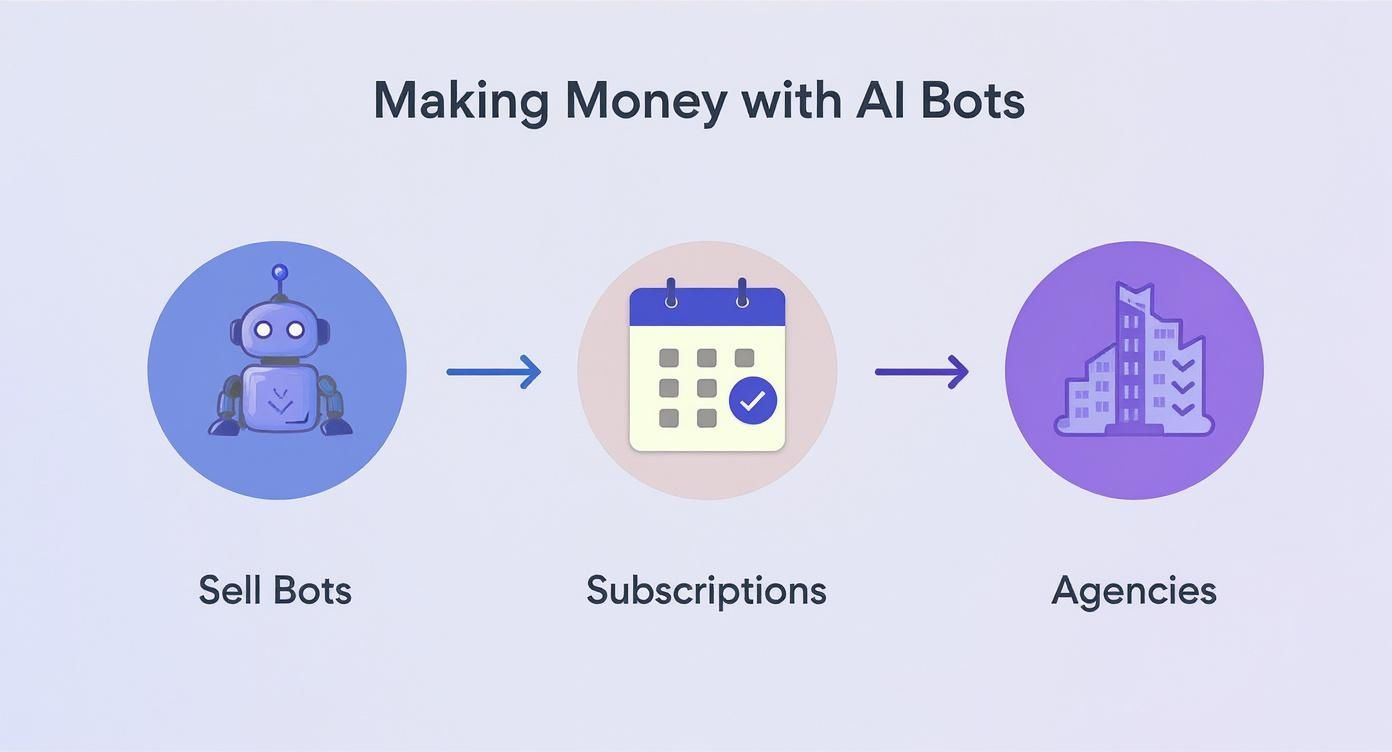
What this really shows is that building the bot is just the beginning. The real income potential comes from creating a scalable model around what you've built. Nailing this mindset is the difference-maker for anyone serious about generating consistent income from their work.
Finding Your Niche And Use Case
To lock down a profitable idea, look at industries that are drowning in appointment scheduling, lead qualification, or just answering the same questions over and over again.
- Real Estate Agents: Imagine a bot that pre-qualifies potential home buyers by asking about their budget, where they want to live, and their timeline. That simple bot could save an agent hours of phone calls every week.
- E-commerce Stores: An FAQ bot can instantly handle common questions like "Where's my order?" or "What's your return policy?" This frees up the human customer service team to deal with the really tricky issues.
- Local Service Businesses: A bot for a local plumber or electrician can schedule appointments, give instant quotes for standard jobs, and collect customer info 24/7, even when the business is closed.
The most successful bots I've seen aren't the most complex; they're the ones that solve the most annoying problems. Find a bottleneck in a business's workflow, and you've found a goldmine for an AI bot solution.
Once you’ve picked your niche, the next job is to map out the bot's conversation flow. Think of it like a choose-your-own-adventure story. What's the first thing a user will say? What are the possible responses? Your mission is to gently guide the user toward a specific, monetizable action. For a deeper dive on how to build these out, check out the resources over at https://createinfluencers.com/guides.
Designing A Conversation That Converts
A great bot conversation feels natural and helpful, not like you're talking to a machine. The secret is to anticipate what the user needs and lead them to a genuinely valuable outcome.
Take that lead qualification bot for a real estate agent. The flow might look something like this:
- Greeting: "Hi! Welcome to Jane Doe Real Estate. Are you looking to buy, sell, or rent a property?"
- Qualification: Based on their answer, it digs a little deeper. If they say "buy," it could ask, "Great! What's your ideal budget range?"
- Action: After gathering the key details, it offers a clear next step: "Thanks! It looks like we have several properties that fit your needs. Would you like to schedule a 15-minute call with Jane to discuss them?"
See how the conversation smoothly moves from gathering information to a direct call-to-action? That final step is what generates a qualified lead. That’s the core of how you make money with AI bots.
As you get into this, exploring the best AI tools for content creation can give you a real edge. These tools can help you write more engaging scripts, fine-tune your bot's personality, and even create marketing materials to promote your new service.
Integrating Revenue-Generating Functions
For your bot to make money, it needs a direct link to the cash register. This means building in functions that can close a sale, capture a lead, or process a payment.
Here are a few must-have integrations to consider:
- Calendar Integration: Connect to tools like Calendly or Google Calendar so users can book appointments or demos right inside the chat. No back-and-forth emails.
- Payment Processing: Integrate with Stripe or PayPal to handle transactions for simple products, services, or deposits.
- CRM Connection: Automatically push qualified leads and all their details directly into the business's CRM, like HubSpot or Salesforce.
Building your first bot is all about iteration. Launch a simple version, get some feedback from real users, and then refine it over time. The goal isn't perfection on day one; it's to create a useful tool that delivers real, tangible value. Once you do that, it becomes a very easy sell for your target clients.
Choosing Your AI Bot Monetization Strategy
Building a fantastic bot is only half the battle. The other, arguably more important half, is figuring out how to actually turn your creation into a real income stream. This is where a smart revenue model comes in. Picking the right one is critical—it has to make sense for what your bot does, who uses it, and what your own financial goals are.
Luckily, you don't have to reinvent the wheel. There are several tried-and-true ways to make money with AI bots. Your job is to find the model that fits your project like a glove, whether you've built a simple FAQ bot or a sophisticated data analysis engine.
Direct Sales and One-Time Fees
The most straightforward way to get paid is to simply sell your bot as a one-off product. This works incredibly well for bots designed to solve a very specific, high-value problem for a niche audience. Think of a custom lead qualification bot for dental clinics or an inventory management bot for small e-commerce stores.
In this scenario, you charge a single fee for the bot's development and setup. Depending on its complexity and the problem it solves, this could be anywhere from $500 to over $5,000. It's a clean transaction that many businesses prefer over getting locked into another monthly bill.
Key Takeaway: The direct sales model is your best bet when the bot delivers a clear, immediate result. The client gets a tangible asset, and you get paid upfront. It's great for cash flow.
Subscription Services for Ongoing Value
Now, if your bot provides continuous value—something that users need day after day, week after week—then a subscription model is the way to go. This approach, often called SaaS (Software as a Service), is perfect for bots that deliver ongoing data, analytics, or other services.
Imagine a bot that scrapes real estate listings and sends daily market updates to investors, or an AI that constantly monitors social media sentiment for brands. Since the value is delivered on a recurring basis, it makes perfect sense to charge a recurring fee. This is how you build a predictable, scalable revenue stream and a truly sustainable business.
Affiliate Marketing and Lead Generation
This strategy is a bit different. Instead of charging users, you turn your bot into a marketing and referral machine. You make money by pointing users toward specific products or services and earning a commission when they buy something or become a qualified lead. This is easily one of the most popular methods to make money with AI bots because the user never has to pull out their credit card.
Here’s how it works in the real world:
Affiliate Marketing: A travel bot helps someone plan a trip to Italy. It suggests flights, hotels, and tours, but it uses special affiliate links for each recommendation. When the user clicks and books, you earn a commission. To get a feel for how these partnerships are structured, you can check out programs like the CreateInfluencers affiliate program.
Lead Generation: A bot on a home renovation website helps a user calculate the cost of a new kitchen. After giving the estimate, it asks, "Would you like a free quote from a top-rated local contractor?" If they say yes, their contact info goes to a partner company, and you get paid for delivering a hot lead.
For this to work, your bot needs to be genuinely helpful first. Trust is everything. You can't just spam links; you have to earn the right to make a recommendation.
This whole ecosystem is being supercharged by a massive wave of investment. Private funding in AI has skyrocketed, hitting $130 billion in 2024. That market confidence is what fuels the platforms and tools that make all these monetization strategies possible. You can dive deeper into these fascinating AI investment trends if you're curious.
At the end of the day, the goal is to choose a monetization strategy that feels like a natural extension of your bot's purpose. Don't try to force a subscription on a bot that offers a one-time fix, and don't cram affiliate links into a conversation where they feel out of place. Match the model to the value, and you’ll build a powerful engine for automated income.
How to Market and Sell Your AI Bot
So, you've built a killer AI bot. That's a huge win, but honestly, it's just half the battle. The real challenge—and where the money is—is getting that bot in front of people who will actually pay for it. A brilliant tool that no one sees is just a passion project, not a business.
The great thing is, you don't need a massive marketing war chest to succeed. The most effective strategies I've seen are all about demonstrating real value, fast. It’s about being smart, targeted, and showing potential clients exactly how your bot solves a problem they actually have.
Embed Your Bot for Instant Engagement
One of the most powerful moves you can make is to let the bot sell itself. Embed a demo version right on your website or a dedicated landing page. This lets potential customers experience its value firsthand instead of just reading about it.
Think about it: if you’ve built a lead qualification bot for real estate agents, let them interact with it right there on your site. They can see for themselves how smoothly it gathers info, answers common questions, and sets up appointments. This kind of direct interaction is far more convincing than any sales pitch and builds instant trust.
Craft a Compelling Value Proposition
When you’re trying to make money with AI bots, your pitch has to be razor-sharp. Business owners don’t care about fancy features; they care about results. Your value proposition needs to speak directly to their pain points and promise a specific, measurable outcome.
Instead of saying your bot "automates customer service," tell them it "reduces customer service tickets by 20%." Don't just say it "qualifies leads"—promise it "delivers 15% more sales-ready leads each month." Using concrete numbers transforms your bot from a neat piece of tech into an indispensable business tool with a clear ROI.
The key is to frame your bot not as a cost, but as a profit center. Show them exactly how it will save them time, reduce expenses, or increase their revenue, and the sale becomes much easier.
Leverage Social Media with Smart Demos
Social media is a fantastic, low-cost way to show off your bot. Just posting about it isn't enough, though. You need to create content that grabs attention and visually demonstrates its power.
- Screen Recordings: Film short clips of your bot in action. Show it handling a complex user query or guiding someone seamlessly through a purchase. These are perfect for platforms like LinkedIn and Twitter.
- Interactive Demos: Use your "link in bio" on Instagram to send followers to a landing page where they can chat with the bot themselves.
- Case Studies: Once you land a few clients, share their success. A simple post like, "See how a local dental clinic used our bot to book 10 new patient appointments last week" is incredibly persuasive.
If you need a spark of inspiration for creating content that drives action, check out some of the latest strategies on the https://createinfluencers.com/blog for fresh ideas.
List on Bot Marketplaces for Inbound Leads
Don't sleep on specialized marketplaces. Platforms like the Bot Store or Chatfuel's marketplace are where businesses are already looking for AI solutions. Listing your bot there is like getting prime shelf space in a busy supermarket.
These platforms can provide a steady stream of inbound leads—people who have a problem and are actively seeking a tool just like yours. Make sure your listing is tight, with a clear description, professional visuals, and a strong value proposition. This is a low-effort marketing channel that can bring in consistent business.
And this channel is only getting bigger. Chatbots have become the fastest-growing way for brands to communicate. Between 2019 and 2020 alone, brand use of chatbots shot up by an incredible 92%, a massive shift toward automated interaction. You can find more insights on this explosive chatbot adoption on AdamConnell.me.
Fine-Tuning Your Bot for Maximum Profit
Getting your AI bot live is a huge step, but it's really just the starting line. If you want to consistently make money with AI bots, you can't just set it and forget it. That's a surefire way to leave cash on the table. The real money is made in the fine-tuning that comes next.
This optimization phase is all about turning raw user data into tangible profit. Think of yourself as a detective, digging into how people are really using your bot. Those little insights are what you'll use to make it smarter, more engaging, and ultimately, a better earner. It’s often the smallest tweaks that unlock the biggest gains.
Uncovering Clues in User Interaction Logs
Your bot’s conversation logs are an absolute goldmine. This isn’t about being creepy; it's about understanding the user's journey from start to finish. Your main goal here is to hunt for "break points"—those exact moments where a user gets stuck, asks something the bot can't handle, or just bails on the conversation entirely.
These break points are your roadmap for what to fix first. For instance, you might notice that 15% of users ask about your refund policy, but the bot has no clue how to answer. Just adding a simple, clear response to that one query could directly save sales from customers who were ready to buy but needed that final piece of information.
To get started, keep an eye out for these patterns:
- Frequent Questions: Are people asking the same thing over and over? That’s a massive red flag that a critical piece of information is missing from your bot's brain.
- "I don't understand" Moments: Pay close attention to the questions or phrases that trigger your bot's generic "I can't help with that" response. This tells you exactly where its language comprehension needs a boost.
- Conversation Drop-offs: Where do users give up and leave? If it’s right after a specific prompt from the bot, the response might be confusing, or the next step isn't compelling enough to keep them engaged.
The most profitable bot optimizations come from listening to what your users are already trying to tell you. Every failed conversation is a free lesson on how to improve your product and make more money.
Boosting Conversions with A/B Testing
Once you've spotted the weak points, it's time to start experimenting. A/B testing is a straightforward but incredibly effective way to improve performance. You simply create two versions of a message (an 'A' and a 'B') and see which one gets better results. It takes all the guesswork out of the equation.
Let's say your bot's main job is to get users to book a demo. Your current call-to-action is pretty standard: "Would you like to schedule a call?" You could test that against a more benefit-driven option, like, "Ready to see how we can boost your leads by 20%? Book a free demo now."
You can A/B test pretty much any element of the conversation:
- Welcome Messages: Is a friendly, casual "Hey there!" more effective than a formal "Welcome, how can I assist you?"
- Button Text: Which gets more clicks: "Learn More" or "See Pricing"?
- Offer Timing: Should you drop an affiliate link right at the start, or is it better to wait until you've provided some value first?
By carefully tracking the conversion rates for each version, you can systematically make every single step of the user journey better. This ongoing cycle of analyzing, testing, and refining is the engine that drives profit growth. It’s what turns your bot from a static tool into a dynamic asset that gets smarter and more profitable with every single interaction.
Frequently Asked Questions About AI Bots
Jumping into the world of AI bots is exciting, but let's be real—you probably have some big questions swirling around. It’s smart to get a handle on the practical side of things, like costs, necessary skills, and what kind of money you can actually make. This is where we’ll clear up the most common concerns people have when they start thinking about how to make money with AI bots.
Think of this as a straightforward chat about what you really need to know. We'll get into the actual startup costs, the skills you truly need (and the ones you don't), what a realistic first year looks like financially, and where the biggest opportunities are hiding in plain sight.
How Much Money Do I Need to Get Started?
One of the biggest myths I hear is that you need a huge pile of cash to get into this game. The truth is, the barrier to entry has never been lower. You aren't building some complex AI model from scratch; you're using powerful platforms that have already done all the heavy lifting for you.
Your main costs really boil down to just a few key things:
- Platform Subscriptions: Most of the top no-code bot-building platforms work on a monthly subscription. You can find plans ranging from a free tier for simple bots all the way up to $50-$300 per month for more powerful features and higher usage caps.
- Marketing & Outreach: Honestly, this can be $0 if you start by tapping into your own network on places like LinkedIn. If you decide to dabble in paid ads, a small budget of $100-$200 is more than enough to get your first few leads in the door.
- Business Basics: This is just the simple stuff like a custom domain for your website and a professional email address, which usually runs about $20-$50 for the whole year.
The bottom line is you can launch your first money-making AI bot for less than what you’d spend on a couple of nice dinners. The initial phase is far more about your time and creativity than it is about a massive financial investment. My advice? Start small, prove your idea works, and then reinvest your early profits.
Do I Really Need to Be a Coding Expert?
Absolutely not. This is probably the number one misconception that stops people in their tracks. The idea that you have to be a programmer to make money with AI bots is completely outdated. The new wave of no-code and low-code platforms has changed everything.
These tools use intuitive, drag-and-drop interfaces that let you design entire conversation flows visually. If you can sketch out a flowchart or map out a simple decision tree, you already have the core logic skills you need to build a surprisingly sophisticated bot. It's much less about writing code and much more about understanding a business's problems and designing a smart, effective solution for them.
What’s a Realistic Income Expectation for the First Year?
Your first year is all about building momentum, not about getting rich overnight. It's so important to set realistic goals. You'll see stories about massive, instant success, but taking a more grounded approach will keep you motivated and help you avoid burnout.
Here’s a more practical timeline of what your income journey could look like:
- Months 1-3: Your entire focus should be on landing your first 1-2 clients. This is the validation stage. The goal here is to prove your concept and get some solid case studies. Your income will likely be modest, maybe $500 - $1,500 total, as you might be offering a lower introductory rate.
- Months 4-8: Once you have a couple of successful projects under your belt, you can start refining your services and charging more. Bringing on 1-2 new clients per month at a better rate could push your monthly income into the $1,000 - $3,000 range.
- Months 9-12: By now, you should have a solid portfolio and some great testimonials. This is the perfect time to explore retainer agreements or subscription-based services. A solid goal would be to consistently hit $3,000 - $5,000+ per month as your reputation and client list grow.
Honestly, success in that first year is less about the final dollar amount and more about building a repeatable system for finding clients, delivering real value, and generating consistent revenue.
What Niches Are Most Profitable Right Now?
While you could build a bot for just about any industry, some niches are way more profitable than others. They have clear, high-value problems that an AI bot can solve almost immediately. If you focus on these areas, you can seriously shorten your path to making good money.
From what I've seen, some of the hottest niches right now include:
- Real Estate: Agents and brokerages are desperate for bots that can pre-qualify buyer leads, schedule property viewings 24/7, and answer common questions about listings.
- E-commerce: FAQ bots that handle order tracking, return policies, and basic product questions can save online stores thousands of dollars a month in customer service costs. It's an easy sell.
- Local Service Businesses: Think plumbers, dentists, and law firms. They can use bots for around-the-clock appointment scheduling and lead capture, making sure they never miss a potential customer who reaches out after hours.
- Coaching and Consulting: Bots are perfect for booking discovery calls, delivering welcome materials, and onboarding new clients, which automates the tedious administrative side of their business.
The secret is to target industries where a single new lead or a saved hour of an employee's time has a high dollar value. When you can draw a straight line from what your bot does to their bottom line, closing the deal becomes incredibly simple.
Ready to stop just reading about AI and start building with it? With CreateInfluencers, you can design your own unique AI characters and generate incredible visuals in just a few minutes. It’s the perfect tool to build your brand or create content that actually gets noticed. Sign up for free at createinfluencers.com and bring your first AI influencer to life today!