How to Start Content Creation A Beginner Guide
Want to learn how to start content creation? This guide breaks down finding your niche, choosing platforms, and creating your first piece of content.
So, you're thinking about creating content. It's a great move, but it's easy to feel like you're a tiny fish in a massive, fast-moving ocean. The good news? You don't need a million followers to build something that matters. It all starts by carving out your own unique corner of the internet. Forget the stereotypes of what a "creator" should be—true success comes from making stuff you're genuinely proud of.
Thriving in Today's Creator Economy

The whole idea of being a "creator" has shifted in a big way. It's no longer just about chasing viral fame or landing huge sponsorship deals. These days, it’s much more about building a real community, sharing what you know, and creating a sustainable career around something you actually enjoy doing.
This change has thrown the doors wide open for beginners. You could launch a niche blog about sustainable urban gardening, become the go-to voice on YouTube for indie video game reviews, or start creating stunning visuals for brands you genuinely admire. Every single one of these paths is a real opportunity to connect with an audience that's tired of slick, corporate content and is craving something authentic.
The trick is to see the real opportunities waiting for you, no matter how small you feel when you start.
The Scale of the Opportunity
The creator economy isn't some fleeting trend; it’s a massive economic force. Back in 2023, it was already a $250 billion global industry. Projections show it’s on track to nearly double, hitting $480 billion by 2027. Even with economic ups and downs, this space just keeps growing, which tells us this is a permanent shift in how we make and consume media. You can learn more about these creator economy statistics over at https://createinfluencers.com/ to really grasp the market's full scope.
This huge ecosystem supports over 200 million creators around the world. But here’s the most important part: success doesn’t mean you have to become a celebrity.
The real engine of the creator economy is the "middle class" of creators. About 140 million of them have audiences between 1,000 and 10,000 followers. This is solid proof that you can build a dedicated community and a successful venture without a massive following.
Finding Your Place
With so many people creating content, it's natural to worry that the market is just too crowded. But that’s the wrong way to look at it.
Think of it as validation. It proves that there's an audience for pretty much any topic you can imagine. Your goal isn't to compete with everyone. It's to find the specific group of people who are searching for exactly what you have to share.
What could that look like for you?
- The Niche Expert: You could become the go-to person for something super specific, like restoring vintage motorcycles or mastering sourdough bread.
- The Community Builder: Maybe your strength is creating a welcoming space where people with a shared interest—like board games or urban hiking—can connect and feel like they belong.
- The Digital Artist: Your talent in photography, video editing, or graphic design could be your content, attracting both a fanbase and potential clients.
Starting your journey is all about picking a direction that plays to your strengths. The first step is simply believing there's a place for your unique voice, because there absolutely is.
Finding Your Niche and Voice
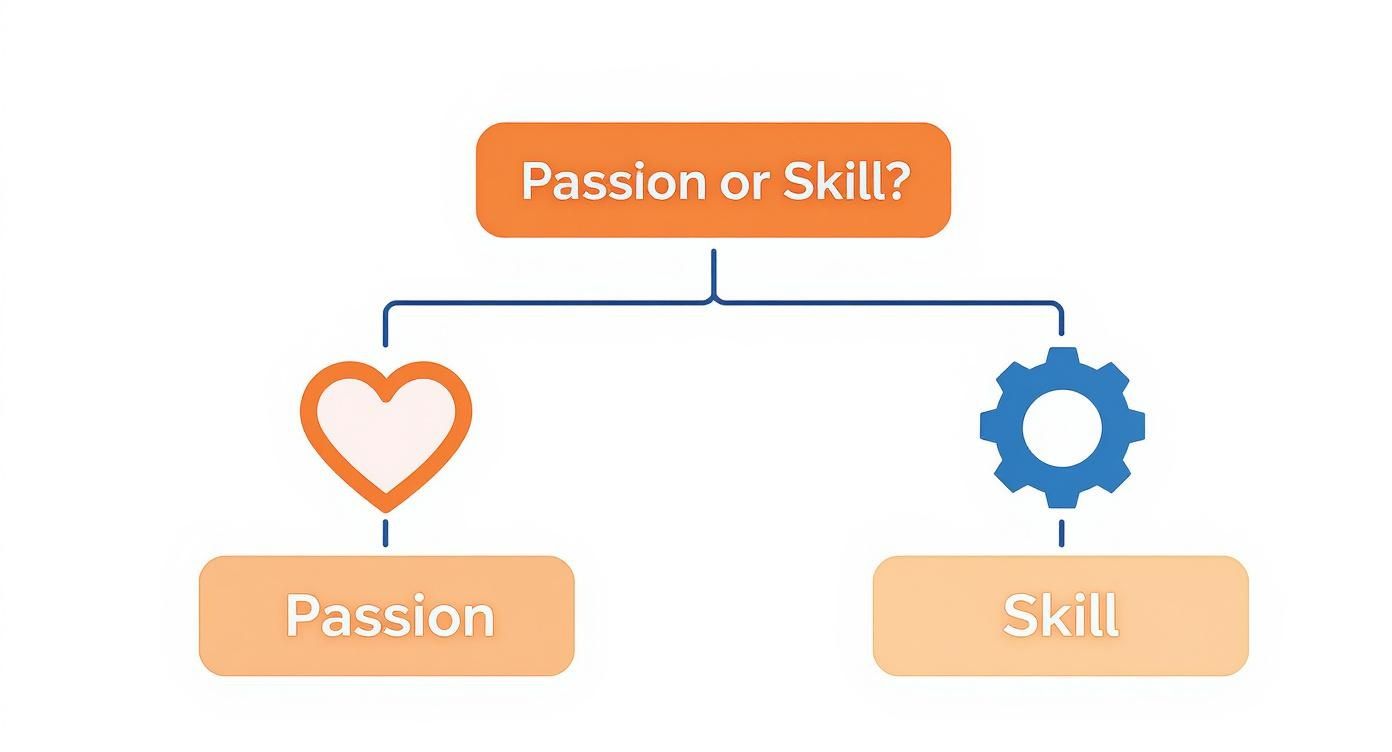
"Find your niche." It's the first piece of advice every new creator gets, and honestly, it can feel a little abstract. What does it actually mean? It’s not about just picking a popular topic. It's about finding that sweet spot where what you're passionate about intersects with what a specific group of people really needs.
Trying to make content for absolutely everyone is a recipe for getting completely ignored. The real magic happens when you get specific. Think about it: instead of a generic "tech review" channel, what if you focused on smart home gadgets for people in small apartments? Instead of a broad "baking" blog, why not specialize in single-serving desserts for people who live alone? This laser-focused approach is how you start building a dedicated community from day one.
And in today's world, that focus is more critical than ever. The global content creation market was a massive $27.1 billion industry in 2023, and it's on track to blow past $34.5 billion by 2025. That tells us two things: people are hungry for great content, but there’s also a ton of noise to cut through. Your unique angle is your best tool for standing out. If you're curious, you can dig into more digital content creation statistics to see just how big this space has become.
How to Pinpoint Your Niche
Nailing down your niche is part self-discovery, part detective work. You’re looking for a topic you could talk about for hours, but also one that has an audience actively searching for answers.
Get a pen and paper (or open a new doc) and start by asking yourself a few key questions:
- What am I obsessed with? What do you find yourself reading, watching, or talking about just for fun? Your genuine curiosity is the fuel that will keep you going long-term.
- What problems can I solve? Content that helps someone learn something new, fix an annoying issue, or reach a goal is always valuable.
- What's my unique take? Your life experiences, your background, even your mistakes—that's what makes your perspective one-of-a-kind. This is the foundation of an authentic voice.
Got a few ideas? Great. Now it's time for a little reconnaissance. Dive into communities on places like Reddit or in Facebook groups. Are people asking questions related to your topic? See what’s already out there. This isn’t to copy anyone, but to find the gaps—the unanswered questions you can step in and fill.
Defining Your Authentic Voice
If your niche is what you talk about, your voice is how you talk about it. It's the personality that shines through, making your content undeniably yours. It can be tempting to mimic a popular creator, but trust me, people connect with realness, not a performance.
Your voice is a mix of your perspective, your personality, and what you stand for. It's the reason someone will choose your podcast or your blog over the thousand others on the same subject. Just be you.
Are you naturally witty and a bit sarcastic? Or are you more of the encouraging, empathetic type? Maybe you’re just straight-to-the-point and analytical. There’s no right or wrong answer. Your voice should feel as comfortable as your favorite t-shirt. If you're straining to sound a certain way, it's not going to work. The more your content sounds like you just talking to a friend, the easier it will be to create and the stronger the connection with your audience will be.
Choosing Your Platforms and Essential Tools
So, you've figured out your niche. Fantastic. The next question is a big one: where is all this amazing content going to live? The platform you pick influences everything—from your creation process to the community you build. It's a major decision, but don't let it become a roadblock.
Choosing between a blog, a YouTube channel, or a TikTok account isn't about chasing trends. It's about finding the sweet spot where your natural talents meet your audience's hangout spots. If you're a writer at heart, a blog is a natural fit. If you light up on camera, video is your stage.
Selecting Your Primary Platform
Your main platform should feel like home—a place you're genuinely excited to show up and create, day in and day out. Think honestly about what kind of content you enjoy making.
- Blogs: Perfect for deep dives and evergreen content. They're a slow burn, but they build serious authority and are gold for SEO.
- YouTube: The undisputed king of long-form video. It's the go-to for tutorials, detailed reviews, and vlogs that let your personality shine.
- TikTok/Instagram Reels: These are all about short, punchy videos. They're built for grabbing attention fast and showing a more spontaneous side of you.
- Podcasts: Incredible for creating a personal connection. Listeners tune in while driving, working out, or doing chores, making you a voice in their daily lives.
To help you sort through the options, I've put together a quick comparison.
Platform Comparison for New Content Creators
This table breaks down the most popular platforms to help you see where your skills and goals might fit best. There's no single "right" answer, only what's right for you.
| Platform | Best For | Primary Skill Needed | Time to See Growth |
|---|---|---|---|
| Blog | In-depth articles, tutorials, building topical authority. | Strong writing and SEO knowledge. | 6-12 months |
| YouTube | Vlogs, how-to videos, product reviews, entertainment. | Video editing and on-camera presence. | 3-9 months |
| TikTok/Reels | Short-form entertainment, trends, quick tips. | Creativity and ability to hook viewers in 3 seconds. | 1-6 months |
| Podcast | Interviews, storytelling, deep-dive discussions. | Clear speaking and audio editing. | 4-8 months |
Ultimately, picking a platform is about leaning into your strengths. Align your choice with what you're naturally good at, because that's what will keep you going when the initial excitement wears off.
If you want to dig deeper into platform-specific strategies, we have a whole collection of creator guides that can help.
Assembling Your Starter Toolkit
Let’s bust a myth right now: you do not need a ton of expensive gear to get started. Your smartphone is a production powerhouse. I’ve seen creators with millions of followers who still film on their iPhones.
High-quality content is born from creativity and resourcefulness, not a hefty credit card bill. The goal is to build a simple, effective toolkit that gets the job done.
The best tool is the one you’ll actually use. Focus on mastering one or two simple programs instead of getting overwhelmed by professional software with a steep learning curve.
A perfect example is Canva. It's a lifesaver for anyone who isn't a graphic designer. You can whip up professional-looking thumbnails, social media posts, and infographics with its drag-and-drop interface. Seriously, it's a game-changer.
Many creators are also turning to AI to help with the heavy lifting. If you want to speed up your process for things like scripting or brainstorming, it’s worth checking out the best AI tools for content creators. Just remember to start simple, focus on making great stuff, and add to your toolkit as you grow.
Planning and Producing Your First Content Piece

Alright, this is where the rubber meets the road—the point where your abstract ideas start taking shape. I know that stare-down with a blank page or an unblinking camera lens can feel intimidating. The secret? Action over perfection.
Seriously. Your first piece of content won't be your magnum opus, and that's not just okay; it's expected. The real goal here is to get something done, learn from the process, and then do it again.
Let's walk through this together, breaking it down from brainstorming an actual topic to the simple mechanics of hitting "publish." Whether you're firing up a Google Doc or setting up your phone to record, a basic plan makes all the difference.
Brainstorming With Purpose
A truly great piece of content almost always starts with a very focused idea. Forget trying to be a revolutionary genius on your first attempt. Instead, just aim to solve one small, specific problem for someone in your audience.
Think about the questions that pop up again and again in your niche.
- What are the little things that constantly trip people up?
- Is there a process everyone finds confusing that you could simplify?
- What's a quick win you can help someone achieve right now?
Answering one of these is gold. For example, if you're a fitness creator, a vague topic like "How to Get Fit" is a black hole. A much better starting point is "A 5-Minute Morning Stretch Routine for Desk Workers." It's specific, targeted, and immediately valuable.
The best content ideas I've seen are often the simplest. They give a clear, direct answer to a single, nagging question your audience has. Focus on delivering that one piece of value, not on reinventing the wheel.
Creating a Simple Outline
Once you’ve landed on your topic, fight the urge to just jump in and start creating. A quick outline is your best friend. It’s the roadmap that keeps you from getting lost and ensures your content flows logically. This doesn't need to be a formal, multi-page document—a few bullet points on a sticky note will do.
No matter the format, a solid piece of content has three core parts:
- The Hook: How will you grab their attention in the first 3 seconds? Start with a relatable problem, a surprising fact, or a bold question.
- The Core Value: This is the meat of your content. Break down the solution or information you promised into a few key points or easy-to-follow steps. This is where you deliver on your hook.
- The Call to Action (CTA): Don't just end abruptly. Tell your audience what to do next. Ask a question to spark comments, invite them to subscribe, or point them to another helpful resource.
This simple structure is incredibly versatile. It works just as well for a 60-second TikTok script as it does for a 2,000-word blog post. To see more of these strategies in action, you can dig into our guides on the CreateInfluencers blog.
Production Basics That Make a Difference
Now it's time to actually make the thing. The good news is, the tools you use matter far less than getting the fundamentals right. Whether you're writing or recording, clarity is everything.
For a blog post, that means making it effortless to read.
- Use short, punchy paragraphs (stick to 1-3 sentences).
- Break up walls of text with descriptive headings and bullet points.
- Bold key phrases to help skimmers catch the most important points.
If you’re making a video, nail just two things: clear audio and good lighting. You don't need a pro-level studio. A quiet room with lots of soft surfaces (like rugs and curtains) kills echo, and sitting near a window gives you beautiful, free, natural light.
Trust me on this: people will forgive a slightly shaky camera, but they will click away instantly if they can't hear you clearly. Getting these basics right is a huge step in learning how to start content creation the right way.
Publishing Your Content and Growing an Audience
You did it. You hit "publish." That’s a huge moment, and it's worth celebrating. But now comes the next, equally important part: getting your hard work in front of the right people. This is where your content stops being a project and starts becoming a conversation.
The good news? You don't need a massive marketing budget to make a splash. It’s all about being smart and strategic with where you put your energy. First, ask yourself: where does my ideal audience already spend their time online?
Smart Promotion on a Budget
Instead of just posting and hoping for the best, you need to go where the conversations are already happening. Think about niche communities on platforms like Reddit, dedicated Facebook Groups, or specific Discord servers that align with your content.
The golden rule here is to contribute before you promote. Jump into discussions, answer questions, and be a genuinely helpful member of the community. Only share your link when it directly answers a question or adds real value to the discussion. People can spot a self-promoter a mile away, but they appreciate someone who leads by helping.
Social media is obviously another great channel, but it demands consistency. One of the most practical skills you can develop is learning how to schedule social media posts effectively. This allows you to maintain a steady presence and keep your audience engaged without having to be glued to your screen all day.
Your goal isn't just to get clicks; it's to build a reputation as a helpful, knowledgeable voice in your community. When you lead with value, people are far more likely to check out what you've created.
A Gentle Introduction to SEO
SEO, or Search Engine Optimization, sounds intimidating, but the core concept is pretty straightforward. You're just making it easier for search engines like Google to understand your content and show it to the right people. For beginners, this really just comes down to a few simple habits.
It all starts with using relevant keywords in your titles, descriptions, and headings. Put yourself in your audience's shoes—what would they actually type into Google to find what you've made?
- A video titled "5-Minute Morning Stretch for Desk Workers" is infinitely more discoverable than "My New Stretch Routine."
- A blog post called "Beginner's Guide to Sourdough Starters" will find its audience much faster than "My Baking Journey."
This tiny shift in how you title your work can make a massive difference in how people find you over time. As you get the hang of content creation, these basic SEO practices will give you a serious leg up.
Learning from Feedback and Data
Finally, remember that every piece of content is a chance to learn. Once your work is live, pay close attention to what people are saying. What comments are you getting? What questions keep popping up? This is direct feedback from your audience on what's resonating.
You should also peek at the basic analytics your platform provides. Which video got the most views? What blog post had the longest average reading time? These numbers aren't a report card on your worth; they're valuable clues. They tell you exactly what your audience wants more of, helping you make your next piece of content even better than the last.
Your Next Steps as a Content Creator
Getting that first piece of content out the door is a huge milestone. Seriously, take a moment to celebrate. But what you do next is what really separates a flash-in-the-pan hobby from a genuine creative career.
The goal right now isn’t to go viral overnight. Instead, it’s all about building simple, repeatable systems that let you create consistently without burning yourself out. This is the foundation for everything that comes next.
Your main job is to find a rhythm. Consistency is a signal—to your audience and to the algorithms—that you’re here to stay. This doesn't mean you need to post every single day. Far from it. It just means picking a realistic schedule you can actually live with, whether that’s one new blog post a week or a couple of short videos.
Build a Simple Content Calendar
I know, a "content calendar" can sound a bit stuffy and corporate. But really, it's just a simple plan to keep your ideas from getting lost and your schedule on track. It completely removes that daily panic of, "Oh no, what am I supposed to post today?"
You don't need fancy software. A basic spreadsheet or even a physical notebook works perfectly. Just start by mapping out your ideas for the next two to four weeks.
All you need are a few columns:
- Publish Date: When you plan for it to go live.
- Topic/Idea: A quick note on what the content is about.
- Format: Is this a blog post? A video? An Instagram Reel?
- Status: A simple tracker like "Idea," "In Progress," or "Published."
This simple framework brings so much clarity. It helps you stop reacting to the whims of the day and start being proactive about the content you want to create.
A content calendar isn't a strict contract you can never break. Think of it as a flexible guide. Its real power is in preventing that "blank page" paralysis because you always know what's coming up.
Set Realistic and Actionable Goals
Okay, you’ve got a plan. Now you need a way to know if it’s actually working. The trick is to avoid vague goals like "get more followers." Instead, focus on small, manageable milestones that create real momentum.
For your first month, a great goal might be: "Publish four blog posts and share each one in three relevant online communities."
See the difference? It's specific, you can measure it, and it's completely within your control. Success, in the beginning, isn't about hitting 10,000 followers in a week. It’s about building the habits that will eventually get you there.
Down the road, as your audience grows, you can start thinking about monetization. When you're ready, our guide on joining an affiliate program is a great place to learn how to turn your influence into income.
At the end of the day, content creation is a marathon, not a sprint. The real secret is to keep refining your process, listen to what your audience responds to, and just keep showing up. That’s how you build something that lasts.
Ready to create stunning visuals for your brand? With CreateInfluencers, you can generate custom AI influencers, images, and videos in minutes. Start creating for free and bring your vision to life.