How to Create Viral Content That Actually Connects
Learn how to create viral content that resonates. Our guide covers emotional triggers, platform strategy, and smart distribution to make your content shareable.

Crafting content that truly goes viral isn't about luck. It's about tapping into the core of human psychology and understanding what makes people need to share something. This is a game of emotion and strategy, not a lottery.
What Really Makes Content Go Viral Today

The biggest myth I see creators fall for is that virality just happens. It doesn't. It’s an engineered outcome. The playbook for creating viral content has changed; it’s less about chasing short-lived trends and more about forging real connections that the algorithms are now smart enough to recognize and reward.
Think about what today’s platforms value. They aren't just counting views anymore. They’re looking for signals of genuine engagement—comments, saves, shares, and even video replies. These actions tell the algorithm that your content isn't just being watched; it's making a real impact. The goal isn't just to be seen, it's to be felt.
The Pillars of Modern Virality
If you want to create shareable content consistently, you need to build it on a solid foundation. I’ve found that focusing on these three elements dramatically boosts the odds of breaking through the noise.
- Emotional Hooks: People share content when it sparks a strong feeling. It could be awe, gut-busting laughter, shock, or even a sense of shared frustration. That emotion is the fuel for the share button.
- Strategic Timing: This is so much more than just posting when your audience is online. It's about plugging into the cultural zeitgeist—a current event, a seasonal moment, a trending conversation—in a way that feels relevant and fresh.
- Platform-Native Formatting: A masterpiece of a TikTok video will likely fall flat on LinkedIn. Every platform has its own unspoken language and visual style. Your content needs to feel like it belongs there.
At its heart, virality is just digital word-of-mouth. Understanding the mechanics behind powerful word-of-mouth marketing strategies is crucial because the same principles apply.
To get a sense of what makes people click that share button, let's break down the core drivers.
Core Elements of Shareable Content
| Element | Psychological Driver | Example Action |
|---|---|---|
| Emotion | High-arousal feelings (joy, anger, awe) trigger a physiological need to act and connect. | Creating a heartwarming rescue story or a hilarious relatable sketch. |
| Utility | People share content that offers practical value to their network, making them look helpful. | Sharing a "life hack" video or a list of genuinely useful free tools. |
| Identity | Content allows people to signal who they are and what they stand for. | Sharing a political meme or a post that celebrates a specific hobby or subculture. |
| Storytelling | A compelling narrative with a clear beginning, middle, and end captivates attention and is more memorable. | Documenting a personal transformation journey or telling a suspenseful short story. |
By consciously building these elements into your work, you move from hoping for a hit to intentionally creating one.
Why Community Trumps Clickbait
Let's face it: the internet is incredibly crowded. With an estimated 5.42 billion social media users globally, and the average person juggling nearly seven different platforms a month, just getting noticed is a challenge. Short-form video is still king, and the algorithms are clearly rewarding interaction over passive consumption. Your content has to be designed for a phone screen, spark a conversation, and feel native to the platform you're on.
The new goal isn't just to get a million views; it's to get a thousand people talking. A passionate, engaged community will amplify your content far more effectively than a passive, disconnected audience ever could.
This is a fundamental mindset shift. Stop asking, "How do I get seen?" and start asking, "How can I start a conversation?" This approach not only aligns with what the algorithms want but also helps you build a loyal base that will champion your work long after one piece of content fades.
For those looking to push the boundaries, exploring how to build an audience with a unique persona can be a game-changer. Some are even using tools to https://createinfluencers.com/ to craft compelling digital personalities that resonate deeply with niche communities.
Unlock Your Audience's Emotional Triggers
If you want your content to go viral, you need to shift your focus. Stop obsessing over what you're making and start thinking about how you want people to feel. Emotion is what powers the share button. Seriously. Content that triggers a powerful, high-arousal emotion—think awe, uncontrollable laughter, or even a bit of righteous anger—is what gets passed around.
People don’t share a video just because it's well-produced. They share it because it made them laugh so hard they cried. They don’t share an article because of its word count; they share it because it confirmed a deeply held belief or gave them a jolt of hope. This is the secret: engineer the feeling first, and the content will follow.
Moving Beyond Generic Emotional Advice
Telling someone to "be authentic" or "make emotional content" is about as helpful as telling a chef to "make tasty food." It's uselessly vague. The real work is in pinpointing the specific emotions that light a fire under your audience. What makes one community erupt in laughter might barely get a smile from another.
Think of yourself as an emotional detective. Your mission is to uncover the unique passions, frustrations, and inside jokes that define your people. This isn't about guesswork; it's about putting your ear to the ground.
- Social Listening: Lurk where your audience lives online. Dive into Reddit threads, Facebook groups, Discord servers, or the comment sections of popular creators in your niche. What are they constantly complaining about? What memes are they passing around? What topics get them riled up?
- Community Analysis: Pay close attention to the language and slang they use. Is it cynical? Hopeful? Self-deprecating? This linguistic fingerprint is a dead giveaway for their collective emotional state.
- Survey Your Superfans: Don't be afraid to just ask! A simple poll or an open-ended question for your most engaged followers, like, "What's the funniest thing you've seen this week?" can give you a goldmine of emotional data.
Going through this process helps you build an "emotional resonance map" for your audience. It becomes your blueprint for what makes them tick, allowing you to create stuff that feels like it was made just for them.
The most powerful content doesn't just present an idea; it validates an existing feeling. It makes someone say, "Finally, someone gets it!" That moment of recognition is what triggers the impulse to share.
Uncovering Niche Passions and Pain Points
Once you really start listening, you’ll find that broad emotions like "happiness" are way too general. You've got to find the niche triggers. For instance, instead of just "humor," you might discover that your audience of software developers finds cathartic humor in the shared misery of debugging stubborn code.
This screenshot from Google Trends compares interest in "dopamine dressing" versus "quiet luxury"—two wildly different fashion mindsets.
The data shows that while both trends have their moments, they cater to completely different emotional needs. One is about joyful self-expression, the other about understated elegance. A brand that tries to tap into the "quiet luxury" vibe will completely miss the mark if its content is screaming "dopamine dressing."
Just look at the Stanley cup phenomenon. On the surface, it’s a tumbler. But the brand tapped into a very specific emotional cocktail: the deep satisfaction of organization (#watertok), a sense of community, and the aspirational feeling of wellness. They didn't just sell a cup; they sold the feeling of having your life together and being part of the in-crowd.
Your goal is to find your audience's "Stanley cup"—that thing, tangible or not, that plugs directly into a deeper emotional need. Once you find it, you have a repeatable way to create content that connects on a level that a simple "like" can't even touch. You're triggering a feeling that makes sharing feel like an involuntary reaction.
Crafting Content People Can't Help But Share
Now that you have a bead on the emotional pulse of your audience, it’s time to actually build the thing. This isn't about just winging it and seeing what sticks; it's more like being an architect. Every truly viral piece of content has a specific anatomy, a structure meticulously designed to grab attention and practically force a share.
Think about it. From the first three seconds of a Reel to the punchline of a killer tweet, every single element has a job to do. The best creators are masters of storytelling, visual hooks, and even sound. They know how to get someone to stop scrolling and keep them there until the very end.
The Shareability Quotient
Before I post anything, I run it through a mental checklist I call the "shareability quotient." It’s an invisible score based on a few key factors that predict whether someone will actually hit that share button.
- Relatability: Does this make someone feel seen? It needs to mirror a shared experience or emotion so perfectly that they think, "OMG, that's me."
- Utility: Is this genuinely useful? A clever life hack, a mind-blowing fact, or a simple tutorial gets shared because it makes the sharer look smart and helpful to their friends.
- Social Currency: Does sharing this make someone look good? People share content that reinforces their identity, signals their humor and intelligence, or shows they’re in on the latest trend.
This infographic gives a good visual breakdown of how these three drivers usually stack up.
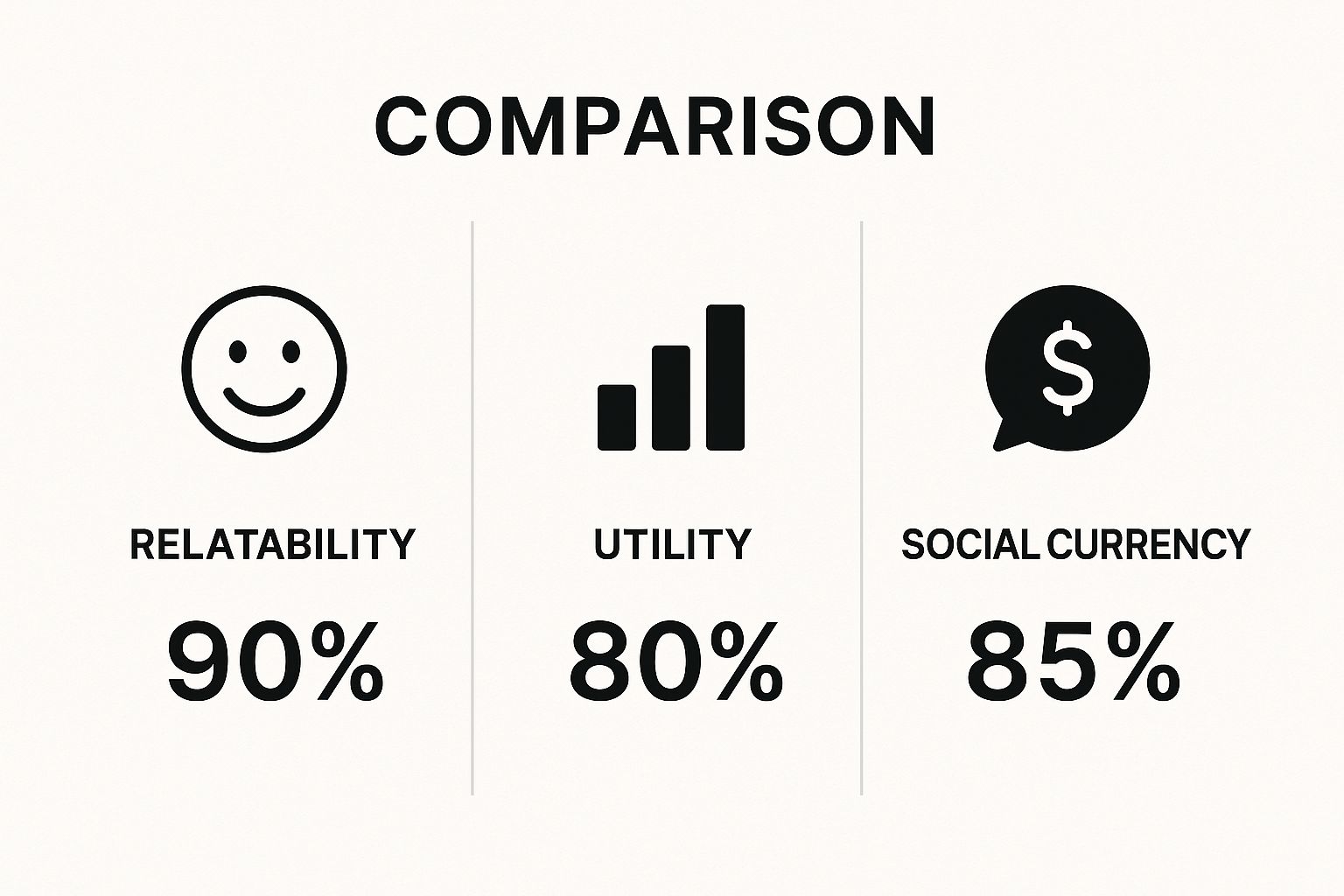
As you can see, while they all play a part, relatability is often the heavy hitter. It creates an instant, personal connection that’s hard to ignore.
Balancing Trends with Originality
Hopping on a trend is an easy way to get in front of eyeballs, but just copying what everyone else is doing is a dead end. The real magic happens when you use a familiar trend as a Trojan horse for your own unique perspective.
You want to join a conversation people are already having, but with a twist they didn't see coming.
For instance, when the "Little Miss" meme was everywhere, a therapist could create a post titled "Little Miss Avoids Her Feelings." It's a perfect example of taking a popular format, applying it to a specific niche, and creating something both funny and relatable that cuts through the noise. For more ideas like this, check out our other creator-focused guides.
The anatomy of a perfect viral post is simple: a familiar hook that grabs attention, followed by an unexpected twist that earns the share. It's the balance between comfort and surprise.
The Power of Calculated Creative Risks
At the end of the day, the creators and brands that consistently go viral are the ones who aren't afraid to experiment. If you're stuck in a rigid brand voice, you'll choke the creativity right out of your content.
Industry research shows that social teams who post boundary-pushing content are way more likely to see a ‘very positive’ impact on their business than those who play it safe. Audiences don't just tolerate creativity; they celebrate it, especially when it feels authentic.
This is your permission slip to try that weird video idea. Post that vulnerable story. Adopt a slightly different persona for TikTok than you use on LinkedIn. Not every bet will pay off, but the ones that do can completely change the game for you. It's about being brave enough to be different.
Choosing the Right Platform to Dominate

Trying to go viral by blasting the same piece of content everywhere is a rookie mistake. It’s like trying to order a coffee in a library—you might get what you want, but you'll mostly just get weird looks.
Every social media platform is its own little universe. Each has a unique culture, a different sense of humor, and its own set of unwritten rules. The secret isn't being everywhere; it's being brilliant in the right place.
A sharp, witty observation that would blow up on X (formerly Twitter) would die a silent death on Instagram Reels. Likewise, a high-energy video using a trending TikTok sound would feel completely out of place and a little desperate on a LinkedIn feed.
Your first job is to stop thinking of platforms as just distribution channels. They're different rooms full of different people. People open TikTok for raw, rapid-fire entertainment. They scroll Instagram for visual inspiration. They use LinkedIn for professional growth. Your content has to match that mindset to even have a fighting chance.
Decoding the Platform Cultures
To create content that feels native and has a shot at spreading, you have to become fluent in the local language of each platform. This goes way beyond just the format—it’s about the entire vibe.
TikTok: This is the home of unfiltered, often chaotic creativity. The humor can be incredibly niche, self-deprecating, and moves at lightning speed. Success here is all about authenticity, jumping on trends with your own spin, and pure relatability. Anything that feels too polished or corporate usually gets ignored.
Instagram Reels: While it looks a lot like TikTok, Reels tends to lean more aspirational and aesthetically pleasing. Think beautifully shot travel clips, oddly satisfying DIY projects, or inspirational mini-vlogs. It's a bit more polished, but genuine storytelling still wins.
X (Twitter): This is the ultimate arena for wit, real-time commentary, and punchy thoughts. Virality here is almost always sparked by a clever joke, a controversial take, or a universally relatable complaint packed into 280 characters. It’s a text-first world where brevity is king.
LinkedIn: The professional playground. Content that takes off here is almost always built around providing real value, inspiration, or sharp industry insights. Think actionable career advice, compelling success stories, or thoughtful analyses of business trends. The tone is more buttoned-up, but vulnerability and personal stories are becoming increasingly powerful.
Getting these nuances right is what separates the content that blends in from the content that stands out. It ensures your message is actually received, not just scrolled past.
You wouldn't wear a tuxedo to a backyard barbecue. Treat your content the same way. Dress your core idea in the right outfit for each specific platform to make it feel like it belongs there.
Adapting Your Core Idea Without Losing Its Soul
Let’s say your core idea is a humorous take on the daily struggles of working from home. Instead of a one-size-fits-all post, you get strategic and adapt it.
For TikTok: You’d create a short, fast-cut video showing the chaotic reality vs. the calm expectation of WFH, all set to a trending audio clip. It’s raw, funny, and uses quick visual gags.
For Instagram Reels: Here, you might film a more cinematic mini-vlog titled "A Day in My WFH Life," mixing aesthetic shots of your workspace with relatable struggles, set to some gentle, inspiring music.
For X: You fire off a witty one-liner: "My WFH productivity is directly proportional to how far away my snack cupboard is. Today, we are not productive."
For LinkedIn: You’d write a short, thoughtful post about overcoming WFH burnout, sharing three practical tips that helped you stay focused. It's framed as a lesson in professional resilience.
The core message is the same in every case, but the execution is tailored perfectly for each audience. This is how you maximize your reach and engagement.
Platform Content Strategy Comparison
To make this crystal clear, here’s a quick-glance table breaking down the essential differences you need to internalize. Think of it as your cheat sheet for adapting your content.
| Platform | Primary Format | Audience Mindset | Key to Virality |
|---|---|---|---|
| TikTok | Short-form video (15-60s) | Entertainment-seeking, trend-driven | Relatability, humor, unique trend participation |
| High-quality visuals, Reels | Aspiration, lifestyle, connection | Aesthetics, emotional storytelling, inspiration | |
| X | Text, memes, short clips | Information-seeking, conversational | Wit, timeliness, bold opinions, humor |
| Text posts, articles, video | Professional development, networking | Utility, inspirational stories, industry insights |
Ultimately, choosing the right platform boils down to matching your content's strengths and your brand’s personality with the audience's expectations. Get really good at one or two platforms where your stuff feels most at home before you even think about conquering them all. This focused approach gives you a much better shot at creating something that truly connects and spreads like wildfire.
Engineering a Smart Distribution Strategy
Making a piece of content with viral potential is only half the battle. The other, arguably more important, half is giving it the strategic push it needs to actually get seen. You can't just hit "publish" and hope for the best. You need a launch plan engineered to show the algorithm your content is worth paying attention to from the second it goes live.
Here’s how it works: the algorithm is always testing new content on small groups of people. If that first batch engages like crazy—liking, commenting, saving, and sharing—the platform sees a strong signal to push it out to a much wider audience. Your whole distribution strategy is built around passing that initial test with flying colors.
Prime Your Post for Peak Performance
Everyone knows timing is important, but it's not just about posting when your analytics dashboard says your followers are online. You have to think about when people are in the right mindset for your specific type of content. A hilarious, relatable skit? That'll probably land best during evening scroll time. A deep dive into industry news? Mid-morning during the workweek is a much better bet.
A common mistake is thinking distribution starts after you post. A smart distribution strategy begins before you even hit 'publish.' It’s about building anticipation and having a clear plan for that critical first hour.
That initial launch window is everything. Be ready to jump on every single comment that comes in. Replying not only builds a community feel but also literally doubles your comment count, signaling to the algorithm that your post is sparking a real conversation. This early momentum can be the single thing that separates a post that dies from one that goes nuclear.
Finding Fertile Ground in Niche Communities
Your content doesn't need to be for everyone, especially not at first. In fact, starting with a hyper-targeted audience is often way more effective. Before you post, scout out some niche communities where your content would be seen as incredibly relevant and valuable.
Think about places like:
- Specific Subreddits: Find subreddits where your content solves a problem, answers a question, or taps into a shared inside joke.
- Dedicated Facebook Groups: Join active groups centered on your topic and share your work when it genuinely adds to the discussion.
- Discord Servers: If you're part of engaged servers, sharing your content can trigger immediate feedback and discussion among true fans.
The key here is not to spam links. It’s about being a genuine member of the community and offering your content as a helpful resource. A single well-received post in the right subreddit can send a wave of highly engaged traffic your way, giving the algorithm all the positive signals it needs. This momentum-building approach is a topic we dive into often over on the CreateInfluencers blog.
Smart Amplification to Widen Your Reach
Once you've got some organic traction bubbling up, it's time to pour some fuel on the fire. This means using other people, current trends, and even a small budget to push your content beyond your immediate circle of followers.
Collaborating with other creators is one of the most powerful ways to do this, and it doesn't have to be some huge, planned-out production. Using built-in features like TikTok's Duets or Instagram's Remix lets you jump onto a bigger creator's content, add your own spin, and get in front of their audience.
Jumping on relevant trends is also non-negotiable. Add your unique take to a trending sound, format, or meme. You're essentially joining a conversation that people are already tuned into, which makes your content far more discoverable.
Finally, don't write off paid promotion. Even a small, tightly targeted ad spend can work wonders in getting your content in front of the perfect audience. For a truly powerful distribution plan, using search engine marketing intelligence can give both your organic and paid efforts a serious boost, making sure you reach the people most likely to engage and share.
Common Questions About Creating Viral Content
Trying to make content go viral can feel like catching lightning in a bottle. Even with a great plan, you're bound to have questions. I get asked these all the time, so let's break down some of the most common ones with answers you can actually use.
This isn't about high-level theory. It's about what really happens in the trenches. Getting these details right can be the difference between a post that gets a handful of likes and one that absolutely explodes.
How Long Does It Take for Content to Go Viral?
There's no set timeline, but virality usually happens in stages. The initial spark almost always happens within the first 24 to 48 hours. This is the algorithm's testing period. It pushes your content out to a small slice of your audience to see if it sticks.
If that first group eats it up—meaning they watch, share, save, and comment like crazy—the algorithm gets the message. It starts pushing your content to a much, much bigger audience. That’s when you see that incredible, exponential growth that can last for days or even weeks. Some content also has a "slow burn," catching fire long after it was first posted.
The big takeaway here? That first burst of engagement is everything. Your job in the first few hours is to convince the algorithm that people are so hooked they can't help but interact.
Can I Make Any Topic Go Viral?
I hear this one a lot. While it’s true that things like comedy or feel-good stories have a natural edge, almost any niche has viral potential. The secret is to find the human element, even in what seems like a "boring" topic. You have to connect it to the universal emotional triggers we talked about earlier.
Think about it this way:
- A dry tutorial on accounting software? Snooze-fest. But a TikTok showing the pure, shared frustration of an accountant during tax season? That’s gold for that specific community because it’s so relatable.
- A video just about organizing a spice rack is fine. But one that shows a chaotic, messy "before" and a perfectly satisfying, color-coded "after"? That triggers a feeling of calm and order that people love to see.
Don't get hung up on the topic itself. Focus on the relatability, surprise, or overwhelming value you can deliver within that niche.
What Metrics Signal Viral Potential?
In the early stages, views are just a vanity metric. To see if something is really about to take off, you need to look at the engagement signals that show people are taking action.
Keep a close eye on these indicators right after you post:
- High Share-to-View Ratio: This is the holy grail. It means people aren't just consuming your content; they're putting their own reputation on the line by recommending it to their friends.
- High Save Rate: When people hit the save button, they're telling the platform, "This is so valuable I need to come back to it." That’s a huge signal of quality.
- High Comment-to-Like Ratio: This shows you’ve sparked a real conversation. An active comment section is a powerful indicator that your content has struck a nerve.
For video, watch time and completion rate are king. If you can keep people watching until the very end, the platform sees your content as high-quality and will push it to more people.
Should I Follow Trends or Be Original?
It’s the classic creator dilemma, right? But it's not an either/or situation. The best content often blends the two. Think of a trend—a sound, a format, a challenge—as a familiar Trojan horse you can use to deliver your own unique perspective.
Just blindly copying a trend adds nothing new and you'll just get lost in the sea of lookalikes. The posts that truly break through are the ones that put a clever, creative twist on what’s popular. Keep an eye on trends to know what people are talking about, but always inject your own personality.
As you build a following, you can even rally your community around your content. Our guide on launching an influencer affiliate program has some great ideas on how to mobilize your biggest fans.
Ready to create AI influencers that captivate audiences and have viral potential? With CreateInfluencers, you can generate unique, high-resolution characters, images, and videos in minutes. Start for free and bring your most creative ideas to life. https://createinfluencers.com