How to Create AI Models for Influencers
Learn how to create AI models with our guide. Discover practical steps for designing, training, and monetizing your own AI influencer from scratch.
Creating an AI influencer isn't about needing a server farm in your garage anymore. It's really an exercise in focused strategy and creativity. You're building a character from the ground up—defining their personality, figuring out who they're for, and then using the right tools to bring that digital person to life. The most important work happens long before you touch any of the tech.
What it Really Takes to Build an AI Influencer Today
The idea of making your own AI model used to feel like pure science fiction, something only massive tech companies with endless budgets could even attempt. That’s just not the reality anymore. Today, a single creator, an artist, or a small marketing team can build a surprisingly sophisticated AI influencer. The barrier to entry has completely fallen away, putting the focus back on the quality of your idea, not the size of your bank account.
So, what changed? A few things. For a while, the big industry players developed nearly 90% of all major AI models. But that's shifting. The cost to actually run these models has plummeted. To give you an idea, the price for running models on par with GPT-3.5 dropped by an incredible 280-fold between late 2022 and late 2024. This is thanks to smarter, more efficient models and better hardware. The power to create is no longer locked away in corporate labs.
The Building Blocks of a Digital Personality
Let's set aside the complex algorithms for a second and think about this like you're creating a character for a movie. Your job is to build a believable, engaging digital person who can actually connect with an audience. The technology is just the paintbrush you use to create the art.
At its heart, an AI influencer isn't just a pile of data and code. It's a structured personality, a curated visual identity, and a consistent communication style—all powered by an AI engine.
Before you generate a single image, you need to lay the strategic groundwork. Your success hinges on how clearly you define these core pieces. To get started, you'll need a solid plan for a few key areas.
This table breaks down the essential pillars for building a digital personality from scratch.
Core Components for Your AI Influencer
| Component | Description | Why It's Important |
|---|---|---|
| Core Personality | The fundamental traits, quirks, and tone of your influencer. Are they witty and sarcastic, or warm and inspirational? | This is the foundation for every piece of content. Consistency in personality builds trust and a believable character. |
| Target Audience | The specific group of people you want to connect with. Who are they, what do they care about, and where do they hang out online? | You can't be for everyone. A model for Gen Z gamers needs a completely different voice than one for luxury travel fans. |
| Unique Value Prop | What makes your AI different from the millions of human creators? This could be a unique skill, a specific niche, or a captivating backstory. | This is your hook. It's the reason people will choose to follow your creation over countless others. |
Thinking through these elements is the most critical part of the process.
This is exactly the principle that platforms like CreateInfluencers are built on. They give you the tools to turn your creative vision into a real digital being, without needing a PhD in data science. The path from a simple idea to a fully-formed digital influencer is now wide open for anyone with a great concept.
Giving Your AI Its Personality
This is where the magic happens—where your AI influencer gets its soul. A cool look might catch someone's eye, but a real personality is what gets them to stick around and build a community. We’re moving beyond generic, robotic answers to craft a character that feels real, all by shaping how it thinks, talks, and interacts.
The secret sauce is a process called fine-tuning. Think of it like this: you have a brilliant student who’s already read every book in the library. Your job is to teach them a very specific subject—your AI's unique persona. You do this by feeding it a hand-picked collection of text that perfectly captures the voice, humor, and worldview you envision for your influencer. This isn't just a pile of facts; it's the stories, conversations, and opinions that make them who they are.
Building the Personality Dataset
The dataset you build is essentially the curriculum for your AI's education. If you feed it random stuff from the internet, you'll get a pretty bland and generic AI. To create someone memorable, your training material has to be focused and high-quality.
- Dialogue Snippets: Write out little back-and-forths showing how your AI would chat with followers. How do they take a compliment? What’s their go-to way of answering a question? How do they handle a hater?
- Backstory Elements: Jot down their history, core memories, and what they believe in. This gives the AI a rich past to pull from, making their content feel more grounded and authentic.
- Tone of Voice Examples: Find or write text that nails their communication style. Are they witty and sarcastic? Warm and bubbly? Maybe a bit more academic and thoughtful?
Before you even start collecting this data, you need to have a clear plan.
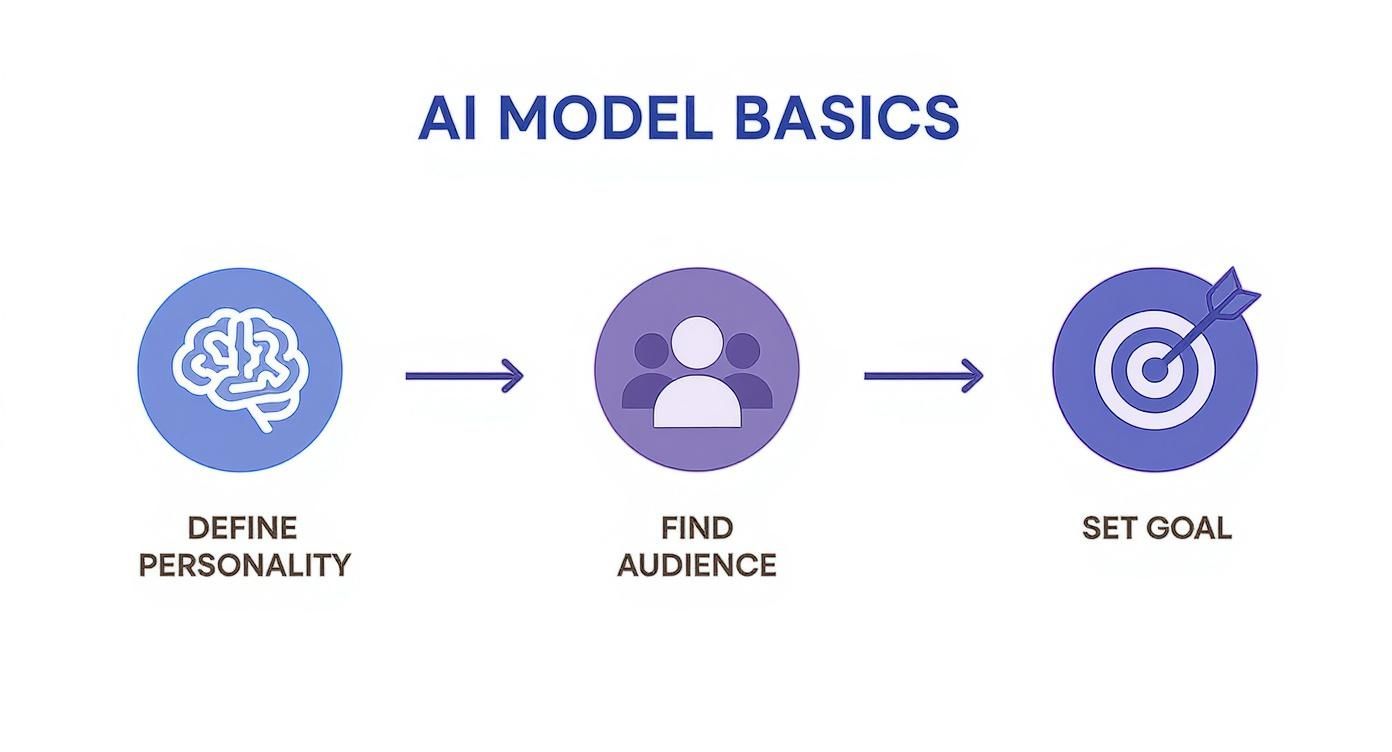
This simple flow is crucial. Having a defined personality, knowing who you're talking to, and having a clear goal are the bedrock of effective training. Without that direction, even the most amazing dataset won't lead to a character that truly connects with people.
Directing Your AI with Prompts
Once the foundational personality is in place, your main tool for creating daily content is prompt engineering. This is simply the art of giving the AI clear, specific instructions to get exactly the response you want. To get really good at this, it helps to understand the core techniques, and resources like A Practical Guide to Artificial Intelligence Prompt Engineering are a great place to start.
I like to think of it as directing an actor. You wouldn't just say, "Act sad." You'd give them motivation: "You're looking at an old photo, feeling a mix of nostalgia and a little bit of melancholy." The more detailed your direction, the more nuanced the performance.
A great prompt provides context, specifies the tone, and defines the format. It leaves very little to chance, ensuring your AI influencer stays consistently in character with every post, comment, and message.
The good news is, you don't need a computer science degree for this. Platforms designed for creators, like CreateInfluencers, have built-in tools that handle the complicated stuff for you. Features like personality sliders and the ability to upload a knowledge base do the heavy lifting, letting you stay focused on the creative side of building your AI model. If you want to dive deeper into these features, we have a whole set of guides at https://createinfluencers.com/guides that break it all down.
Crafting a Memorable Visual Identity
An AI influencer's personality is only half the battle. What truly stops the scroll and forges that instant connection is their visual identity. This is the fun part, where you transform abstract ideas into a tangible, memorable face. It all starts not with images, but with words. You're essentially designing your character from the ground up using detailed text prompts.
Think of yourself as a casting director, stylist, and location scout all in one. Your prompts are the creative brief. Don't just say "a woman with brown hair." Get granular. Is it a warm chestnut brown or a cool ash tone? Does she have a dusting of freckles across her nose? Is her hair a chic, sharp bob or styled in effortless beach waves? This obsessive level of detail is what creates a believable and, most importantly, consistent character.

From Detailed Prompts to Visual Content
Once you've nailed down the textual description, you can start generating images. This is where all that detailed prep work pays off. The more specific your prompts are, the more control you have over the final look, which is absolutely essential for building a recognizable brand.
I've found it helps to break it down into a few key areas:
- Facial Features: Go way beyond the basics. Think about face shape (oval, heart, square), eye color, the specific shape of their nose, and even subtle quirks like a beauty mark or a slightly crooked smile. These are the details that make a face unique.
- Fashion Sense: Really define their style. Are they into minimalist Scandi fashion, bold and vibrant streetwear, or cozy vintage finds? Get specific with clothing items, colors, and even textures.
- Environment and Vibe: A generic "photo in a coffee shop" won't cut it. Instead, try "a candid shot in a rustic, sunlit cafe with exposed brick, holding a heavy ceramic mug." The setting tells as much of a story as the character does.
This granular approach gives the AI a crystal-clear picture of your vision and is the secret to a consistent visual narrative.
Platforms like CreateInfluencers are built for this. You can create a base avatar and then quickly generate a whole stream of on-brand content. The system even offers themed photo packs like "Tinder Shoot" or "Instagram Shoot," which is a massive time-saver for building out a diverse but cohesive portfolio.
Achieving Visual Consistency
Okay, let's talk about the biggest challenge you'll face: keeping your influencer looking like the same person across hundreds of images. It’s easy for an AI to drift, changing facial structures between different poses, lighting, and expressions. This is the number one thing that can shatter the illusion.
The trick is to establish a seed image or a strong reference photo. Many AI tools let you use one of your first successful generations as a guidepost for all future images. This helps lock in the core facial features and gives you a stable foundation to build on. I also make it a habit to reuse a few key descriptive phrases in every single prompt to constantly reinforce the character’s core appearance.
Consistency is everything. Every single image you post should feel like it belongs to the same person. It’s how you build a recognizable identity and earn your audience’s trust. Small variations are natural, but the core essence of your character must never change.
From there, you can explore more advanced tools to really bring your influencer to life. Voice-driven video synthesis can animate your character's face to match an audio clip, creating dynamic short-form videos. And don't forget upscaling tools—the HyperReal engine in CreateInfluencers, for instance, makes sure every image is sharp, high-resolution, and professional enough for any campaign. These finishing touches are what separate a simple AI image from a compelling digital person.
Building Ethical Guardrails for Your AI
Creating an AI influencer is more than just a tech project—it’s a commitment. After you’ve sculpted the perfect look and personality, your next job is to make sure your creation behaves responsibly out in the wild. This isn’t just a nice-to-have; it’s fundamental to building a brand people can actually trust.
Stress-Testing Your Model Before Launch
Your first move should be to put your AI through its paces with some serious testing. Before it ever sees a real audience, you need to push its boundaries. Think of it as a personality stress test.
I always recommend checking for three things: performance, consistency, and safety. Does the AI stay in character when thrown a curveball? What happens when it encounters a troll or a deliberately inappropriate prompt? You need to know the answers.
This is all about finding the weak spots before your audience does. As the creator, remember this: you’re ultimately on the hook for every single thing your AI says or does.
Setting Up Smart Content Filters
Once you have a good sense of your model's potential blind spots, you can build your safety net. These are the guardrails—the specific rules and filters that keep your AI from generating anything harmful, biased, or completely off-brand. If you're serious about learning how to create ai models that can succeed long-term, this part is non-negotiable.
While many tools come with some safety features baked in, I always build my own custom rules on top of them.
- Keyword Blocklists: Start with the obvious. Make a comprehensive list of words and phrases your AI should never, ever use.
- Topic Avoidance: Decide which sensitive topics are off-limits. Politics, controversial news, and other hot-button issues are often best left alone to keep your brand from getting dragged into debates.
- Response Redirection: Plan for the worst. Create automated replies that steer the conversation back to safe ground whenever the AI gets an inappropriate question.
These filters are your first line of defense. They protect your audience, and just as importantly, they protect your brand's reputation.
An ethical AI is a transparent AI. Your audience deserves to know they are interacting with a digital creation. This isn’t about tricking people; it’s about building an honest and authentic connection.
The Bigger Picture: The Ethics of a Digital Person
Beyond the technical side, you have to think about the bigger ethical questions that come with creating a digital person. It carries a unique weight. Honesty should be your north star here.
Be completely transparent from the very beginning that your influencer is AI-generated. Disclosing this upfront doesn't ruin the magic; it builds trust and manages expectations.
Finally, always respect privacy and data rights. Never, ever use your AI to imitate a real person without their direct permission, and be extremely careful about the data it handles. The whole point is to build something that adds genuine value to the world, not something that causes harm. Putting these ethical principles at the heart of your process is how you build a positive brand that lasts.
How to Deploy and Monetize Your AI Influencer
You've designed a compelling character, fine-tuned the model, and established a unique visual identity. Now comes the exciting part—turning your creation into a real digital brand and, potentially, a business. This is where you switch hats from creator to entrepreneur.
The launch is all about building momentum. My advice? Don't try to be everywhere at once. Pick one or two social media platforms where your ideal audience hangs out and go all-in there. Your goal is to create a steady flow of high-quality content that feels true to the personality you’ve built. Get in the trenches: reply to comments, run polls, and ask questions. That’s how you start building an actual community, not just a follower count.
Choosing Your Monetization Path
Once you have a bit of an engaged audience (it doesn't have to be massive!), you can start thinking about money. There's no single "right" way to do it; the best strategy really depends on your influencer's niche and what your audience wants.
Many creators dip their toes in the water with brand partnerships and sponsored posts. The key is finding products or services that genuinely fit your AI's persona. Authenticity matters, even when your influencer isn't human.
But that's just the beginning. Other solid monetization routes include:
- Selling Digital Goods: Think custom art prints of your influencer, digital style guides, or exclusive photo packs. It’s a great way to give your top fans something special.
- Subscription Models: Platforms like Patreon or Fanvue are perfect for this. You can offer behind-the-scenes content, tutorials, or even one-on-one "chats" for a recurring monthly fee.
- Affiliate Marketing: This is a classic for a reason. You can promote products you genuinely like and earn a commission from any sales made through your link. It’s a fantastic way to build up some passive income over time.
Don't underestimate the potential here. The generative AI market hit $44.89 billion in 2023, and total funding in the space shot up an incredible 407% from the year before. This isn't just a niche hobby; it's a rapidly growing industry with serious commercial interest. You can read up on the latest generative AI statistics on mend.io to see just how fast things are moving.
Comparing AI Influencer Monetization Models
To help you decide which path to take, I've put together a quick comparison of the most common monetization strategies. Each has its own set of pros and cons, so think about what aligns best with your goals and your influencer's brand.
| Strategy | Potential Earnings | Effort Level | Best For |
|---|---|---|---|
| Brand Partnerships | Medium to Very High | Medium | Influencers with a strong, engaged niche audience. |
| Subscription Services | Low to High (Recurring) | High | Creators who can offer consistent, exclusive content to loyal fans. |
| Affiliate Marketing | Low to Medium (Passive) | Low to Medium | Anyone who wants to generate income by recommending products. |
| Selling Digital Products | Low to Medium | High (Upfront) | Creators with artistic skills or a unique digital offering. |
Ultimately, most successful creators end up using a mix of these models. Starting with one or two and then diversifying as your audience grows is a smart approach.
Turning your AI influencer into a business requires the same grit as any startup. It’s about knowing your market, giving your audience real value, and diversifying your income to build something that lasts.
Scaling Your Operations
As your brand takes off, you'll need to produce more content without letting the quality slip. This is where the power of AI really comes into play. You can lean on your established prompts and fine-tuned models to quickly generate new images, video clips, and social media posts, helping you stay consistent and relevant.
Another great way to grow is by tapping into affiliate programs. For example, the CreateInfluencers affiliate program lets you earn money by referring other creators to the platform. It's a win-win: you open up another revenue stream and help others start their own journey. This kind of networking builds a stronger community around your brand.
At the end of the day, successfully monetizing an AI influencer means treating it like a real business. Keep a close eye on your analytics, listen to what your audience is telling you, and never be afraid to test out new content formats or income ideas. When you combine creativity with a smart business mindset, you can turn your digital character into a profitable and enduring brand.
Common Questions About Creating AI Models
Jumping into the world of AI creation naturally brings up a lot of questions. As you get the hang of building AI models, it’s normal to wonder about the practical stuff—from the technical skills needed to what this is all going to cost. Let's walk through some of the most common things creators ask.
Do I Need Coding Skills Anymore?
The short answer? Not anymore. Modern no-code platforms like CreateInfluencers are built for creators and marketers, not software engineers. They’re designed with intuitive, visual interfaces that let you do everything with a few clicks. You can design your AI's look, shape its personality with plain text, and generate content without touching a single line of code.
Sure, deep technical skills can be useful for super advanced, custom work, but they’re no longer a gatekeeper. The focus has completely shifted from coding to pure creativity.
What Is the Real Cost to Run an AI Influencer?
This is a big one, and the costs can really vary. If you were to build a model completely from scratch, you'd be paying for cloud GPUs for both training and day-to-day operations (inference). That path can get expensive and unpredictable fast.
For most creators, using a dedicated platform with a clear subscription fee is the most sensible and cost-effective way to go. These services bundle all the heavy-duty computing costs, which makes budgeting a whole lot easier. The great news is that across the industry, the cost to run powerful models has dropped dramatically, making the ongoing upkeep more affordable than ever.
How Can I Make My AI Content Feel Unique?
Your AI's uniqueness comes directly from your creative vision and the specific details you provide. The secret is to build a very distinct dataset for training that captures a specific personality, a compelling backstory, and a clear set of values. Then, you combine that foundation with smart, creative prompt engineering when you generate new content.
Specificity is your best tool for originality. Instead of a generic prompt like "photo at the beach," try "a candid shot of [AI Name] laughing during a golden hour sunset at Malibu, wearing a vintage sundress."
This detailed approach is what makes your content truly yours and not just another generic AI image. For a deeper dive into creative strategies, you can find a ton of articles on our blog at https://createinfluencers.com/blog.
Are There Legal or Ethical Rules to Follow?
Absolutely. Creating an AI influencer is perfectly legal, but the most important ethical rule is transparency. You should always be upfront with your audience that your character is AI-generated. This is how you build trust. It’s also critical that you never create deepfakes of real people without their direct and explicit consent.
As the creator, you're the one responsible for what your AI puts out there. It's on you to have safeguards in place to prevent it from generating harmful, biased, or inappropriate content. For more detailed answers on this topic, resources like the BuddyPro AI FAQ can be really helpful.
Ready to bring your own AI character to life without getting bogged down in the technical weeds? With CreateInfluencers, you can design, train, and launch a unique digital personality in minutes. Start creating for free today.