Create Superhero Character: Easy Steps to Bring Your Hero to Life
Learn how to create superhero character ideas with our expert guide. Discover tips on origins, powers, and costumes to craft your perfect hero.
A truly great superhero needs more than just a cool costume and a catchy name. They need a story. This origin isn't just about how they got their powers; it’s the foundation for their motivations, their flaws, and the very world they live in. It’s what makes them feel real and, ultimately, what makes them memorable.
Building Your Hero's Origin Story
Every hero's journey starts with a compelling origin. This is the bedrock of their personality, the event or series of events that shapes their entire worldview and gives them a reason to fight. Without a strong "why," a character is just a collection of impressive abilities with no soul.
Think of the origin story as your character's emotional engine. Are they a reluctant hero, pushed into the spotlight by a tragic lab accident they feel responsible for? Or maybe they're a determined crusader, forged in the fires of injustice and now dedicated to ensuring no one else suffers the same fate. This single decision will guide their entire arc.
Defining the Core Identity
Before you start writing their life story, it helps to pin down their core archetype. This isn't about fitting them into a box, but about establishing a clear direction for their personality and powers. Using a common archetype as a starting point gives you a solid frame to build upon and customize.
This chart shows just how popular different types of heroes are, with strength-based and tech-based characters leading the pack.
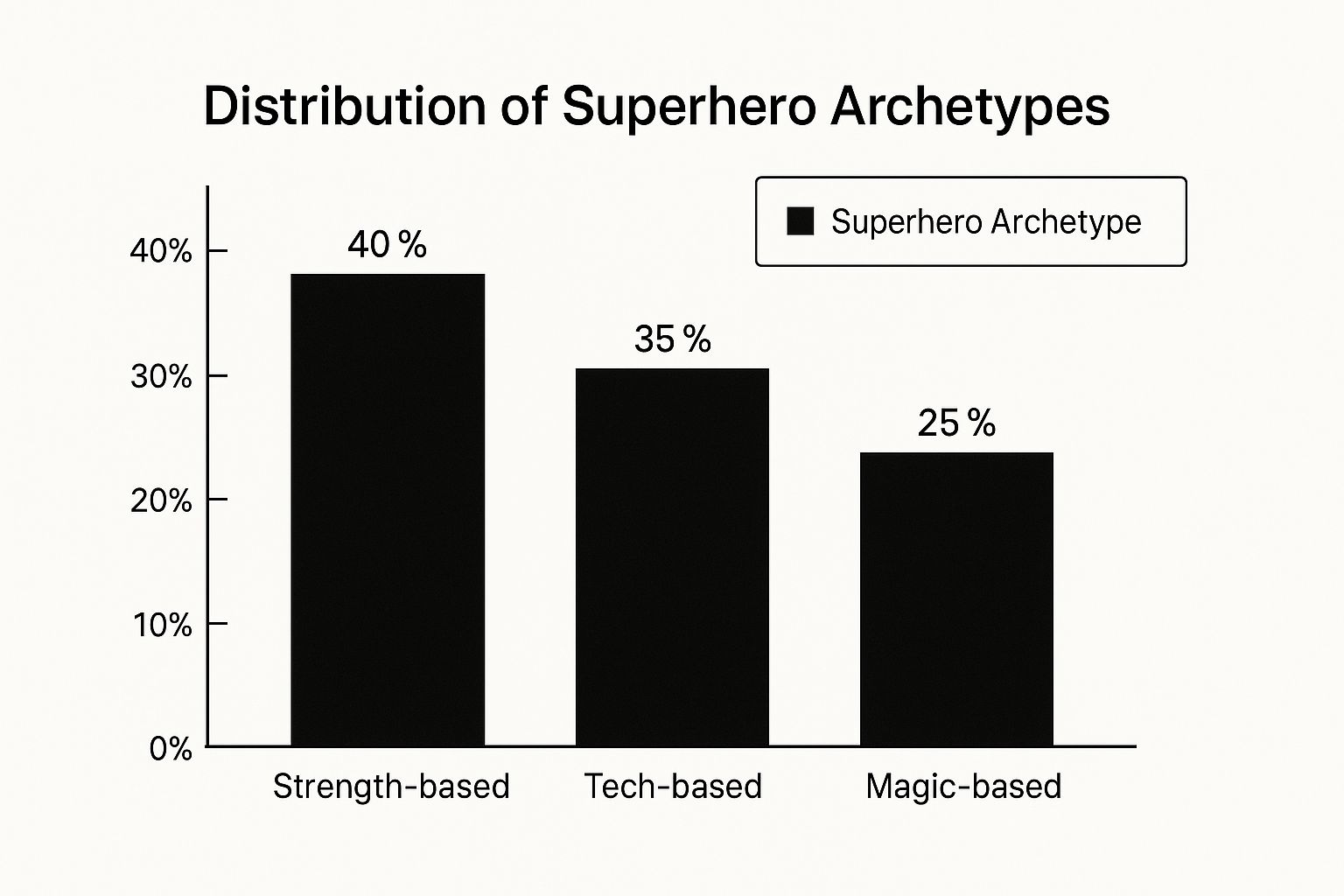
While brute force is a classic, the data shows there's plenty of room to innovate with technology or even magic. Don't be afraid to mix and match—some of the most interesting heroes blend elements from multiple archetypes to create something totally fresh.
To help you get started, think about where your hero might fit. This breakdown of common superhero archetypes can spark some ideas for defining their core identity.
Core Character Archetype Comparison
| Archetype | Core Motivation | Common Strengths | Common Weaknesses |
|---|---|---|---|
| The Paragon | A deep-seated sense of duty and moral righteousness. | Unwavering resolve, inspirational leadership, immense power. | Can be naive, inflexible, or burdened by their own ideals. |
| The Vigilante | A personal tragedy or a quest for vengeance. | Tactical genius, resourcefulness, driven and determined. | Prone to anger, moral ambiguity, difficulty trusting others. |
| The Accidental Hero | Thrown into heroism by chance; just trying to do the right thing. | Relatable, adaptable, often has unique or strange powers. | Inexperienced, self-doubt, may be overwhelmed by responsibility. |
| The Tech Genius | The pursuit of knowledge and a belief in progress. | Brilliant intellect, advanced gadgets, problem-solving skills. | Physical vulnerability, over-reliance on tech, occasional arrogance. |
Choosing an archetype is just the beginning. The real magic happens when you start layering in the unique details, motivations, and flaws that bring your specific character to life.
Connecting Past to Present
The most powerful origin stories are the ones that directly impact a hero's actions today. A character who gained their powers from a cursed artifact might constantly struggle with its corrupting influence, making them hesitant in battle. A hero who built their own suit from scraps will likely be resourceful and always tinkering, showing their intellect under pressure.
Your hero's backstory shouldn't just be an event that happened to them. It should be an active part of their identity, influencing their moral code, their relationships, and the very way they use their powers.
This connection between history and character has been at the heart of the genre since its inception. Superman’s debut in 1938 didn't just create a character; it launched the 'Golden Age of Comic Books' and an industry built on heroes whose origins often reflected the anxieties and hopes of their time.
If you want to make sure your origin story hits all the right notes, brushing up on foundational script writing principles can give you a huge advantage. Understanding narrative structure helps you reveal your hero's past in a way that feels earned and keeps your audience hooked.
Ultimately, it all comes down to asking the right "what if" questions. What if a firefighter gained pyrokinesis but was forever haunted by the one person he couldn't save from a blaze? What if an archaeologist bonded with an ancient spirit but was ethically bound never to use its power for personal gain? Those are the conflicts that transform an idea into a living, breathing hero.
Crafting a Power Set That's Genuinely Unique
Let’s be honest, a superhero’s powers are their calling card. But if you just pick "flight" or "super strength" from the usual list, your creation will feel like a carbon copy. To make a character that really grabs people, their powers need to feel like they grew directly out of who they are and where they came from. This turns their abilities from a simple gimmick into the very core of their identity.
The trick is to dig deeper than just the what. You need to explore the how and the why. Forget generic telekinesis. What about a character who can only move non-living organic matter—like wood or paper—a direct result of their past life as a botanist? That kind of specific detail instantly creates limits and opens the door for clever problem-solving.
Give Them Rules (and Weaknesses)
There's nothing more boring than a hero who can do anything. When there are no stakes and no struggle, their wins feel cheap and unearned. One of the most critical things you can do is set clear, consistent rules for how their powers work. It’s what makes their challenges feel real.
These limitations can come from anywhere—inside or out. Think about the real cost of their abilities.
- A Physical Price: Does using super-speed burn an insane number of calories, meaning they have to eat constantly?
- A Mental Toll: Can your mind-reader ever turn it off, or are they always drowning in a sea of other people's thoughts, fighting for their own sanity?
- An External Anchor: Maybe their powers only work in a specific place, with a certain object, or even at a particular time of day. Take that away, and they're vulnerable.
When you define these drawbacks, their power stops being a simple gift. It becomes a complicated part of their life—sometimes a blessing, other times a heavy cross to bear. That inner conflict is what drives a great story.
Think Outside the Punch
Even powers that seem minor or weirdly specific can be incredibly powerful and memorable if used creatively. The goal is to design an ability that forces your hero to be strategic, not just a blunt instrument. Don’t sleep on unconventional powers.
Imagine a hero whose only real power is perfectly mimicking any sound they've ever heard. It might not sound as flashy as invulnerability, but look at what they could do:
- Infiltration: They could perfectly copy a villain's voice to walk right through a security checkpoint.
- Distraction: Need to get past some guards? Create the sound of a massive explosion on the other side of the building.
- Interrogation: They could psychologically break a foe by replaying a single, incriminating line from a past conversation.
That’s so much more engaging than watching someone punch through yet another wall. If you're looking for more ideas on building out characters and their stories, we have a ton of resources in the guides on our site.
The most interesting powers aren't always the strongest; they're the ones that force the hero to be smart. When a character has to out-think their opponent instead of just overpowering them, the audience becomes more invested in the outcome.
Link Their Powers to Their Personality
Finally, make sure the power set is a mirror of the character's personality. A cautious, methodical hero might have some form of precognition, letting them plan every move with precision. On the flip side, a hot-headed, impulsive character could wield some kind of volatile, barely-controlled energy that’s as much a danger to their friends as it is to their enemies.
This kind of alignment makes a character feel whole and believable. When their abilities and personality are in sync—or even clashing—it adds a fascinating layer to who they are. That synergy is what elevates a decent idea into a truly unforgettable superhero.
Designing an Iconic Costume and Symbol
Let's talk about the fun part: the suit. A superhero’s costume is so much more than just clothes; it’s their visual signature. It's the first thing people see, and it instantly telegraphs who your hero is—their mission, their personality, even their powers—before they ever throw a punch. A truly great design sticks with you, becoming a legendary part of the character's identity.
The visual language here is incredibly powerful. Simple color choices can say a lot. A hero in bright reds and blues feels like a beacon of hope, while someone cloaked in dark grays and blacks gives off a more serious, maybe even morally ambiguous, vibe. The material of the suit tells a story, too. Is it sleek, high-tech armor or rugged, practical fabric? Every detail should be a deliberate choice that builds on the character you've already created.
This focus on iconic design has been the bedrock of the genre for decades. Just look at Marvel Comics, which got its start as Timely Publications back in 1939. They launched a universe of characters whose looks became legendary. Their very first issue, Marvel Comics #1, featured heroes like the Human Torch and Namor the Sub-Mariner and was a massive hit, selling a combined 900,000 copies in its first two printings.
The Psychology of Color and Shape
When you're designing a superhero, your color palette is your secret weapon for setting the emotional tone. It goes way beyond just looking cool; colors have deep-seated psychological meanings you can play with.
Think about what you want your hero to project:
- Red: This color screams passion, strength, and even danger. It's an attention-grabber, perfect for a hero with raw power or an intense personality.
- Blue: Generally conveys trust, stability, and calm. It’s a classic choice for protectors and symbols of hope.
- Yellow/Gold: Can represent optimism, intellect, or something a bit more divine. It's often used as an accent to highlight a hero's positive or even royal qualities.
- Green: This one's tricky. It can mean nature, healing, and growth, but also poison or envy. That duality makes it fantastic for characters with complex or nature-based powers.
- Black/Gray: Suggests mystery, sophistication, and a serious attitude. It’s ideal for stealthy, tactical heroes or those with a darker, more pragmatic view of the world.
The shapes and lines of the costume are just as important. Sharp, angular patterns can make a character seem more aggressive or tech-focused. On the flip side, smooth, flowing lines might suggest grace, speed, or a connection to something natural, like wind or water.
Weaving Story into the Symbol
The symbol is the heart of the costume—it’s the one powerful image that boils down the hero's entire identity. The best ones are simple enough to be recognized in a flash, even as a silhouette, but they carry a ton of meaning.
A great symbol often ties directly to the hero's origin, powers, or name. For instance, a character empowered by a mythical phoenix might rock a stylized flame or bird emblem. A hero who defends a specific city could even work a local landmark into their logo.
A truly iconic symbol works like a corporate logo. It's a shorthand for everything the hero stands for. It should be distinctive, scalable, and instantly identifiable, whether it's on a chest plate or a billboard.
If you're looking for a jolt of inspiration, I highly recommend checking out some galleries of modern superhero character design concepts. Seeing how other artists tackle form and color can really get the creative juices flowing.
Balancing Form and Function
Finally, a costume has to make sense for the character and their world. While the classic spandex look is timeless, modern designs often weave in practical elements that reflect what the hero actually does.
Ask yourself a few questions about function:
- Protection: If your hero isn't bulletproof, their suit should probably offer some armor. Where are they most likely to get hit? That's where you'd add plating.
- Mobility: How does your character get around? A high-flying acrobat needs something lightweight and flexible. A tank-like brawler might wear something heavier and more durable.
- Utility: Does the costume hold gadgets, weapons, or a comms device? A utility belt, high-tech gauntlets, or integrated gear can add a layer of realism and show that your hero came prepared.
When you blend striking visuals with thoughtful, practical details, you create more than just a costume. You design a second skin for your hero—one that becomes as recognizable and core to their identity as their own name.
Give Them a Personality (and Some Relatable Flaws)
Let's be real: flashy powers might catch someone's eye, but it's the hero's personality that makes people stick around. The most iconic heroes aren't perfect, untouchable beings. They’re relatable because their struggles feel just like ours, even if they can fly. If you want to create a superhero persona that feels genuine, you have to move past simple good-versus-evil.
Think of it this way: their personality needs to be as well-defined as their powers. What are they secretly terrified of, even with all that strength? What past failure haunts them? Giving your hero these kinds of authentic vulnerabilities is what makes their wins feel earned and actually mean something.
The Beauty of Being a Little Broken
We connect with imperfection. A hero who is always right, always strong, and always comes out on top isn't just predictable—they're boring. It’s their flaws—that quick temper, the crippling self-doubt, their stubborn pride—that create the inner turmoil that really drives the story.
Think of flaws as storytelling gold. A hero who can fly but is secretly terrified of heights? Instant tension. A powerhouse who is so socially awkward they can barely talk to the people they just saved? That’s a recipe for some fantastic character growth.
A character's flaws aren't just obstacles to overcome. They're the very threads that weave their identity together. These imperfections dictate how a hero reacts under pressure, mess up their relationships, and fuel the internal battles that are often far more gripping than any fistfight.
This is what grounds your hero. It makes them someone your audience can actually root for, not just admire from a distance. When a hero's victory is as much over their own inner demons as it is over the bad guy, the story becomes so much more powerful.
Figure Out Their Moral Compass
Every hero needs a code, but the most compelling ones operate in shades of gray. Your character's sense of right and wrong shouldn't be generic; it should be a direct result of their backstory and experiences. And, most importantly, it needs to be tested—a lot.
To really nail down their moral compass, start by asking a few questions:
- What’s their hard line? Are they willing to injure but never kill? Do they trust the system, or do they see it as part of the problem?
- What’s their one non-negotiable rule? Is it protecting the innocent, no matter the cost? Or is it all about exposing the truth, even when it hurts?
- How do their flaws clash with their morals? A hero who preaches honesty but keeps huge secrets from their friends is an instant source of conflict. A character who believes in non-violence but has a raging temper is a walking contradiction, and that’s what makes them interesting.
Imagine a hero whose power comes from a chaotic, uncontrollable energy source. They might live by an incredibly strict personal code just to keep themselves from going off the rails. Their biggest fear isn't some supervillain; it's losing control of themselves. That internal struggle is far more compelling than a simple desire to "do good."
Show, Don't Just Tell
This is one of the oldest rules in storytelling for a reason. Don't just tell us your hero is brave; throw them into a situation that forces them to act brave even when they're terrified. Instead of saying they have a sharp wit, write some genuinely clever dialogue for them in the middle of a crisis.
How a character uses—or doesn't use—their powers can say everything about them. Does a hero with super strength use it to intimidate everyone, or do they show incredible restraint, only unleashing their full power when absolutely necessary? Does a telepath respect people's privacy, or are they constantly peeking into minds for personal gain?
Every choice, every line of dialogue, and every action should be a window into the personality you've created. When you focus on these relatable flaws and internal conflicts, you’ll end up with a superhero persona that feels real, resonant, and completely unforgettable.
Building a World That Needs a Hero
Let's be honest, a hero is only as interesting as the world they're trying to save. You can dream up a character with the most incredible powers imaginable, but without a setting that gives them real stakes and challenges, they just feel hollow. Building an immersive world is how you give your hero's journey purpose.
It doesn't matter if you're picturing a gritty, rain-slicked metropolis or a sprawling sci-fi landscape. The environment should be more than just a pretty backdrop; it needs to be an active participant in the story. Think about it: a hero raised in a gleaming utopian city will have a radically different worldview than one who clawed their way up from a lawless wasteland. The world shapes them, their allies, and the very nature of the threats they face.
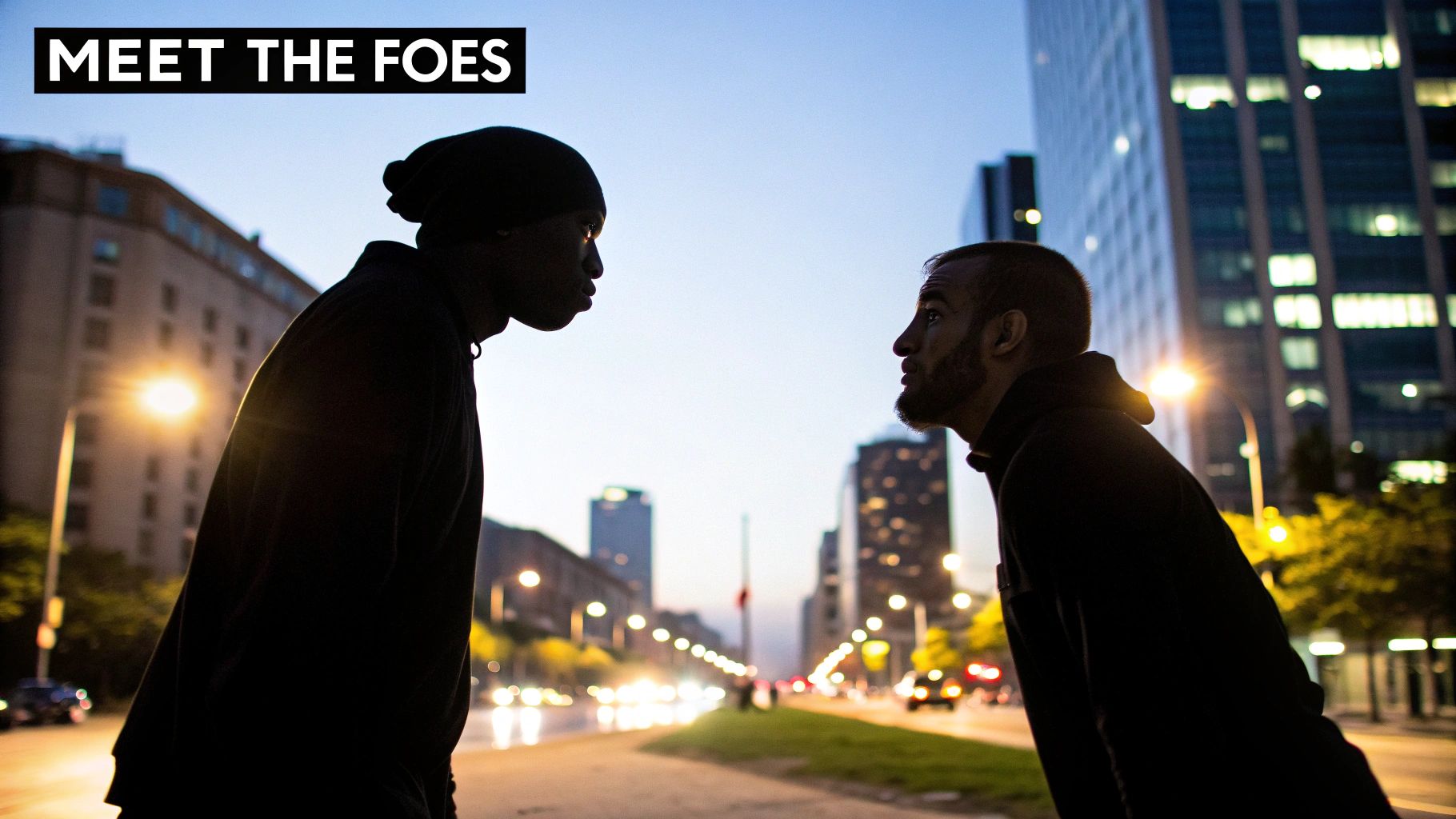
This whole process of world-building is what sets the stage for those classic "heroic moments" that define the genre. In fact, a deep-dive analysis of comics like Detective Comics and Captain America found that significant 'Heroic Moments'—those key events that teach a moral lesson or idealize heroism—popped up in 53% to 60% of the issues published over a decade. A well-defined world is the perfect canvas for these moments. You can read more about these fascinating findings on the structure of superhero narratives.
Establishing the Rules of Your World
Every believable world has rules. I'm not just talking about physics or magic, but the societal norms, the old historical conflicts, and the technological limits that make your setting feel real and consistent. Laying this groundwork is essential if you want to create a superhero character that feels grounded.
Here are a few core elements I always focus on:
- History and Lore: What major events shaped this society? A history of war, an alien invasion, or a technological revolution will leave deep scars that influence everything from politics to how the public feels about superhumans.
- Power Dynamics: Who's really in charge? Is it a handful of corrupt corporations, a military government, an ancient magical order, or some all-seeing AI? This helps define the primary opposition your hero will inevitably run up against.
- Public Perception: How does the average person on the street view heroes? Are they celebrated as saviors, feared as weapons of mass destruction, or just written off as dangerous vigilantes? This reaction will have a direct impact on your hero’s day-to-day life.
These rules create a sense of scale and consequence, making your hero's actions feel like they actually matter.
A world with clear, established rules gives your character something tangible to push against. When a hero breaks a societal law for the greater good, the internal and external conflict is far more powerful than if those rules never existed in the first place.
Crafting a Compelling Supporting Cast
No hero is an island. A rich cast of supporting characters—allies, mentors, rivals, and just regular civilians—is what makes the world feel alive. More importantly, it gives your hero a personal, emotional stake in protecting it.
Try to think beyond one-dimensional archetypes. An ally shouldn't just be a loyal sidekick; give them their own goals, fears, and a life that exists outside of the hero's orbit. A mentor might offer wise guidance but also be haunted by their own past failures. These relationships are the engine for character development, revealing different facets of your hero's personality along the way. If you're looking for more tips on character development, we've got a ton of great articles over on the CreateInfluencers blog.
Designing Villains Who Matter
You've heard it a thousand times, but it's true: a great hero is often defined by their greatest villain. To create a truly memorable antagonist, you have to move beyond the simple goal of "world domination." The best villains I've ever seen serve as thematic foils, challenging the hero's core beliefs and forcing them to confront their own weaknesses.
A truly strong villain should be a dark mirror of the hero.
- A Thematic Foil: If your hero stands for hope, create a villain who embodies complete nihilism.
- A Personal Connection: Does the villain share a past with the hero? This instantly makes the conflict deeply personal and ratchets up the emotional stakes.
- Understandable Motives: A villain who genuinely believes they are the hero of their own story is infinitely more compelling than one who is just "evil" for the sake of it.
By building a world rich with history, populating it with a dynamic supporting cast, and creating villains who are more than just obstacles, you set the stage for a truly epic saga. This living, breathing world is what gives your hero something truly worth fighting for.
Working Through Your Superhero Creation Questions
Even the best-laid plans hit a snag. You’ve got a killer origin story and a cool costume idea, but now you’re stuck on some nagging detail. It happens to everyone. Let's walk through some of the most common questions and creative roadblocks people face and find some real-world answers.
Getting caught up on these things is a totally normal part of the creative process. Every single writer and artist has been there, staring at a character whose powers feel a bit too god-like or whose backstory feels like something they've seen a dozen times before. The trick is knowing how to push through.
How Do I Make an Origin Story Feel Fresh?
Look, the "lab accident" and "avenging murdered parents" storylines are classics for a reason, but let's be honest—they're tired. If you want your hero’s beginning to feel truly unique, you have to get specific. Really specific.
Instead of a generic accident, what exactly was the experiment they were working on? Maybe it was a personal project to cure a loved one, which adds a layer of tragic irony to their newfound powers. Instead of simply avenging parents, maybe they’re driven to uphold a forgotten family legacy or stop a very specific injustice they witnessed up close.
The secret to originality isn't always some brand-new, earth-shattering idea. It's often a familiar idea told with deeply personal and specific details. The more the origin is tangled up in your character's unique life, relationships, and worldview, the less it will feel like a retread.
What’s the Best Way to Balance a Hero's Powers?
An all-powerful hero is a boring hero. Period. To avoid the "Superman problem"—where your character is so strong that nothing feels like a real challenge—you have to build in meaningful limits and costs. Real tension comes from the struggle, not from watching someone win effortlessly.
For every amazing ability you give them, define a clear and consistent drawback. This forces your hero to think on their feet and be strategic, rather than just punching their way through every problem.
- Introduce a Physical Toll: Maybe using their super-strength leaves them completely exhausted, or phasing through walls makes them dizzy and nauseous.
- Create a Mental Cost: Perhaps a mind-reader can't turn their power off, leading to crippling migraines from the constant psychic noise of being in a crowd.
- Establish an External Weakness: Their powers might only work when they're near a specific energy source, or maybe they can be neutralized by a surprisingly common material. Instant vulnerability.
These weaknesses aren't just cheap plot devices; they’re tools for building character. They make your hero’s victories feel truly earned.
Should I Design the Costume Before the Personality?
It’s so tempting to jump right into sketching a cool suit—that’s the fun part, right? But I’ve found it’s almost always better to nail down the personality and origin story first. A great costume is a visual summary of the character. It should be an extension of who they are, not just a random outfit.
Once you really understand your character's core identity, the design choices start to make themselves. A hero who relies on stealth and tactics wouldn't be caught dead in a bright, flowing cape. They’d have a functional, dark suit loaded with practical gear. The symbol on their chest needs to mean something to them, tying back to their mission or their past.
Thinking about your character's journey first makes the costume feel authentic and resonant. The entire process of building a digital persona is an exciting one, and tools like CreateInfluencers are fantastic for bringing your visual concepts to life once you have that core identity locked in.
At the end of the day, every question you stop to answer helps you build a more complex and believable hero. Don't be afraid to experiment, go back and revise, and let your character's story be your guide.
Ready to bring your unique hero persona to life? With CreateInfluencers, you can generate stunning, high-resolution images of your character in minutes. Transform your ideas into a fully realized AI influencer today. Start for free at https://createinfluencers.com.