9 Content Marketing Best Practices to Follow in 2025
Discover 9 essential content marketing best practices for 2025. Drive engagement, boost SEO, and achieve your goals with these expert strategies.

In a world saturated with content, simply creating more isn't the answer. Many brands and creators are stuck in a cycle of publishing blog posts, videos, and social updates that barely make a ripple. They invest time and resources, only to see minimal engagement and disappointing results. The problem isn't a lack of effort; it's the absence of a smart, strategic approach. If your content feels invisible, it's time to stop guessing and start implementing proven tactics.
This guide moves beyond generic advice to provide a clear, actionable framework of the most effective content marketing best practices. We've distilled the essentials into nine core principles that will transform your approach. You will learn how to understand your audience on a deeper level, optimize for search engines without sacrificing quality, and tell stories that build a loyal community.
Each practice is designed to help you build a content engine that not only attracts attention but also establishes authority and drives meaningful growth. We'll also explore how innovative platforms like CreateInfluencers' AI can supercharge your efforts, making high-impact visual content accessible to everyone. Forget the fluff. This is your direct roadmap to creating content that works.
1. Know Your Audience Inside and Out: The Foundation of All Great Content
Before creating any content, you must deeply understand who it's for. This foundational practice goes far beyond basic demographics like age and location. The most effective content marketing best practices are built on an empathetic understanding of your audience’s specific challenges, goals, and content consumption habits. This ensures every piece of content you produce is relevant, valuable, and directly addresses their needs, making them feel seen and understood.

A shallow understanding leads to generic content that gets ignored, while a deep understanding cultivates a loyal, engaged community. Companies like HubSpot pioneered this approach by developing extensive buyer persona templates that help marketers visualize their ideal customer, from their daily pain points to their career aspirations. This deep dive allows for hyper-targeted content that resonates on a personal level.
How to Implement This Practice
Creating detailed buyer personas is your first actionable step. A persona is a semi-fictional representation of your ideal customer based on market research and real data.
- Conduct Thorough Research: Combine quantitative data from analytics with qualitative insights. Analyze your social media follower demographics, send out customer surveys, and, most importantly, conduct one-on-one interviews with your best customers or followers.
- Identify Pain Points and Motivations: What problems keep your audience up at night? What are they trying to achieve? Your content should be the solution or the inspiration they are looking for.
- Understand Their Content Habits: Where do they spend their time online? Do they prefer short-form video on TikTok, in-depth articles on a blog, or visual inspiration on Instagram? Match your content format and distribution to their behavior.
By following these steps, you build a solid foundation for a content strategy that not only attracts but also retains a dedicated audience.
2. Create a Comprehensive Content Strategy: Your Roadmap to Success
Content without a strategy is just noise. A comprehensive content strategy is the systematic roadmap that guides your content creation, ensuring every blog post, video, and social media update is purposeful and aligned with your broader business objectives. This is one of the most critical content marketing best practices because it transforms random acts of content into a cohesive, goal-driven machine. It provides clarity, consistency, and a framework for measuring what truly works.
Brands like Red Bull have mastered this, building an entire media ecosystem around extreme sports that aligns perfectly with their brand identity, rather than just advertising their energy drink. This strategic approach builds an audience that is invested in the brand's world, not just its products. Similarly, Salesforce's Trailhead platform offers a wealth of educational content, strategically positioning them as leaders and essential resources in their industry.
How to Implement This Practice
A great strategy begins with clear goals and foundational themes, known as content pillars. These pillars will be the core topics your brand consistently creates content about, establishing your authority and expertise.
- Set SMART Goals: Define what you want to achieve. Is it to increase website traffic by 20%, generate 50 new leads per month, or improve brand sentiment? Your goals must be Specific, Measurable, Achievable, Relevant, and Time-bound.
- Establish Core Content Pillars: Choose 3-4 core topics that your audience cares about and that align with your brand's expertise. For a fitness brand, these might be "High-Intensity Workouts," "Nutritional Guidance," and "Mental Wellness."
- Plan Your Editorial Calendar: Use your pillars to brainstorm and schedule content at least 3 months in advance. A calendar ensures a consistent publishing cadence and helps you plan for key dates, product launches, or seasonal trends. Include a plan for repurposing content, like turning a detailed blog post into a series of short videos or an infographic.
The infographic below illustrates the fundamental workflow for building a content strategy from the ground up.
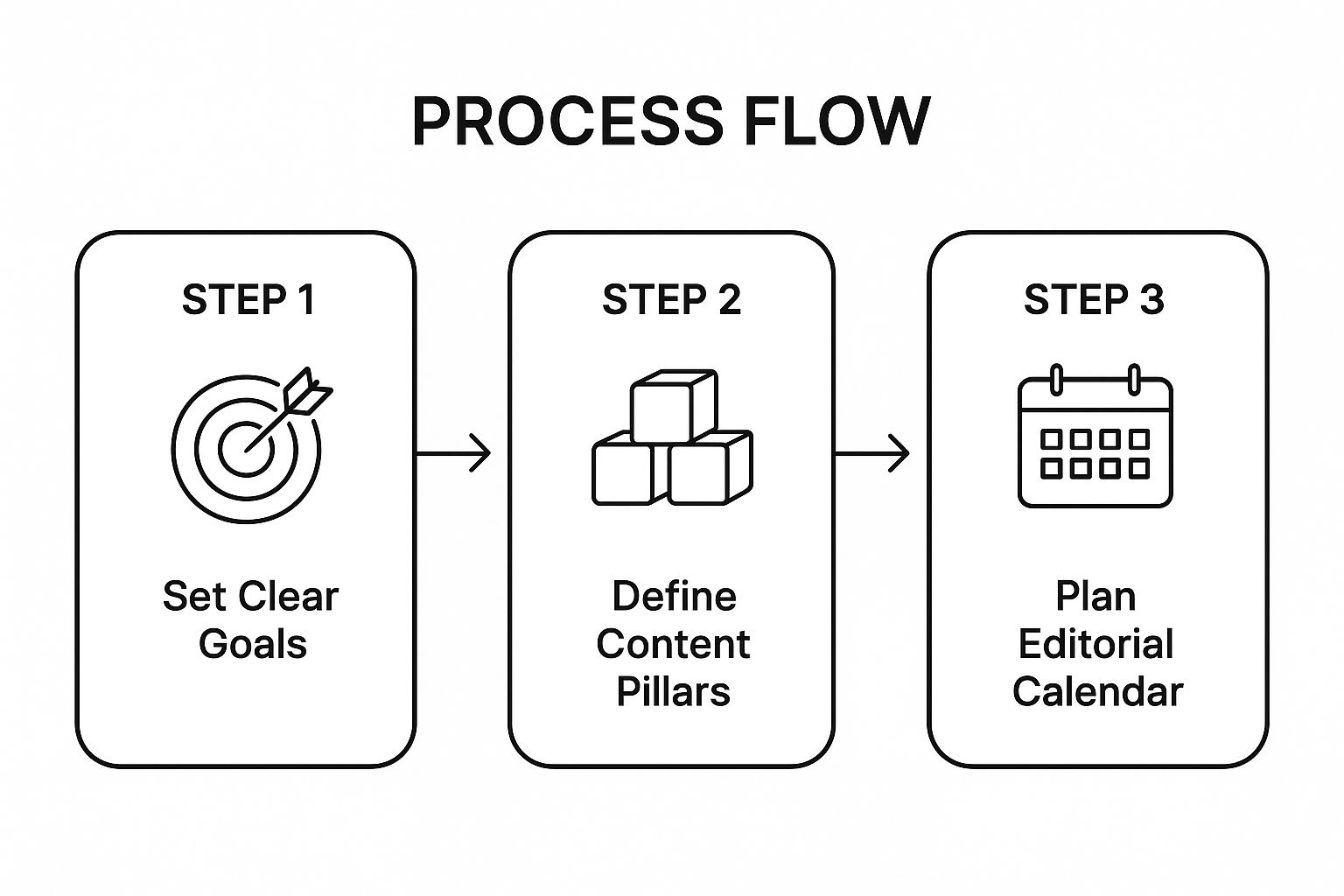
This simple, sequential process ensures that your content planning is always rooted in your business objectives and structured around key areas of expertise.
3. Focus on Quality Over Quantity: Building Authority Through Value
In an online world saturated with content, the "publish more" mantra has lost its power. One of the most critical content marketing best practices is shifting focus from sheer volume to exceptional quality. This approach prioritizes creating high-value, deeply researched, and expertly crafted content over publishing a large volume of mediocre material. It’s about delivering genuine value to build lasting authority and trust with your audience.
Publishing one definitive, comprehensive guide can drive more traffic, engagement, and conversions than ten superficial blog posts. Pioneers like Brian Dean of Backlinko built their empires on this principle, proving that in-depth, "skyscraper" content establishes credibility and earns high-ranking positions. Similarly, Moz’s exhaustive SEO guides have become industry cornerstones, attracting a loyal following by being the most reliable resource available. This strategy isn’t about publishing less; it's about making every piece count.
How to Implement This Practice
Adopting a quality-first mindset requires a deliberate investment in the content creation process, from ideation to promotion.
- Conduct In-depth Research: Go beyond a quick search. Dig into academic studies, industry reports, and expert interviews. The goal is to become a true subject matter expert before you write a single word.
- Include Original Data and Insights: Differentiate your content by including unique data from your own surveys, case studies, or experiments. This makes your work a primary source that others will cite, boosting your authority and backlinks.
- Invest in Professional Polish: High-quality content isn't just about the words. Invest in professional editing for clarity and error-free copy, and use high-quality design and visuals to make the information engaging and easy to digest.
- Solve a Specific, Tangible Problem: The best content provides a clear solution. Frame your piece around a specific challenge your audience faces and deliver a comprehensive, actionable answer that leaves them better off than before.
4. Optimize for Search Engines (SEO)
Creating amazing content is only half the battle; people need to be able to find it. This is where Search Engine Optimization (SEO) becomes a non-negotiable part of your strategy. Integrating SEO principles means creating content that is not only valuable to your audience but also easily discoverable by search engines like Google. This practice ensures your efforts translate into organic traffic, improved visibility, and a steady stream of your target audience finding you exactly when they need a solution.
Without SEO, even the best content can get lost in the digital noise. Ahrefs, a leading SEO tool provider, exemplifies this principle by building its entire blog around targeted, high-value keywords that its audience is actively searching for. This approach is one of the most effective content marketing best practices because it directly connects user search intent with the valuable answers you provide, establishing authority and driving qualified leads organically over the long term.
How to Implement This Practice
SEO isn't just about stuffing keywords; it's about creating a seamless and valuable user experience that search engines reward.
- Conduct In-Depth Keyword Research: Use tools to identify what your audience is searching for. Focus on long-tail keywords (e.g., "how to start an AI influencer on Fanvue") as they often have higher conversion rates and less competition.
- Prioritize On-Page Optimization: Ensure your target keyword appears naturally in your title, meta description, headers, and the first paragraph. Optimize your images with descriptive alt text to improve accessibility and image search ranking.
- Focus on Satisfying Search Intent: Understand why a user is searching for a specific term. Are they looking for information, a tutorial, or a product? Structure your content to deliver the most comprehensive and direct answer to their query.
- Build Internal and External Links: Link to other relevant pages on your site to help search engines understand your site structure and keep users engaged. Linking out to authoritative external sources also builds credibility.
5. Tell Compelling Stories: Making Your Message Memorable
Facts and figures inform, but stories connect and persuade. One of the most powerful content marketing best practices is to wrap your message in a compelling narrative. This involves using storytelling elements like a clear plot, relatable characters, and emotional arcs to transform dry information into an engaging experience. This practice makes your content more memorable, shareable, and emotionally resonant with your audience.

Storytelling isn't just for novelists; it's a strategic tool for marketers. Brands like Patagonia excel at this by weaving their environmental activism into powerful stories of conservation and adventure, making customers feel like part of a larger mission. Similarly, Airbnb uses narratives from hosts and guests to showcase unique travel experiences, focusing on human connection rather than just property listings. This approach, popularized by frameworks like Donald Miller's StoryBrand, positions the customer as the hero and the brand as the guide.
How to Implement This Practice
Integrating storytelling into your content strategy requires a shift from presenting features to crafting narratives. Your goal is to make your audience feel something and see themselves in the story.
- Start with a Hook: Grab your audience's attention immediately with a relatable problem, a surprising statement, or an emotional scenario. This creates an open loop that they will want to see closed.
- Include Conflict and Resolution: Every good story involves a challenge. Showcase a common pain point your audience faces (the conflict) and then demonstrate how your product, service, or advice helps overcome it (the resolution).
- Use Real Customer Stories: Authenticity is key. Feature testimonials, case studies, or user-generated content that tells the story of how real people benefited from your brand. This provides social proof and builds trust.
- Make Your Brand the Guide, Not the Hero: Position your audience as the protagonist of the story. Your brand is the wise mentor or helpful tool that equips them to succeed on their journey.
6. Maintain Consistency Across All Channels
A disjointed brand experience confuses your audience and dilutes your message. One of the most critical content marketing best practices is maintaining a unified voice, visual identity, and quality standard across every platform you use. This consistency ensures your brand is instantly recognizable and builds trust, whether someone finds you on TikTok, reads your blog, or receives your newsletter. It creates a seamless and professional journey for your audience, reinforcing your brand’s credibility at every touchpoint.
A lack of consistency makes a brand feel amateur and unreliable, while a cohesive presence signals authority and professionalism. Consider how brands like Coca-Cola maintain their optimistic, friendly tone globally, or how Apple’s minimalist design and direct messaging are present in every product, ad, and retail store. This approach, championed by content strategists like Kristina Halvorson, transforms a collection of random content pieces into a powerful, unified brand experience that fosters loyalty.
How to Implement This Practice
Creating and adhering to brand guidelines is the key to achieving cross-channel consistency. This document becomes the single source of truth for anyone creating content for your brand.
- Develop Detailed Brand Guidelines: Your guidelines should cover everything: brand voice and tone (e.g., witty, professional, empathetic), color palettes, typography, logo usage, and even specific grammar rules.
- Create and Use Content Templates: Design templates for social media posts, blog headers, and video thumbnails. This not only saves time but also guarantees visual cohesion across different channels and content formats.
- Conduct Regular Brand Audits: Periodically review all your content channels to check for inconsistencies. Does your Instagram bio match the tone of your website? Are you using the correct logo on your latest YouTube video? This helps you catch and correct any deviations.
By implementing these steps, you ensure every piece of content works together to build a strong, memorable brand identity that resonates with your audience no matter where they interact with you.
7. Leverage Multiple Content Formats: Reach Wider Audiences
Relying on a single content format, like blog posts, means you're only connecting with the segment of your audience that prefers to read. To maximize your reach and impact, one of the most crucial content marketing best practices is to diversify your content across multiple formats. This means creating a mix of videos, podcasts, infographics, and interactive content to cater to different consumption preferences and capture attention on various platforms.

A multi-format strategy ensures your core message is accessible to everyone, whether they prefer watching a quick video on TikTok, listening to a podcast during their commute, or scanning a visual infographic on Pinterest. Gary Vaynerchuk famously popularized this with his "content pyramid" model, where he creates one long-form "pillar" piece of content (like a keynote speech) and then repurposes it into dozens of smaller micro-content pieces across different formats and platforms. This approach amplifies your message and boosts engagement opportunities significantly.
How to Implement This Practice
Start by repurposing existing high-performing content into new formats rather than creating everything from scratch. This allows you to test what resonates without a massive initial investment of time and resources.
- Start with a Pillar Piece: Choose a comprehensive blog post, a detailed video, or a podcast episode as your foundation. This will be the source material for all your repurposed assets.
- Repurpose Strategically: Extract key quotes from a blog post to create tweetable graphics. Turn a video tutorial into a step-by-step infographic. Condense podcast audio into a shareable audiogram for social media.
- Match Format to Platform: Tailor your repurposed content to the platform's strengths. Create short, engaging video clips for Instagram Reels and TikTok, professional carousels for LinkedIn, and high-quality images for Pinterest and Instagram feeds.
- Test and Analyze: Monitor the performance of each format to see what your specific audience engages with most. Use these insights to guide your future content creation efforts and double down on what works.
8. Engage and Build Community: From Broadcast to Conversation
Content creation isn't a one-way street. The most successful brands understand that their job isn't done once they hit "publish." A critical component of modern content marketing best practices involves transforming passive content consumption into an active, two-way conversation. This means actively fostering a sense of community around your brand, making your audience feel like valued participants rather than just viewers. This engagement is what builds true loyalty and advocacy.
This approach turns your audience from a metric into a movement. Brands like Sephora have excelled with their Beauty Insider Community, creating a dedicated space for users to share tips and reviews. Similarly, Peloton’s success is built not just on its equipment but on the powerful, interconnected community of riders who motivate and engage with one another. This shift from broadcasting to community-building creates a powerful moat that competitors can't easily replicate.
How to Implement This Practice
Building a community requires consistent effort and a genuine desire to connect with your audience. It’s about creating spaces and opportunities for interaction.
- Foster Two-Way Communication: Make a habit of responding to comments and direct messages promptly, ideally within 24 hours. Ask open-ended questions in your captions and posts to spark discussions and invite your audience to share their thoughts.
- Encourage and Share User-Generated Content (UGC): Actively encourage your followers to share content featuring your products or services using a branded hashtag. When you feature this UGC, it serves as powerful social proof and makes your community members feel recognized and valued.
- Create Exclusive Spaces or Content: Offer value that isn't available elsewhere. This could be a private Facebook Group, a Discord server, or exclusive content for your email subscribers. These spaces provide a more intimate setting for your most dedicated fans to connect.
By implementing these tactics, you transition from simply acquiring an audience to cultivating a loyal, interactive, and self-sustaining brand community.
9. Measure and Analyze Performance: Data-Driven Content Evolution
Creating great content is only half the battle; understanding its impact is what separates stagnant strategies from successful ones. This essential practice involves using analytics to track content performance, understand audience behavior, and make informed decisions. The best content marketing best practices are iterative, relying on data, not guesswork, to refine and improve your approach over time. This ensures you consistently deliver what resonates while optimizing your return on investment.
Without measurement, you're flying blind. Companies like Netflix leverage sophisticated analytics to not only recommend content but also to inform which shows to produce, based entirely on user engagement data. Similarly, BuzzFeed’s A/B testing of headlines and formats is a masterclass in using data to optimize for virality and engagement, proving that continuous analysis is key to content success.
How to Implement This Practice
Integrating analytics into your workflow is non-negotiable. Start by defining what success looks like and then choose the right tools and processes to measure it.
- Focus on Key Metrics: Don't get lost in vanity metrics. Identify 3-5 key performance indicators (KPIs) that align with your business goals, such as conversion rates, time on page, email sign-ups, or lead generation.
- Use Tracking Tools: Implement tools like Google Analytics to monitor website traffic and user behavior. For social media, use platform-specific analytics to track reach, engagement, and follower growth. Use UTM codes in your links to precisely track where traffic is coming from.
- Conduct Regular Reviews: Schedule monthly or quarterly performance reviews to analyze your data. Identify which content formats, topics, and distribution channels are performing best and which are underperforming. Use these insights to adjust your content calendar and overall strategy.
By systematically measuring and analyzing your content's performance, you can stop guessing what works and start building a predictable engine for growth.
Best Practices Comparison of 9 Content Marketing Strategies
| Strategy | Implementation Complexity 🔄 | Resource Requirements ⚡ | Expected Outcomes 📊 | Ideal Use Cases 💡 | Key Advantages ⭐ |
|---|---|---|---|---|---|
| Know Your Audience Inside and Out | High (detailed research, ongoing) | Moderate to High (surveys, analytics) | Increased engagement & conversions; better content fit | Audience-driven marketing, personalized content | Better targeting and efficient resource use |
| Create a Comprehensive Content Strategy | High (planning, coordination) | High (team alignment, calendar tools) | Consistent content output; measurable ROI improvements | Businesses needing structured content planning | Ensures consistency and maximizes content ROI |
| Focus on Quality Over Quantity | Moderate to High (in-depth work) | High (research, editing, production) | Strong brand authority; evergreen content value | Brands building trust and authority through depth | Builds trust; improves SEO and engagement |
| Optimize for Search Engines (SEO) | Moderate (technical + creative) | Moderate (SEO tools, ongoing updates) | Increased organic traffic and long-term visibility | Content needing search engine ranking and traffic growth | Cost-effective, sustained organic growth |
| Tell Compelling Stories | Moderate (creative writing skill) | Moderate (story development resources) | Emotional engagement; memorable content | Brands looking to emotionally connect and differentiate | Enhances engagement and brand differentiation |
| Maintain Consistency Across All Channels | High (guidelines and enforcement) | Moderate to High (training, audits) | Strong brand recognition and unified customer experience | Multi-channel brands requiring cohesive messaging | Builds trust and professional credibility |
| Leverage Multiple Content Formats | High (multiple skills and formats) | High (varied production capabilities) | Wider audience reach; increased engagement | Brands targeting diverse audiences across platforms | Maximizes content investment and engagement |
| Engage and Build Community | High (ongoing interaction needed) | High (community management resources) | Loyalty, brand advocates, expanded reach | Brands focusing on active audience interaction | Builds loyalty and valuable feedback |
| Measure and Analyze Performance | Moderate to High (analytics setup) | Moderate (tools and expertise) | Data-driven improvement; optimized ROI | Data-focused teams optimizing content strategies | Provides actionable insights and ROI tracking |
Putting These Practices into Action
Mastering content marketing is an ongoing journey, not a final destination. The landscape of digital engagement is constantly shifting, but the foundational principles of creating valuable, audience-centric content remain your most reliable compass. The nine content marketing best practices we've explored provide a comprehensive blueprint for building a program that not only captures attention but also fosters loyalty, builds authority, and drives measurable results for your brand or persona.
The true power of this knowledge lies in its application. It’s easy to feel overwhelmed by a long list of strategies, but you don’t need to implement everything at once. The key is to move from theory to focused execution.
Your Immediate Next Steps
Start by performing a quick audit of your current efforts against the practices outlined in this article. Where are the biggest gaps? Where is the lowest-hanging fruit for significant improvement?
- For Beginners: If you're just starting, your first step is crystal clear: Know Your Audience Inside and Out. Every other practice, from storytelling to SEO, is built upon this foundation. Don't skip the research phase.
- For Intermediates: If you have a good grasp of your audience, focus on Creating a Comprehensive Content Strategy and Maintaining Consistency. This is where many creators falter, losing momentum by treating content as a series of one-off tasks rather than a cohesive, strategic program.
- For Advanced Practitioners: Your focus should be on refinement and optimization. Dive deep into Measuring and Analyzing Performance to ensure every piece of content delivers maximum ROI. Experiment with leveraging multiple content formats to reach new audience segments and prevent content fatigue.
The Unifying Thread: Value and Connection
Remember, the unifying thread connecting all these best practices is the creation of genuine value and human connection. Whether you're optimizing a blog post for search engines, crafting a compelling narrative for a video, or engaging with followers in the comments, your ultimate goal is to solve a problem, provide entertainment, or make your audience feel seen and understood.
Consistently applying these content marketing best practices will fundamentally change your approach. You will move from simply producing content to strategically building a powerful asset that works for you around the clock, attracting your ideal followers and converting them into a dedicated community. Tools are here to amplify your efforts; for instance, leveraging AI for visual creation can free up your time to focus on the high-level strategy and community engagement that truly set you apart. By committing to this strategic framework, you can transform your content from a daily task into your most valuable and sustainable marketing engine.
Ready to elevate your visual content and bring your strategy to life with stunning, unique AI-generated visuals? CreateInfluencers empowers you to produce high-quality images and videos effortlessly, ensuring your content always stands out. Explore how our AI tools can support your content marketing goals by visiting CreateInfluencers today