Mastering AI Character Design with CreateInfluencers
Your definitive guide to AI character design. Learn how to create, refine, and bring virtual influencers to life using CreateInfluencers for incredible results.
Ever wondered how those hyper-realistic digital characters pop up on social media, seemingly out of nowhere? That’s the magic of AI character design. It's a process where artificial intelligence helps you dream up and build digital personalities from scratch, often for social media, marketing, or pure entertainment.
This isn't just about slapping a filter on a photo. We're talking about creating unique, visually stunning virtual influencers with their own detailed backstories and personalities, blowing traditional creative methods out of the water.
Why AI Character Design Is Reshaping Creativity
Welcome to a new frontier in digital creation. AI is fundamentally changing how we brainstorm, design, and launch virtual personalities. Forget the buzzwords and the hype for a moment; this guide is your hands-on manual for bringing your very own AI influencer to life. Let's dive into why so many creators and brands are jumping on board, driven by a real, growing hunger for new kinds of digital connection.
This isn't some fleeting trend confined to tech circles. It's a genuine movement. The demand for interesting, AI-powered experiences is absolutely booming, especially with younger crowds.
- Limitless Customization: You can meticulously craft every last detail, from a character's eye color to their unique fashion sense, all without needing to be a professional digital artist.
- Warp-Speed Creation: Tasks that used to eat up days of painstaking manual design work? Now, you can conceptualize and generate stunning visuals in a matter of minutes.
- Untapped Creative Potential: AI is unlocking brand new avenues for storytelling, personal branding, and artistic expression that just weren't feasible for most people before.
The Audience Is Already Here
The data tells a clear story: a massive, highly engaged audience is already waiting. Platforms built around AI characters have seen staggering growth, with monthly active users soaring past 20 million. People aren't just looking; they're participating. Users are creating millions of their own unique chatbots and are spending an average of 75 minutes per day interacting with them.
This explosive adoption shows that AI character platforms are becoming a core part of modern digital life, not just a novelty. Find out more about these character AI statistics and how they’re shaping online trends.
This level of intense engagement proves that people are not only ready but genuinely excited to connect with well-developed virtual personalities. The trick is to build a character that feels real and has something to say.
A successful AI character is more than just a pretty picture. It's a combination of a believable backstory, a consistent visual identity, and a clear purpose that connects with a specific audience.
Building Your Foundation
To really harness this potential, you've got to understand the building blocks of AI-driven creation. Your goal is to design a character that isn't just a visual masterpiece but one that truly connects with people on an emotional level.
This guide will walk you through the essentials, step-by-step, to get you ready for the fun part. We’ll arm you with the strategies and insights to build your own AI influencer using a platform like the one from CreateInfluencers. From locking in a persona to generating the final images, every decision is a strategic move toward crafting a memorable and effective digital presence.
It's tempting to dive right into prompting, but I've seen countless projects fall flat because they skipped the most critical part of ai character design: laying the groundwork. Before you even think about generating an image, you need a solid concept. This is what makes an AI influencer feel real and engaging, rather than just another digital face.
First things first, figure out your character's core purpose. This is their "why." What role are they meant to play? Maybe they're a charismatic brand advocate for a new sustainable tech gadget, or a mysterious storyteller captivating audiences with fictional sagas on Instagram. It could even be a helpful virtual guide for a complex piece of software. Nailing this down first makes every other decision a whole lot easier.
Crafting a Detailed Persona
Once you have a purpose, it’s time to breathe life into the character by building a detailed persona. This is where you go way beyond surface-level traits. A truly compelling persona has personality quirks, a rich backstory, and a clear set of values that drive their actions and what they "talk" about.
For instance, a sustainable fashion influencer doesn't just "like eco-friendly clothes." That's boring. A better persona might detail a backstory where she grew up near a polluted river, which ignited her passion for environmental activism. Her core values would be transparency and anti-consumerism, directly influencing the brands she partners with and the content she puts out.
The image below really captures how this initial strategic planning is the bedrock for all the creative work that follows.
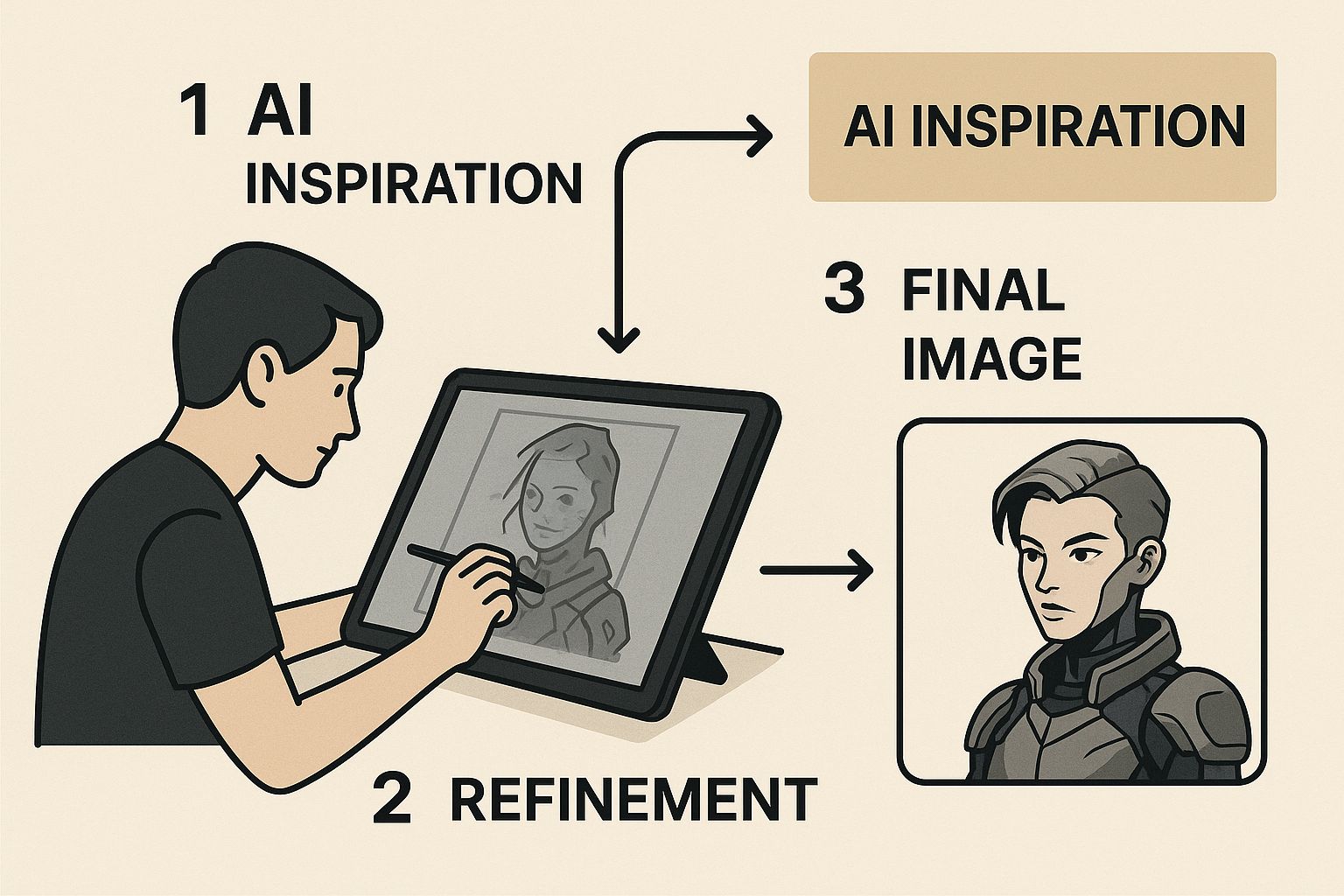
As you can see, a well-defined concept is essentially your blueprint. It guides the AI to generate results that are not only believable but also consistent across every single post. A detailed persona document is your single most valuable tool here. For more hands-on tutorials, you can always check out the resources in our AI character design guides.
To help you get started, I've put together a checklist. Think of it as a pre-flight check before you launch your character. Going through these questions ensures you've covered all the essential bases for a well-rounded and believable persona.
Persona Development Checklist
| Persona Element | Key Questions to Answer | Example (For a 'Sustainable Fashion' Influencer) |
|---|---|---|
| Core Identity | What is their name, age, and occupation? | Name: Anya, Age: 26, Occupation: Freelance Textile Designer & Activist |
| Backstory | What key life events shaped who they are? | Grew up in a town impacted by industrial pollution, sparking her passion. |
| Personality | What are their main personality traits? (e.g., introverted, witty) | Passionate, thoughtful, sometimes cynical but ultimately hopeful. |
| Values & Beliefs | What do they stand for? What are their non-negotiables? | Transparency, ethical production, anti-consumerism, community over profit. |
| Goals & Motivations | What drives them? What are they trying to achieve? | To educate her audience about conscious consumption and promote small, ethical brands. |
| Interests & Hobbies | What do they do for fun? | Natural fabric dyeing, visiting flea markets, hiking, documentary photography. |
By filling this out, you're not just creating a character; you're building a brand identity that will feel authentic and connect with a real audience.
Brainstorming a Cohesive Visual Style
Finally, let's talk visuals. Your character’s look needs to be a perfect match for their persona. This isn't just about what looks cool; it's a strategic choice that ensures your character connects with the right people. You need a crystal-clear vision before writing a single prompt.
Start thinking about these key visual elements:
- Art Style: Do you want them to be hyperrealistic, seamlessly blending in with human influencers? Or would a more stylized anime aesthetic better fit their story? The choice depends entirely on their world and narrative.
- Color Palette: Colors are a shortcut to personality. A bubbly, high-energy character might live in a world of bright pastels. A sophisticated, luxury-focused influencer, on the other hand, would probably stick to a palette of muted, elegant tones.
- Fashion and Accessories: Their wardrobe is a massive part of their story. Are they into vintage finds, futuristic techwear, clean minimalism, or a bohemian vibe? Every piece of clothing reinforces who they are.
A character's visual identity should be an instant reflection of their personality and values. The moment someone sees your character, their appearance should immediately tell them who they are and what they're all about.
Putting in this strategic work upfront means that when you finally get to the prompting stage in CreateInfluencers, you're not just guessing and hoping for the best. You're steering the AI with a clear, well-defined vision, which always leads to a stronger, more cohesive, and ultimately more successful character.
How to Write Prompts That Actually Work
If there’s one thing I’ve learned from designing hundreds of AI characters, it’s this: your prompt is everything. It’s the direct line from your creative vision to the AI's output. A vague, lazy prompt will get you a generic, forgettable character. But a thoughtfully crafted one? That’s how you create something that feels like it was pulled straight from your imagination.
You have to move past the basics. It's time to get specific—really specific.
Instead of just "a woman with brown hair," think like a stylist. Is it "wavy, shoulder-length chestnut brown hair with sun-kissed highlights" or "tightly coiled, dark chocolate-colored curls"? The same goes for facial features. "Pretty face" is useless. "Sharp jawline, high cheekbones, and piercing almond-shaped eyes" gives the AI real direction. This is the difference between an amateur snapshot and a professional portrait. You're painting a picture with words.
Defining the Scene and Mood
Your character isn't just floating in a white void. The setting, the lighting, and the overall style are just as important as their physical appearance. These details are what create a mood and tell a story in a single frame. A few extra words in your prompt can completely change the feeling of the final image.
Let's look at a quick comparison:
- Prompt A:
photo of a woman in a cafe - Prompt B:
candid shot of a young woman with freckles, sitting in a cozy, sun-drenched cafe, soft morning light filtering through the window, cinematic, shallow depth of field, photorealistic
Prompt B is on another level. It’s not just a request; it’s a creative brief. It sets a scene, dictates the atmosphere, and will produce a far more compelling and professional-looking image. You've stopped being a user and started being a director.
Here's what that looks like inside the CreateInfluencers platform, where you can separate your core ideas from the things you want to avoid.
The ability to input both positive and negative prompts gives you surgical control over the final result.
This drive for custom visuals is huge. The global AI image generation market is on track to hit $1.3 billion by 2025, largely because creators and marketers need high-quality, specific imagery. You can find more about how AI is reshaping creative fields over on the blog.
Pro Tip: The best prompts I've seen read like a shot list from a film director. They cover the subject, action, environment, lighting, camera angle, and artistic style. This leaves very little room for the AI to guess, which gets you closer to what you want on the first try.
The Power of Negative Prompts
Telling the AI what you want is only half the battle. You also have to tell it what you don't want. That's where negative prompts are a game-changer.
Think of negative prompts as your quality control tool. They help you eliminate all the common AI art issues—funky hands, extra limbs, clashing colors, or styles you just don't like. If your character keeps showing up wearing sunglasses, just add sunglasses to the negative prompt field. Problem solved.
This is how you get that polished, professional look without spending hours generating dozens of variations. For more deep dives into perfecting your characters, check out the guides on our blog at https://createinfluencers.com/blog. When you combine a detailed positive prompt with a strategic negative one, you unlock an incredible amount of creative power.
You’ve done it. You generated the perfect first image, and your AI character looks amazing. That's a huge milestone, but now comes the real test: making sure they look like the same person in every single picture.
This is, hands down, the biggest challenge in creating AI art. It's also where you separate the amateurs from the pros. You need that consistency to make your AI influencer feel real. When your audience sees them in different clothes, places, and moods, they have to recognize them instantly. If not, the illusion is broken, and all you have is a random collection of pretty pictures.
Let’s get into the practical techniques I use to build a cohesive and recognizable portfolio with CreateInfluencers.
Using Seed Images for Visual Continuity
The most straightforward way to nail consistency is to use a seed image. It’s exactly what it sounds like: a reference photo you give the AI to copy. You're essentially pointing to a picture and saying, "Make the new person look like this one." It's incredibly powerful for locking in those crucial facial features.
Think of your very first successful generation as the master portrait. From now on, every new image you create should stem from it.
So, when you want to move your character from a coffee shop to a beach, you upload that original master portrait as the seed. The AI will then do its best to replicate the facial structure, eye color, and other defining features in the completely new setting.
The seed image is your character's visual DNA. It's the anchor that ensures, no matter the pose or lighting, the core likeness holds true. This is what makes your character instantly familiar to their followers.
The Power of Consistent Prompt Architecture
A seed image gets you most of the way there, but your prompts handle everything else. To keep your character looking the same, your prompts need a solid, repeatable structure. This doesn't mean you copy-paste the same prompt every time. Instead, you create a template where core details stay the same, and you only swap out the variables.
I call this building a prompt architecture.
Here’s a real-world example for a character I might call "Anya":
- Core Descriptors (These never change):
Anya, 26-year-old woman, sharp jawline, high cheekbones, almond-shaped green eyes, long wavy chestnut hair, fair skin with light freckles. - Variable Descriptors (These are what you change):
wearing a black leather jacket, standing on a neon-lit street in Tokyo at night, cinematic lighting, photorealistic.
By keeping those core descriptors identical in every single prompt, you're constantly reminding the AI what makes Anya, well, Anya. The only things you're changing are her clothes, her location, and the overall vibe of the shot. This modular approach is not only efficient but also boosts your consistency tenfold.
This technique is borrowed straight from the world of video game design. Artists create a base character model and then layer different outfits and accessories on top. Your core prompt is your base model. This ensures every image you generate feels like it belongs to the same person, strengthening your influencer's brand and making them someone your audience will remember.
Bringing Your AI Character to Life with Story and Motion
A great-looking AI character is a solid start, but let's be honest, it's only half the battle. To really turn that digital creation into an influencer people actually care about, you need to give them a story. A voice. A bit of life and motion. This is where your character stops being just a pretty picture and starts building a real connection with an audience.
You don't need a massive animation studio anymore to make this happen. Seriously. The latest AI tools have made it incredibly easy to whip up short videos, create expressive reactions, and produce engaging motion graphics. This means your character can jump on trends, share stories, and react to what's happening online—just like any other creator.
And this isn't just a fun creative exercise; it's where the entire industry is heading. The global animation market is exploding, projected to hit a mind-boggling $462 billion by 2025, with AI-driven tools leading the charge. This tech is making it possible to create complex animations faster than ever before. If you're curious, you can find more insights about how AI is revolutionizing motion graphics right now.
Building a Narrative That Sticks
Okay, before you jump into making your first video, pause for a second. What’s your character actually going to talk about? You need a content strategy that’s baked into their personality. This all comes down to defining their content pillars—the core themes they’ll consistently post about.
Think of an AI influencer focused on travel. Their content pillars might look something like this:
- Hidden Gems: Forget the tourist traps. They'd showcase those incredible, lesser-known spots.
- Sustainable Travel: Sharing practical tips on how to explore the world more responsibly.
- Cultural Immersion: Diving deep into local food, music, and traditions.
Having these pillars acts as your North Star. It ensures every piece of content feels authentic and true to who your character is. From there, you can start scripting short stories or daily vlogs that give their digital life some real substance.
A character without a story is just a model. A character with a narrative becomes a personality people want to follow and interact with. Your content pillars are the foundation of that narrative.
From Static to Dynamic Content
With your story and pillars in place, it's time for the fun part: adding motion. The key here is to start small. You're not trying to produce the next Pixar movie on day one. The goal is to create short, snappy content that adds a whole new dimension to your character's online presence.
Here are a few easy ways to get started:
- Reaction Clips: Have your character react to a trending video or a piece of news. It’s a fantastic way to make them feel current and part of the bigger online conversation.
- Simple Explainer Videos: Let your character walk through a quick tutorial related to their niche. Use some basic motion graphics to highlight the important bits.
- Animated "Get Ready With Me" Videos: This is a super popular format. Your character can show off different outfits or styles that fit perfectly with their established persona.
Every little piece of animated content you create reinforces the idea that this is a living, breathing digital person. When you pair a compelling story with dynamic visuals, your AI character transforms from a static image into someone people genuinely want to follow.
Got Questions About AI Character Design? We've Got Answers
Jumping into AI character creation is exciting, but it definitely comes with its own set of questions. As you start bringing your ideas to life, you'll probably hit a few snags or wonder how to get things just right.
Let's clear up some of the most common sticking points I see creators run into all the time.
How Do I Keep My Character's Face Consistent?
Ah, the million-dollar question. Getting your AI influencer to look the same in every single picture is crucial for building a recognizable brand. The best way I’ve found to do this is by using a "seed" image.
Once the AI generates a face you absolutely love, save it. Use that specific image as a direct reference for every new picture you create. You're essentially telling the AI, "This is the face. Now put it in this new scene."
Combine that with a rock-solid prompt structure. Lock in the core details of your character—things like sharp jawline, almond-shaped green eyes, light freckles—and use them every single time. Then, you just swap out the variables like their outfit, the location, or their expression. This one-two punch of a seed image and a consistent prompt is the key to consistency.
What's the Deal with Commercial Usage Rights?
This is a big one, and it's smart to ask. The rules around using AI-generated images for commercial projects can feel a bit murky, and they often change depending on the tool you're using. The good news is that with a platform like CreateInfluencers, the images you create are yours to use for your own projects, including monetized ones.
That said, I always tell people to get in the habit of checking the terms of service for any AI tool they use. Knowing the specifics of ownership and licensing from day one will save you a world of trouble later. Keep an eye out for differences between free and paid plans, as the rules can sometimes change.
A quick five-minute read of the commercial use policy is one of the smartest things you can do. It ensures you can confidently build and monetize your character's brand without any legal surprises.
Which AI Model Should I Pick?
You'll quickly notice that not all AI models are built the same. The one you choose really comes down to the specific art style you're going for. Each model has been trained on different kinds of images, giving them a distinct visual personality.
- Going for Hyperrealism? You'll want a model that specializes in photorealistic results. These are perfect if your goal is to create an influencer who looks like a real person you could bump into on the street.
- Want a Stylized Vibe? If you're imagining an anime hero, a cartoon character, or something with a painterly feel, you'll need a model trained specifically for that look.
There's no substitute for just playing around. Hop into CreateInfluencers and generate a few test images with different models. You'll quickly get a feel for which one truly nails the vision you have for your character.
Can I Actually Make Money with My AI Characters?
Yes, absolutely. For many creators, monetization is the end game. You've got the obvious routes like brand deals and creating exclusive content for platforms like Fanvue or OnlyFans.
But don't forget about other revenue streams. You can also join partner programs to add another layer to your income. For example, check out our AI influencer affiliate program to see how you can earn by helping others get started. It's a great way to make money while your character's brand continues to grow.
Ready to bring your own unforgettable AI influencer to life? With CreateInfluencers, you can generate lifelike characters, stunning images, and dynamic videos in minutes. Start creating for free today!