Affiliate Marketing for Content Creators A Practical Guide
A practical guide to affiliate marketing for content creators. Learn how to authentically integrate links, grow your audience, and maximize revenue.
As a content creator, you're constantly looking for ways to earn a living from your passion. Affiliate marketing is one of the most natural ways to do just that. At its heart, it’s about getting paid for recommending the products you already use and genuinely love.
It’s less about "selling" and more about sharing. You're turning the trust you've built with your audience into a real, sustainable income stream—without sacrificing the integrity of your content.
Why Affiliate Marketing Is a Game Changer for Creators
Let's be real: figuring out how to monetize your work without feeling like a sellout is tough. Affiliate marketing offers a fantastic way to bridge that gap. It's not just another revenue stream; it's a way to provide genuine value to your audience while building a business.
Think about a gaming streamer who's always getting asked, "What headset is that?" Instead of just typing out the name in the chat, they can pop an affiliate link into their video description. When someone clicks and buys, the streamer earns a small commission. The content doesn't change, but it's suddenly more helpful and profitable.
The Power of Authentic Recommendations
The magic of affiliate marketing is that it works best when it's completely authentic. Unlike a traditional, interruptive ad, an affiliate link feels like a natural part of the conversation. You’re not just pushing a product for a paycheck; you’re pointing people to a tool or item that has genuinely made your life better.
This whole strategy hinges on the trust you’ve already cultivated. When your followers see you recommending something you truly stand behind, it actually strengthens your credibility. This is the foundation for long-term success, and it’s why creator-first platforms like https://createinfluencers.com/ are so effective.
Tapping into a Booming Economy
This isn't some small, niche tactic anymore. It’s a massive part of the creator economy, which is currently valued at over $250 billion. And it's not slowing down—projections show it rocketing to nearly $480 billion by 2027. This explosive growth highlights a huge opportunity for creators to build a real, scalable business.
Affiliate marketing helps you diversify your income beyond chasing brand deals or relying on fluctuating ad revenue. It creates a much more stable financial base, giving you the freedom to focus on what you love: creating incredible content.
While this guide dives deep into affiliate marketing, it's also smart to explore all the ways you can monetize your online content to build multiple income streams. Now, let's get into the actionable steps you can take to make affiliate marketing a core part of your strategy.
How to Find Affiliate Programs That Actually Fit Your Brand
Choosing the right affiliate partners is the bedrock of your long-term success. This is about so much more than just chasing the highest commission rates—it’s about protecting the trust you’ve worked so hard to build with your audience. The best partnerships feel like a natural extension of your content, not a jarring, out-of-place sales pitch.
Instead of defaulting to massive platforms like Amazon Associates, think more strategically. Picture a travel vlogger who partners with the specific luggage brand they actually use in every video. That kind of authentic alignment is what really drives conversions because the recommendation is backed by genuine, real-world experience.
As this visual guide shows, the path to making money always starts with creating content that serves your audience first.
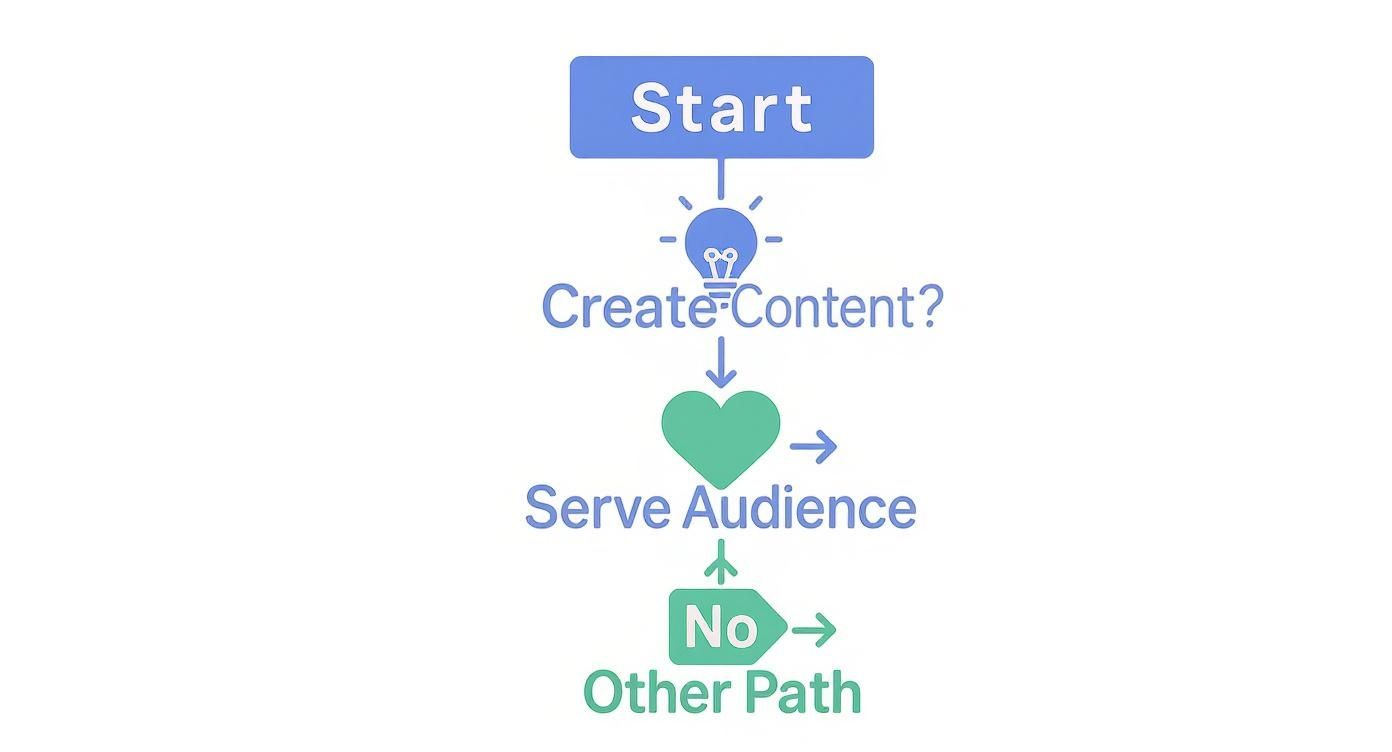
At the end of the day, authentic, valuable content is the engine behind any successful monetization strategy, including affiliate marketing.
What to Look For in a Potential Affiliate Partner
Before you even think about promoting a product, you need to look under the hood. The terms and conditions of an affiliate program can make or break your earning potential, and they vary wildly from one company to the next.
Here are the key factors I always evaluate:
- The Commission Model: Is it a one-time payout (pay-per-sale), or does it offer recurring commissions for subscription products? Recurring models are fantastic for building a more stable, predictable income stream over time.
- Cookie Duration: This is critical. It’s the window of time after someone clicks your link during which you can still earn a commission on their purchase. A longer cookie duration, like 60-90 days, is always better than a short one (some are just 24 hours!).
- Payout Threshold: How much do you need to earn before you can actually get paid? Some programs set high thresholds that can be tough for new creators to hit, leaving your earnings stuck in limbo.
The financial upside can be massive if you find the right fit. Top-tier programs like Bluehost have paid out over $5 million to affiliates in a single year, with individual creators earning between $65 and $130 per sale. This potential is why it's worth the effort to find partners that truly resonate. Brands see the value too—some report a staggering 15:1 ROI from their affiliate channels.
Affiliate Networks vs. Direct In-House Programs
So, where do you find these partners? You generally have two paths: joining a large affiliate network or partnering directly with a brand through their in-house program. Each has its pros and cons, and the right choice often depends on where you are in your creator journey.
Deciding between a network and a direct program is a common crossroads for creators. One offers convenience and variety, while the other provides a closer relationship and potentially better terms. This table breaks down the key differences.
Affiliate Networks vs Direct In--House Programs
| Feature | Affiliate Networks (e.g., ShareASale, CJ) | Direct Programs (e.g., Brand's Own) |
|---|---|---|
| Variety | Huge plus. Access thousands of brands from a single dashboard. | Limited to that one brand's products. |
| Commissions | Often a bit lower, as the network takes a small cut for their service. | Can be higher since there's no middleman. |
| Relationship | Mostly impersonal; you're one of many affiliates in a large system. | You often get direct contact with a dedicated affiliate manager. |
| Payments | A major convenience—you get consolidated payments from multiple brands at once. | You'll receive separate payments from each individual program. |
Ultimately, the best approach depends on your specific goals and workflow.
My Advice: Don't be afraid to start with a network like ShareASale or CJ to test the waters and discover new brands. As you grow and identify your top-performing merchants, you can then pursue direct partnerships with them to negotiate better rates and build a stronger, more personal relationship.
Finding the right fit is a continuous process of research, testing, and learning what works for your audience. For a deeper dive, check out our other creator economy guides for more strategies on growing your business.
Weaving Affiliate Links into Your Content (Without Sounding Salesy)
This is where so many creators trip up. You’ve found some killer affiliate programs, but now you have to actually use the links. The trick is to stop thinking about "selling" and start thinking about "recommending." An affiliate link shouldn't be the star of the show; it's a helpful resource you're offering your audience.
Your credibility is everything. When you place links naturally, you're just pointing people toward tools and products you genuinely believe in. This doesn't just protect your reputation—it actually strengthens it by making your content even more useful.
For Bloggers: Make It Flow
If you’re a blogger, your main goal is to embed links so seamlessly that they feel like a natural part of the text. Please, don't just dump a list of links at the end of a post and call it a day. Instead, sprinkle them in where they genuinely add value.
- In-Depth Tutorials: Writing a how-to guide on photo editing? Link to your favorite software or that preset pack you swear by right at the moment you’re explaining how to use it.
- Honest Reviews: A good, balanced review is the perfect home for an affiliate link. After you’ve laid out all the pros and cons, the link is just the logical next step for anyone who’s decided the product is a good fit.
- Resource Pages: This is a classic for a reason. Create a dedicated "My Gear" or "Tools I Use" page. It becomes a one-stop shop for your audience and can turn into a fantastic source of passive income over time.
Think of each link as a helpful nudge in the right direction. The more it feels like a genuine tip and less like a sales pitch, the more likely your readers are to click. This is a foundational piece of successful affiliate marketing for content creators.
For YouTubers: Be Direct and Clear
Video gives you some really interesting ways to share links, but you have to be more direct since viewers can't just click on your video. Your job is to make it dead simple for them to find what you're talking about.
Your video description is prime real estate. Keep it organized. Use clear headings like "Products Mentioned" or "My Camera Gear" and list each item with a clean, shortened affiliate link. And don't forget to tell people the links are there! A quick "all the gear I used is linked in the description below" works wonders.
Another great trick is to use a pinned comment. As soon as you publish, drop a comment with your top one or two most important affiliate links and pin it. It's often the first thing people see when they scroll down to join the conversation.
Key Takeaway: Always lead with the recommendation, not the sale. Your job is to help your audience solve a problem or find something great. The affiliate link is just the bridge that gets them there.
For Social Media Creators: The "Link in Bio" is Your Hub
On platforms like Instagram or TikTok, you have fewer places to put clickable links, which makes your strategy even more important. Your "link in bio" is your command center. Use a tool like Linktree or Beacons to create a simple landing page that houses all of your go-to affiliate links.
From there, all your content should point people to that hub.
- Instagram Stories: The link sticker is a game-changer. When you’re talking about a product you love, pop a sticker on the Story that links directly to it. Use a clear call-to-action like "Tap to Shop" or "Get it Here."
- In-Feed Posts: You can't put live links in Instagram captions (yet!), so your CTA has to be crystal clear: direct people to your bio. Something as simple as "You can grab my favorite moisturizer at the link in my bio!" does the job perfectly.
By getting comfortable with these platform-specific tactics, you can turn your genuine recommendations into a steady revenue stream. For a deeper dive into building your business this way, check out this great overview of how affiliate marketing for creators works.
Turning Clicks Into Cash: How to Actually Drive Conversions

It’s one thing to get someone to click your affiliate link. It’s another thing entirely to get them to buy. The real art of affiliate marketing lies in moving beyond simple link placement and creating content that genuinely helps your audience.
Your goal isn't to sell; it's to solve. When you create content that addresses a real problem your audience has, the sale becomes the natural next step for them. Think of your affiliate link not as a sales tool, but as part of the solution you’re offering.
Build Content That Sells Itself
Some content formats are just built to convert. Why? Because they meet your audience right when they’re in a buying mindset. Someone Googling "best podcasting microphones" isn't just browsing—they're ready to make a decision. Your job is to be the resource that guides them.
Here are a few battle-tested content types that work wonders:
- Head-to-Head Comparisons: Put popular products in the ring together. An article breaking down Canva vs. Adobe Express is gold because it helps people who are stuck between two great options finally make a choice.
- "Best Of" Listicles: These are absolute magnets for search traffic. A post like "The 10 Best Laptops for Video Editing Under $1500" speaks directly to people hunting for recommendations, making it a perfect spot for your affiliate links.
- Deep-Dive Reviews: Don't just list the features. A truly great review shares your personal experience—the good, the bad, and the ugly. Include your own photos or sample footage. This level of detail builds trust that a generic product page never can.
Pro Tip: Want to give your conversion rate a serious boost? Offer an exclusive bonus. If you’re promoting an online course, for example, throw in a free PDF checklist or a short video tutorial for anyone who buys through your link. That little extra something is often all it takes to push someone over the edge.
Sharpen Your Calls to Action
Your Call-to-Action (CTA) is your closing argument. A lazy "click here" isn't going to cut it. A great CTA is specific, highlights a benefit, and feels like the obvious next step for the reader.
Get rid of the passive language and tell people exactly what to do and why.
| Weak CTA | Strong CTA |
|---|---|
| "Check it out" | "Find the Best Price on Amazon Now" |
| "Link" | "Start Your Free Trial Today" |
| "Buy Now" | "Yes, I Want to Upgrade My Gear!" |
See the difference? This small shift in language reframes the click from a simple transaction into a step toward solving their problem.
Marry SEO with Social Media
Don't put all your eggs in one basket. Relying on a single source of traffic is a recipe for disaster. The most successful affiliates build a system where search engines and social media work together.
Think of SEO as your long-term engine. A well-ranked review post can bring in motivated buyers for years to come. But social media gives you that immediate traffic boost and helps you build a direct connection with your audience. For creators on Instagram, learning the right strategies to monetize Instagram and master affiliate marketing can open up a massive new revenue stream.
Video, in particular, is a powerhouse. We're seeing video-based campaigns convert at 82% higher rates than text alone because they build so much more trust and connection. And with a staggering 70% of affiliate purchases now happening on mobile devices, you simply can't afford to ignore platforms like YouTube, TikTok, and Instagram Reels.
If you’re looking for more practical advice like this, we’ve got plenty more over on the https://createinfluencers.com/blog.
Building Audience Trust Through Transparency and Disclosure
Let's talk about the absolute bedrock of successful affiliate marketing: trust. Your audience is everything, and nothing will shatter their confidence faster than a recommendation that feels like a sneaky, undisclosed ad. This is why being transparent about your affiliate links isn't just good ethics—it's a legal must-have.
Being upfront doesn't make you look "salesy." In my experience, it does the exact opposite. It proves you're authentic. When you openly say you might earn a commission, you're treating your audience like intelligent people who appreciate honesty. It's a simple sign of respect that strengthens your connection.
Why You Can't Skip the Disclosure
The Federal Trade Commission (FTC) has very clear rules about this. If you have a financial relationship with a brand you're talking about, you must disclose it. This isn't a suggestion. Ignoring these guidelines can lead to some hefty fines, but even worse, it can torpedo the credibility you've worked so hard to build.
Your disclosure needs to be impossible to miss. Don't bury it in the footer of your website or hide it behind a generic "legal" link. Put it out there, clear and proud. Honesty is your best policy, and in affiliate marketing, it also happens to be the law.
A lot of creators worry that a disclosure will scare people away and kill their conversion rates. I've found the opposite to be true. When your followers see you're being straight with them about how you make money, they're often more inclined to trust your recommendations and use your links to support you.
Practical Ways to Disclose on Any Platform
Making disclosures a natural part of your content is easy once you build the habit. Think of it as just another part of your content creation checklist, whether you're writing a blog post or filming a video.
Here are some dead-simple ways to do it right:
- Blog Posts: The best spot is right at the top, before the main content begins. A simple line like, "Heads up: This post contains affiliate links, which means I may earn a small commission if you make a purchase, at no extra cost to you," is perfect.
- YouTube Videos: Say it out loud in the video, especially near the beginning when you first mention a product. Then, in the video description, just add a quick
(affiliate link)or(commission link)next to each relevant URL. - Social Media: Hashtags are your friend here. Using #ad or #sponsored is the clearest way to go on platforms like Instagram, TikTok, or X. For things like Instagram Stories, you can add text right next to your link sticker that says "(affiliate link)."
Stop thinking of disclosure as a chore. It's a tool. It's how you show your audience you value their trust above a quick buck, and that's how you build a loyal community for the long haul.
Answering Your Top Affiliate Marketing Questions
Jumping into affiliate marketing can feel a bit overwhelming at first. There are a lot of moving parts, and it's totally normal to have a few questions before you get started. Let's clear up some of the most common ones I hear from other creators.
Getting these basics down will give you the confidence to build a strategy that actually works.
How Many Followers Do I Need to Start?
This is probably the number one question I get, and the answer almost always surprises people: there's no magic number. It's not about the size of your audience; it's about their trust and engagement.
Honestly, a creator with 1,000 super-engaged followers who hang on their every word can easily make more than someone with 100,000 passive followers who barely notice their posts.
You can start the minute you have a community that looks to you for recommendations, no matter how small. Focus on building that tight-knit group first. The income is a byproduct of the trust you earn.
Can I Use Affiliate Links on Instagram and TikTok?
Absolutely! These platforms are goldmines for affiliate marketing, as long as you play by their rules and use their tools smartly. You just can't plaster links everywhere, so you have to be strategic.
- Instagram: Your best bet is a "link-in-bio" tool. I've seen creators have great success with Linktree or Beacons to house a bunch of links at once. For time-sensitive promotions, the "link sticker" in your Stories is fantastic for driving immediate clicks.
- TikTok: The "link-in-bio" is your prime real estate here, too. The key is to get people to go there. Make your call-to-action super clear in your video, both by saying it out loud and adding it as on-screen text.
On any platform, just remember to disclose that it's an affiliate link. A simple "(ad)" or "#affiliatelink" does the trick. It's required by the FTC, but more importantly, it keeps you transparent with your audience.
You’re not just an affiliate; you're a trusted curator for your audience. Your role is to vet products and share only what you genuinely believe will benefit them. This mindset shifts affiliate marketing from a sales tactic to an act of service.
Affiliate Network vs. Direct Program: What's the Difference?
Think of it as convenience versus a direct relationship.
An affiliate network (like ShareASale or CJ) is a big marketplace. You get a single dashboard to find and manage programs for thousands of brands. They handle all the tracking and consolidate your payments into one check, which is a lifesaver when you're starting out.
A direct program is run by the brand itself. The Amazon Associates program is a classic example. These often pay higher commission rates and give you a direct contact (an affiliate manager) at the company. The downside is you have to manage each program, application, and payout separately.
A common path is to start with a network to get your feet wet, then pursue direct partnerships with the brands that become your top earners.
How Long Does It Take to Actually Make Money?
Affiliate marketing is a marathon, not a sprint. Anyone who tells you otherwise is selling something. While you might get lucky and see your first commission in a few weeks, building a steady, reliable income stream usually takes several months of consistent work.
Your timeline really depends on your niche, the quality of your content, and how you promote it.
The creators who really succeed are the ones who focus on evergreen content—things like detailed tutorials on YouTube or SEO-optimized blog posts. This kind of content works for you 24/7, attracting new people and earning commissions long after you hit "publish." Patience and consistency are your two most valuable assets here.
Ready to create stunning visuals for your brand? With CreateInfluencers, you can generate unique AI influencers, hyper-realistic images, and dynamic videos in minutes. Start creating for free today!